
Home / Research / State AI Legislation Statistics
State AI Legislation Statistics: 2026 Report
 By Darin ten Bruggencate, Founder, AI Industry Reviews · November 13, 2026
Our analysts compiled 3,445 state AI bills from the National Conference of State Legislatures (NCSL) AI legislation records for 2023 through 2026, to understand where state AI rules stand as of Q4 2026. For 2025 and 2026 we queried NCSL's Artificial Intelligence Legislation Database, which covers every jurisdiction and topic and was dated October 1, 2026, when we retrieved it on October 23, 2026. For 2023 and 2024 we parsed the bill tables on NCSL's annual AI legislation pages. We counted bills introduced and bills enacted or adopted by year, state, and NCSL topic tag, and computed enactment rates. We then checked the main comprehensive laws on state legislature and governor websites, and traced the federal preemption fight through Senate, White House, Justice Department, and court records.
Key Findings
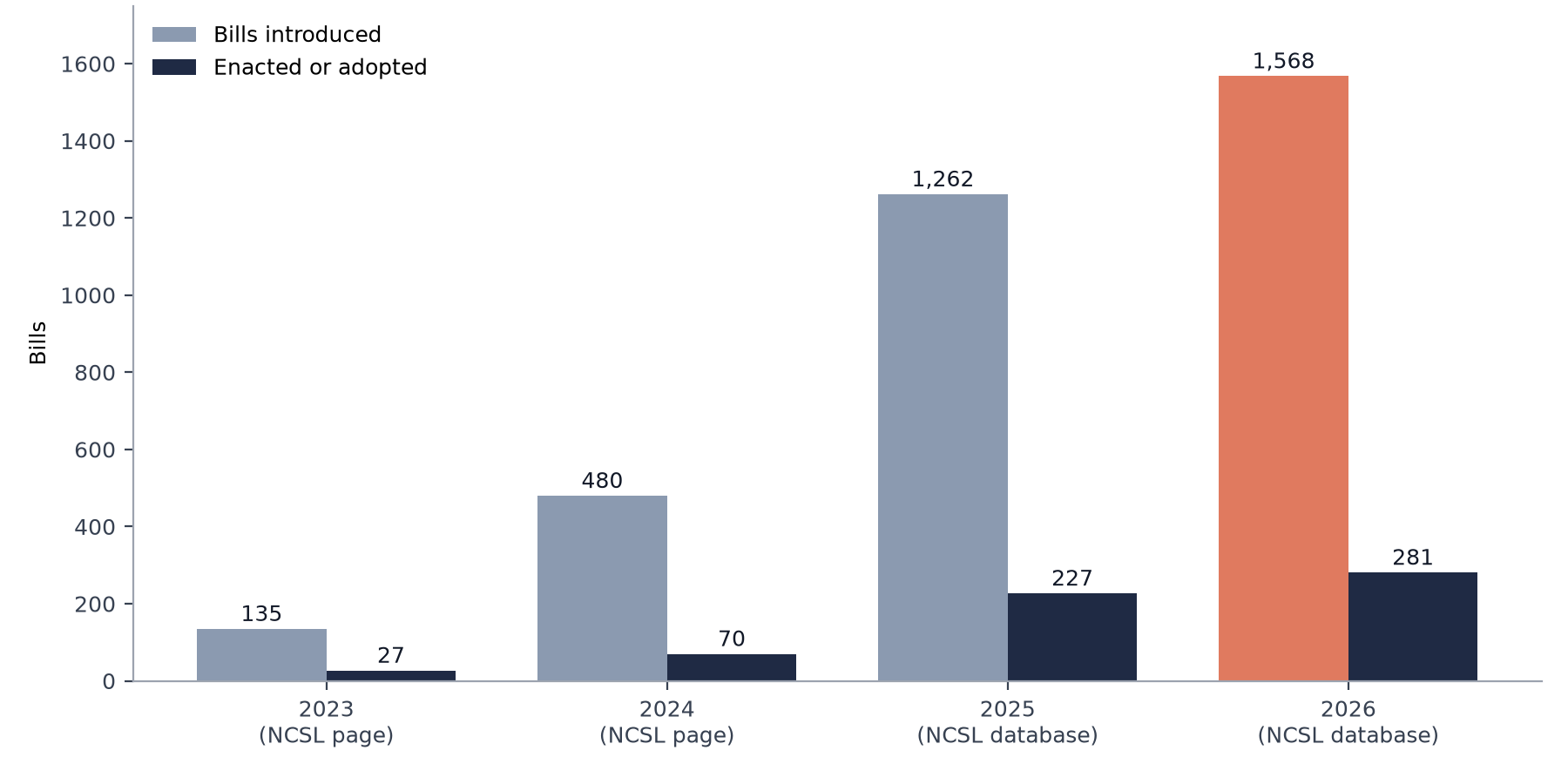
- States introduced 1,568 AI bills in 2026 and enacted or adopted 281, up from 1,262 and 227 in 2025.
- About 18% of state AI bills became law or adopted resolutions in each of the last two years, and 579 of the 2026 bills were still pending at the October cut-off.
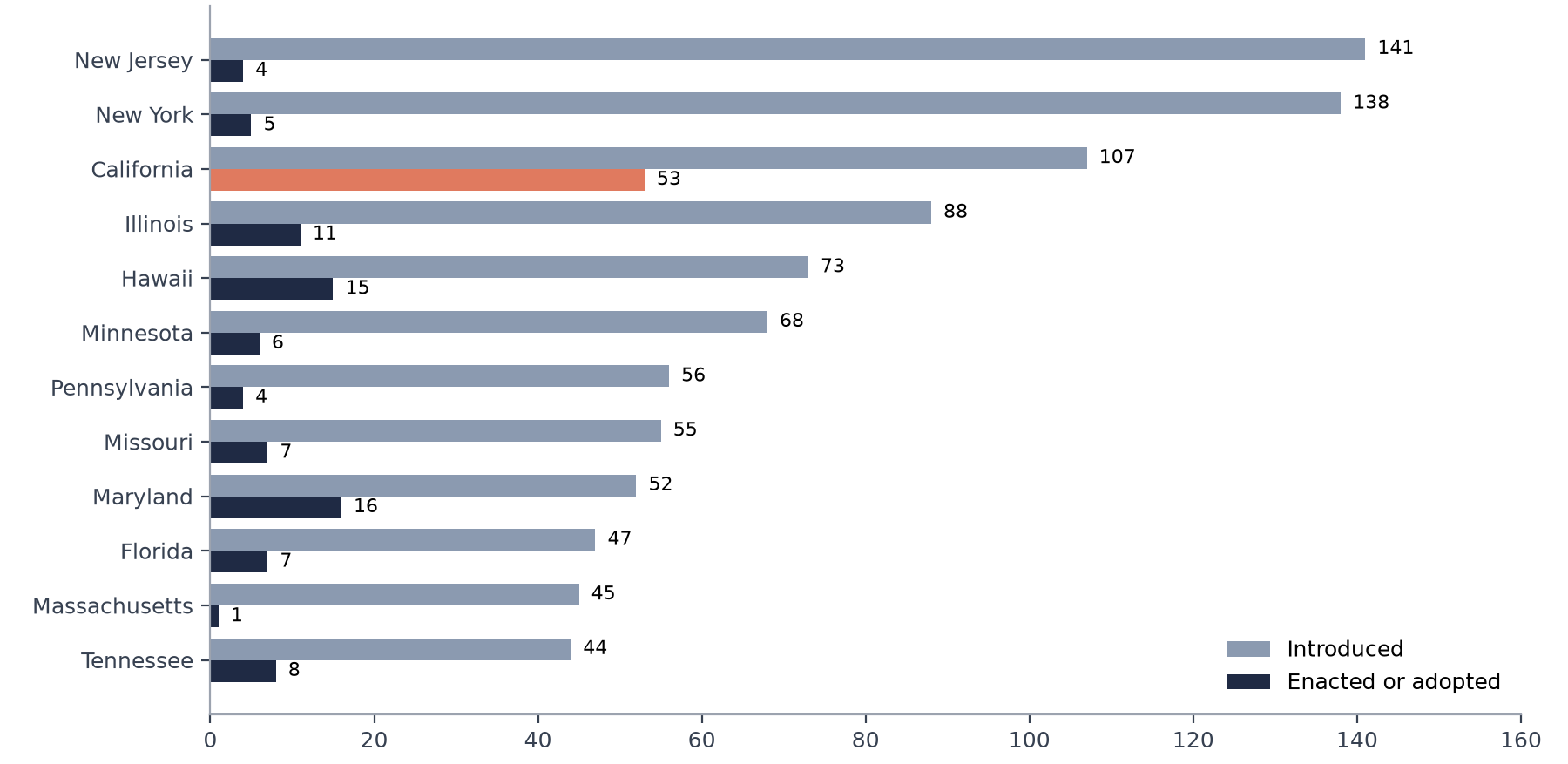
- New Jersey (141), New York (138), and California (107) introduced the most AI bills in 2026, and California enacted or adopted 53, more than three times any other state.
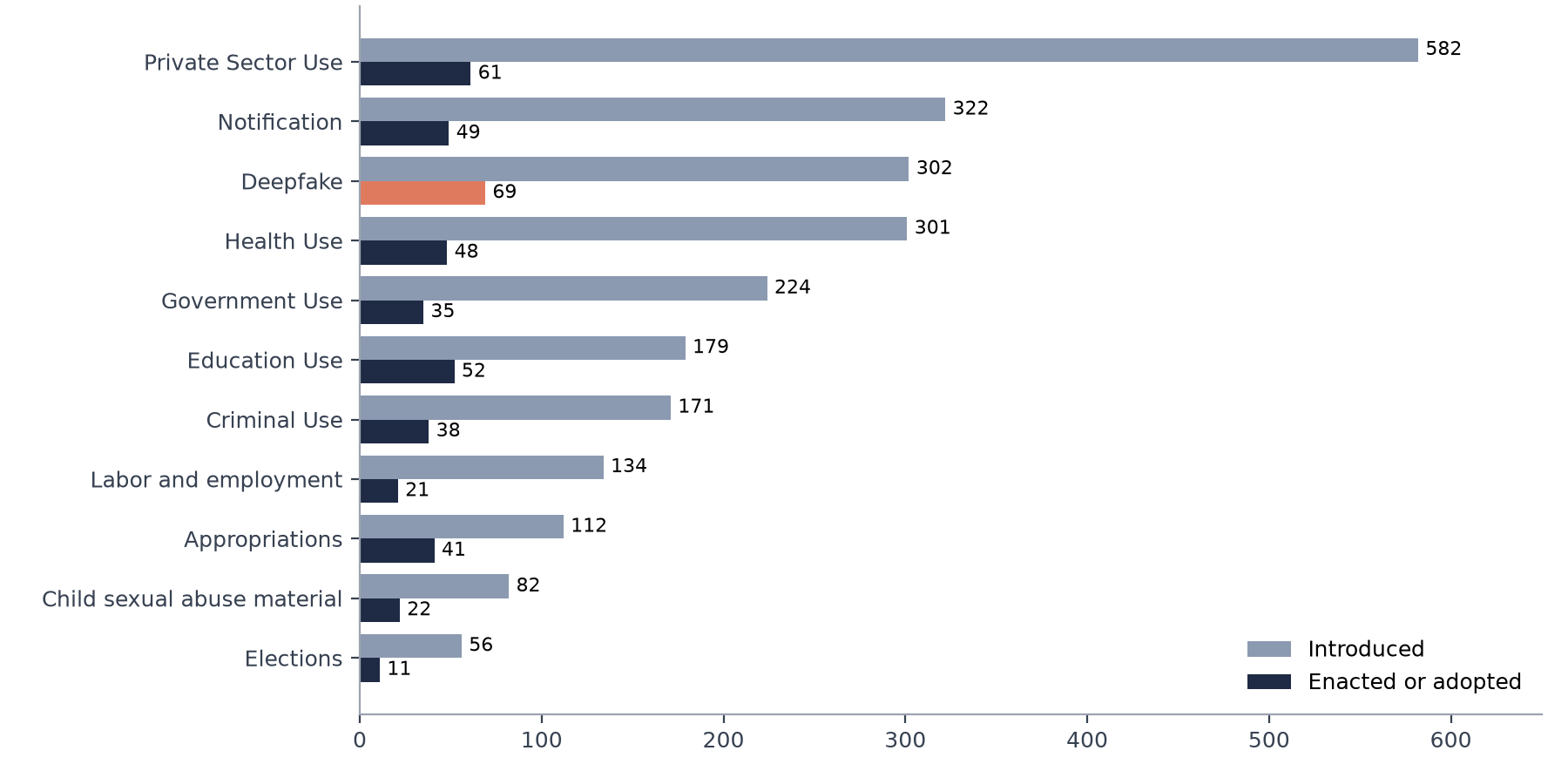
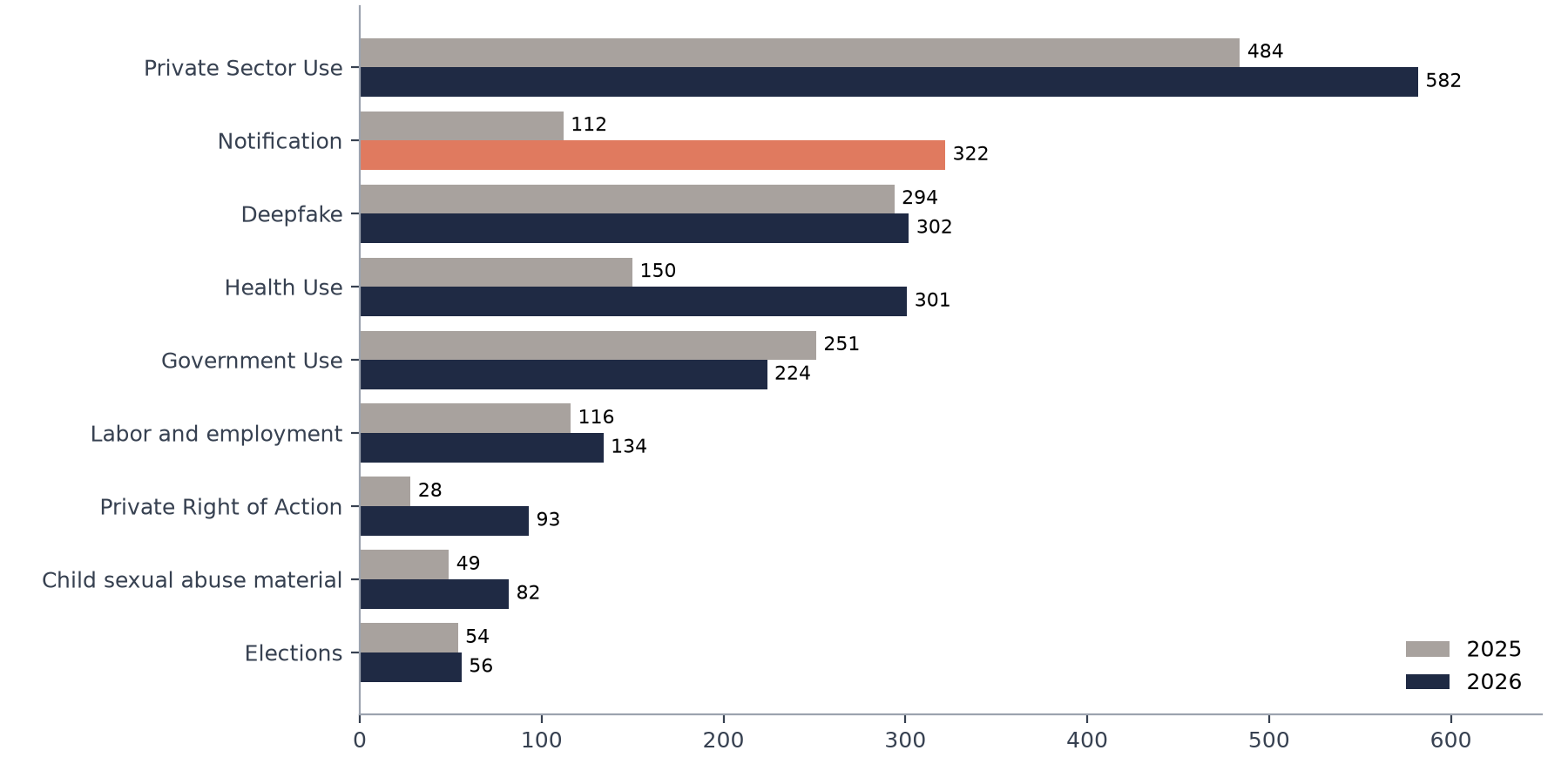
- Deepfake bills were the most enacted topic, with 69 in each year, while health care AI bills doubled to 301 and notification bills nearly tripled to 322.
- Chatbot and AI companion bills rose from 16 in 2025 to 93 in 2026, and the Senate voted 99 to 1 in 2025 to strip a federal moratorium on state AI laws.
In the United States, much of the work of writing rules for artificial intelligence is happening in state legislatures. Congress has deliberated several AI bills, while states have passed laws on deepfake election ads, sexual images made with AI, chatbots that talk to children, health insurers' use of AI in coverage decisions, and hiring software. A handful of states have gone further and passed laws that cover AI across many industries. That activity has also drawn a federal response, including a Senate vote on a moratorium, an executive order, and a Justice Department court filing against a state law. The counts below show how large that state activity has become and where it is concentrated.
The sections below cover yearly totals and enactment rates, a second tracker's counts, the most active states, bills by topic, the comprehensive and frontier model laws, and the federal effort to override state AI rules.
How Many AI Bills Have States Introduced and Enacted?
We looked at NCSL's yearly totals first, because they show how fast state AI lawmaking has grown. The totals rise in every year, but the series mixes two collection methods. The 2023 and 2024 pages covered general AI bills and tracked some technology-specific bills separately, while the database used for 2025 and 2026 covers all AI legislation.
State AI bills introduced and enacted or adopted, 2023 to 2026
| Year | NCSL record and cut-off | Jurisdictions with bills | Bills introduced | Enacted or adopted | Enactment rate |
|---|---|---|---|---|---|
| 2023 | 2023 page, updated Jan 12, 2024 | 32 (30 states, DC, Puerto Rico) | 135 | 27 | 20.0% |
| 2024 | 2024 page, updated Sep 9, 2024 | 48 (45 states, DC, Puerto Rico, Virgin Islands) | 480 | 70 | 14.6% |
| 2025 | Database, dated Oct 1, 2026 | 53 (50 states, DC, Guam, Puerto Rico) | 1,262 | 227 | 18.0% |
| 2026 | Database, dated Oct 1, 2026 | 49 (45 states, DC, Guam, Puerto Rico, Virgin Islands) | 1,568 | 281 | 17.9% |
State AI Bills Introduced and Enacted, 2023 to 2026
Key Findings
- The 2025 database totals match NCSL's own published figures of 1,262 AI bills introduced and 227 enacted or adopted. NCSL's early October count for 2026 was 1,539 introduced and 280 enacted, and our October 23 pull shows 1,568 and 281.
- Introductions rose 24.2% from 2025 to 2026, and enactments rose 23.8%, so the enactment rate held near 18% while volume grew. The rate counts pending bills in the denominator, and 579 of the 2026 bills were still pending or awaiting a governor's action when we pulled the data.
- For compliance teams, pending bills matter as much as enacted ones. About four of every five state AI bills introduced in 2025 or 2026 had not become law by the cut-off, yet the minority that passed still added 281 measures in a single year.
How Do the Main Trackers Compare?
We also compared NCSL's counts with MultiState's tracker, because readers often see both totals quoted. The two use different definitions of an AI bill, so their totals differ even for the same year.
AI bill counts by tracker
| Year | NCSL introduced | NCSL enacted or adopted | MultiState introduced | MultiState enacted |
|---|---|---|---|---|
| 2023 | 135 (general AI page) | 27 | Fewer than 200 | Not stated |
| 2024 | 480 (general AI page) | 70 | 635 in 45 states | Nearly 100 |
| 2025 | 1,262 | 227 | 1,208 in all 50 states | 145 |
| 2026 | 1,568 (to Oct 1 database) | 281 | 1,561 in 45 states (as of March 2026) | Not stated |
Key Findings
- Both trackers place 2025 introductions near 1,200 to 1,300 bills, but their enactment counts differ, 227 for NCSL against 145 for MultiState. NCSL's figure includes 35 adopted resolutions, and its count of enacted bills alone is 192.
- MultiState counted 1,561 bills as of March 2026, while NCSL's database holds 1,568 through its October 1 update, so the two trackers are not measuring the same set of bills. We use NCSL as the backbone because its records are bill-level and can be counted by status, state, and topic.
- Anyone quoting a national total should name the tracker and its cut-off date. A 2025 figure can be 1,208 or 1,262 depending on the source, and a 2026 figure depends on the month it was pulled.
Which States Are the Most Active?
We ranked states by bills introduced across 2025 and 2026 combined to see where AI lawmaking is concentrated. A small group of legislatures produces a large share of AI bills, and the states that introduce the most are not the states that enact the most.
Most active states for AI bills, 2025 and 2026
| State | 2025 introduced | 2025 enacted or adopted | 2026 introduced | 2026 enacted or adopted | Combined enactment rate |
|---|---|---|---|---|---|
| New York | 152 | 6 | 138 | 5 | 3.8% |
| New Jersey | 56 | 2 | 141 | 4 | 3.0% |
| California | 65 | 25 | 107 | 53 | 45.3% |
| Illinois | 52 | 7 | 88 | 11 | 12.9% |
| Hawaii | 44 | 4 | 73 | 15 | 16.2% |
| Minnesota | 36 | 1 | 68 | 6 | 6.7% |
| Maryland | 48 | 8 | 52 | 16 | 24.0% |
| Massachusetts | 55 | 0 | 45 | 1 | 1.0% |
| Texas | 86 | 17 | 0 | 0 | 19.8% |
| Pennsylvania | 26 | 1 | 56 | 4 | 6.1% |
| Virginia | 42 | 8 | 40 | 10 | 22.0% |
| Florida | 33 | 4 | 47 | 7 | 13.8% |
Most Active States for AI Bills, 2026
Key Findings
- New Jersey had the most AI bills introduced in 2026 with 141, ahead of New York's 138 and California's 107. New York had the most in 2025 with 152, and across both years its 290 bills produced 11 enacted or adopted measures.
- California enacted or adopted 53 AI measures in 2026, more than three times Maryland's 16, the next highest. Utah, which does not appear in the introduction ranking, enacted 13 in 2026 from 25 bills.
- The database has no 2026 entries for Arkansas, Montana, Nevada, North Dakota, or Texas. Year-over-year state rankings therefore need to be read against each legislature's calendar, not as a measure of interest alone.
AI Bill Enactment Rate in States With 60 or More Bills, 2025 to 2026
Key Findings
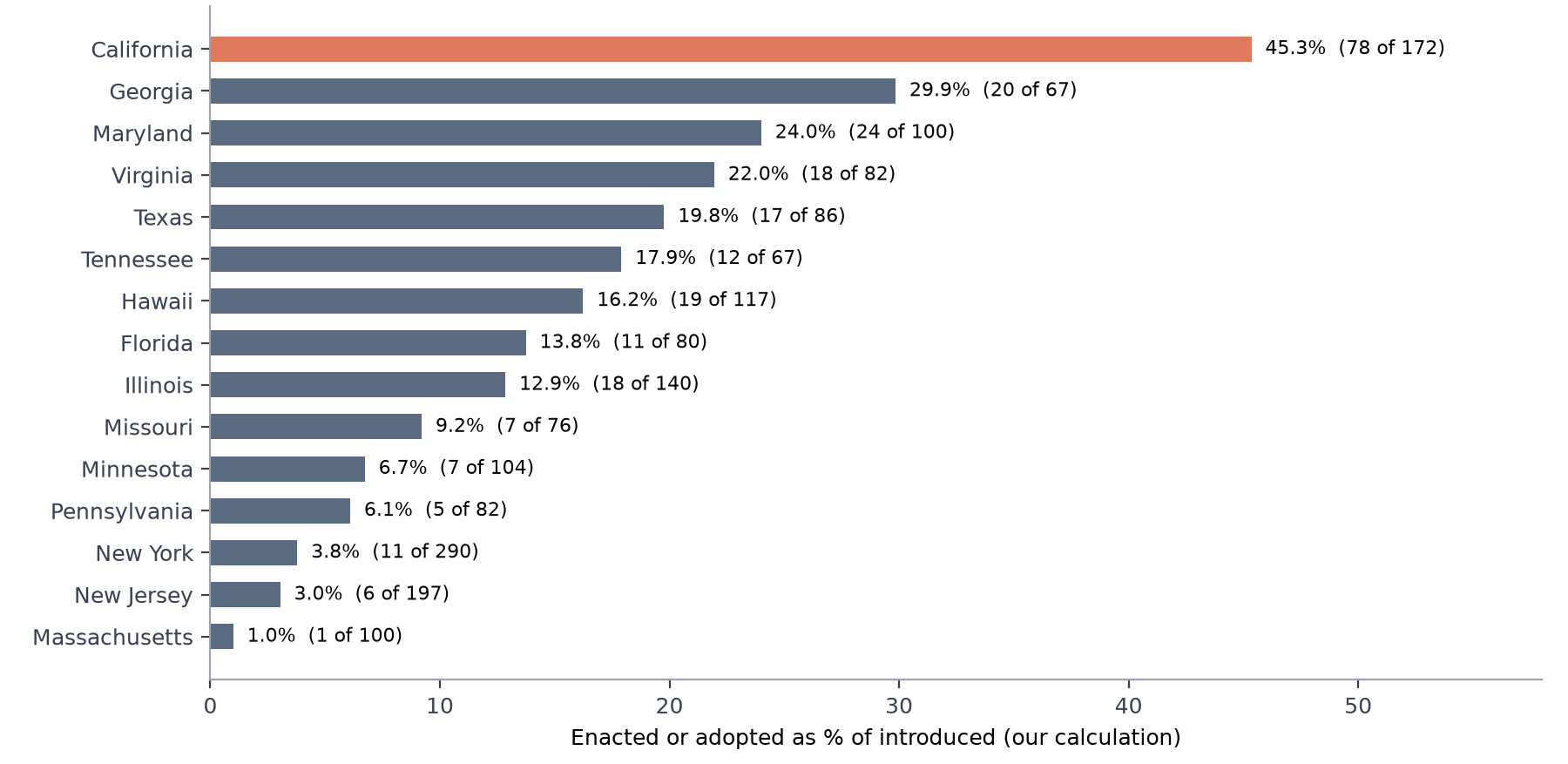
- Among the 15 states with at least 60 AI bills across the two years, enactment rates ranged from 45.3% in California to 1.0% in Massachusetts. Georgia, at 29.9%, had the second-highest rate in that group.
- Bill counts alone are a weak signal of where state AI rules will land. California and Maryland together account for 102 of the enacted or adopted measures in 2025 and 2026, while New York and New Jersey account for 487 introductions and 17 enactments.
What Topics Do State AI Bills Cover?
We broke the bills down by NCSL's 25 topic tags to see which subjects lawmakers file on and which ones pass. A single bill can carry several tags, so it can count in several rows.
AI bills by NCSL topic tag, 2025 and 2026
| NCSL topic | 2025 introduced | 2025 enacted or adopted | 2026 introduced | 2026 enacted or adopted | 2026 enactment rate |
|---|---|---|---|---|---|
| Private Sector Use | 484 | 56 | 582 | 61 | 10.5% |
| Notification | 112 | 14 | 322 | 49 | 15.2% |
| Deepfake | 294 | 69 | 302 | 69 | 22.8% |
| Health Use | 150 | 20 | 301 | 48 | 15.9% |
| Government Use | 251 | 60 | 224 | 35 | 15.6% |
| Education Use | 178 | 45 | 179 | 52 | 29.1% |
| Effect on Labor/Employment | 116 | 18 | 134 | 21 | 15.7% |
| Private Right of Action | 28 | 6 | 93 | 6 | 6.5% |
| Child Pornography | 49 | 20 | 82 | 22 | 26.8% |
| Elections | 54 | 8 | 56 | 11 | 19.6% |
State AI Bills by NCSL Topic, 2026
Key Findings
- Private sector use was the most common tag in both years, with 582 bills in 2026, but only 10.5% of those passed. Deepfake bills were the most enacted tag in both years, with 69 enacted or adopted in each, making deepfakes the most common type of AI law enacted in 2026.
- Health care AI doubled, from 150 bills in 2025 to 301 in 2026. Enacted health measures rose from 20 to 48, including an Alabama law that limits how health benefit plan providers use AI in coverage decisions.
- After deepfakes, AI rules are moving fastest in health care. The Health Use tag added 151 bills between 2025 and 2026, more than any tag except notification.
State AI Bills Introduced by Topic, 2025 vs 2026
Key Findings
- Bills tagged for notification, which require telling people they are dealing with AI, went from 112 to 322, a 2.9-fold increase.
- Government use fell from 251 bills to 224, and its enactments dropped from 60 to 35. Bills with a private right of action, which let individuals sue, more than tripled from 28 to 93, but six passed in each year.
- Disclosure duties are the fastest-growing type of state AI rule. States enacted or adopted 49 notification bills in 2026, compared with 14 in 2025, so more of them now require telling users when AI is involved.
Some of the topics readers ask about do not map to a single NCSL tag, so we built three groups from the tags and bill text.
Selected AI bill groups, 2025 and 2026
| Group and rule | 2025 introduced | 2025 enacted or adopted | 2026 introduced | 2026 enacted or adopted |
|---|---|---|---|---|
| Election deepfakes: bills tagged both Deepfake and Elections | 41 | 7 | 50 | 10 |
| Sexual deepfakes: Child Pornography tag, or Deepfake tag with sexual, intimate, explicit, nude or pornographic in title or summary | 153 | 46 | 116 | 32 |
| Chatbots and AI companions: chatbot or AI companion terms in title or summary | 16 | 3 | 93 | 11 |
| Employment and hiring: Effect on Labor/Employment tag | 116 | 18 | 134 | 21 |
Key Findings
- Chatbot bills rose from 16 in 2025 to 93 in 2026 under our rule. The 2026 enactments include companion chatbot laws in Oregon (SB 1546), Washington (HB 2225) and Rhode Island (H 7350 and S 2195), and three California chatbot laws.
- Sexual deepfake bills passed at a higher rate than the overall average: 30.1% in 2025 and 27.6% in 2026. Election deepfake bills were fewer, with 50 in 2026 and 10 enacted or adopted.
- For chatbot operators, 2026 was the first year with a broad set of state companion chatbot rules. California's SB 243, signed on October 13, 2025, was one of only three chatbot measures enacted in 2025 under our rule.
Which States Have Passed Comprehensive or Frontier AI Laws?
We then checked the small number of laws that apply across sectors or to the largest AI developers, because these draw most of the federal attention. Each one was checked against state legislature, governor, or NCSL records.
Selected comprehensive, frontier and chatbot AI laws
| State and bill | What it does | Key dates |
|---|---|---|
| Colorado SB24-205 | Duties on developers and deployers of high-risk AI systems to prevent algorithmic discrimination | Signed May 17, 2024; duties originally from Feb 1, 2026 |
| Colorado SB25B-004 | Extends SB24-205 requirements to June 30, 2026 | Signed Aug 28, 2025 |
| Colorado SB26-189 | Repeals and reenacts SB24-205 as rules on automated decision-making technology | Signed May 14, 2026; developer duties from Jan 1, 2027 |
| Texas HB 149 (TRAIGA) | Regulates use of AI systems in Texas, with civil penalties | Signed Jun 22, 2025; effective Jan 1, 2026 |
| California SB 53 | Transparency in Frontier Artificial Intelligence Act | Signed Sep 29, 2025 |
| California SB 243 | Companion chatbot safeguards | Signed Oct 13, 2025 |
| Connecticut SB 5 (2026) | AI and online safety across several sectors, including employment decisions | Signed May 27, 2026; Public Act 26-15 |
| New York S 8828 (RAISE Act) | Safety and transparency rules for large frontier model developers | Enacted in 2026 per NCSL |
| Illinois SB 315 | Artificial Intelligence Safety Measures Act | Enacted in 2026 per NCSL |
| Virginia HB 2094 | High-risk AI developer and deployer duties | Vetoed in 2025 per NCSL |
Key Findings
- Colorado passed three AI framework bills in three years. SB25B-004 pushed its start date to June 30, 2026, and SB26-189 then repealed and reenacted it with new duties starting January 1, 2027.
- Two comprehensive AI laws were enacted in 2026, Colorado's SB 189 and Connecticut's SB 5, while bills aimed at frontier models were more common, including Illinois SB 315 and New York S 8828. California's SB 53 was signed on September 29, 2025 as the Transparency in Frontier Artificial Intelligence Act.
- Frontier model rules now exist in more than one state. California's SB 53 and the New York and Illinois bills mean the largest developers face frontier rules in at least three states.
Where Does the Federal Preemption Fight Stand?
Finally, we traced the federal effort to limit state AI laws through Congress, the White House, and the courts, since it could override much of the activity above. Congress has not enacted preemption, and the executive branch has turned to litigation and recommendations.
Federal actions on state AI laws, 2025 and 2026
| Date | Action | Outcome |
|---|---|---|
| Jul 1, 2025 | Senate vote on Blackburn amendment 2814 to strike the AI section from H.R. 1 | Adopted 99 to 1; Sen. Tillis voted no |
| Dec 2, 2025 | House Majority Leader Scalise on adding preemption to the NDAA | Called the defense bill the wrong place for it |
| Dec 11, 2025 | Executive Order 14365, Ensuring a National Policy Framework for Artificial Intelligence | Orders an AI Litigation Task Force, a Commerce review of state laws and BEAD funding conditions |
| Jan 9, 2026 | Attorney General memorandum | Establishes the AI Litigation Task Force |
| Mar 20, 2026 | White House legislative recommendations | Asks Congress to preempt state AI laws that impose undue burdens |
| Apr 9, 2026 | xAI sues Colorado's attorney general over SB24-205 | Case filed in federal court in Colorado |
| Apr 24, 2026 | Justice Department moves to intervene | Alleges SB24-205 violates the Equal Protection Clause |
| Apr 27, 2026 | Court grants joint stay motion | Colorado will not start enforcement for conduct through 14 days after a ruling on xAI's preliminary injunction motion |
Key Findings
- The Senate's 99 to 1 vote removed a ten-year moratorium on state AI regulation from the 2025 reconciliation bill. Seventeen Republican governors and 40 state attorneys general had opposed the provision, which tied state AI enforcement to $42 billion in broadband funding.
- Executive Order 14365 gave the Commerce Department 90 days to identify onerous state AI laws and cited Colorado's algorithmic discrimination law as an example. The order's legislative section excludes child safety laws, data center infrastructure laws other than permitting reform, and state procurement and use of AI from the preemption it asks advisers to propose.
- The main federal pressure on states now comes through the courts and funding rules, not a statute. The Justice Department's intervention in the Colorado case is the first time the federal government has sought to invalidate a state AI law, and the case was still ongoing as of June 1, 2026.
What Comes Next for State AI Laws
The 2026 numbers show a legislative system that files far more AI bills than it passes, and that passes most of them in a few states. Deepfakes, health care, education, and notification rules account for much of what becomes law, while broad private sector bills and private rights of action mostly stall.
The federal side is unsettled. The White House has asked Congress for preemption, but the Senate's 2025 vote and the December 2025 defense bill negotiations both ended without it. Colorado's experience shows the other path: a state law delayed, rewritten, and placed on hold while a federal lawsuit waits on state rulemaking.
Some dates in Table 6 are still ahead, including Colorado's January 1, 2027 developer duties. Those dates, and any ruling in the Colorado case, will show whether state AI rules take effect as written.
If you build, sell, or deploy AI in the United States, track enacted state laws and their effective dates in California, Colorado, Texas, New York, and the other states in this report, more than the total bill count.
Methodology
Data for 2025 and 2026 come from the NCSL Artificial Intelligence Legislation Database. On October 23, 2026 we ran the database search with all topics, all states and territories, and all statuses selected, once for 2025 and once for 2026. The database page was dated October 1, 2026, and NCSL describes it as updated monthly, so bills and status changes after that update may be missing. The search returned 1,262 bills for 2025 and 1,568 for 2026, matching the totals NCSL displays.
Data for 2023 and 2024 come from the bill tables on NCSL's annual AI legislation pages, updated January 12, 2024 and September 9, 2024. We excluded rows that recorded no bills or no legislative session. Those pages cover AI issues generally and state that bills on specific technologies, such as facial recognition and autonomous vehicles, and in 2024 deepfakes, were tracked separately. Their statuses are frozen at the update date. The 2023 and 2024 counts are therefore not directly comparable with 2025 and 2026.
A bill counts as enacted or adopted when its NCSL status begins with Enacted or Adopted. Adopted entries are resolutions. Every other status, including pending, carryover, sent to governor, vetoed and failed, counts as not enacted. Enactment rates are our calculation: enacted or adopted bills divided by all bills introduced in that year, with pending bills left in the denominator. States are counted as NCSL records them, including DC and territories where noted.
Topic counts use NCSL's 25 topic tags. Because a bill can carry several tags, topic rows overlap. The election deepfake, sexual deepfake and chatbot groups in Table 5 are our own rules applied to NCSL's tags, titles and summaries, as described in the table. They can miss bills that use other wording and can include bills that mention the terms in passing.
Federal actions and individual laws were checked against the Senate roll call record, the White House order and recommendations, the Justice Department memorandum and press release, court filings, and state legislature or governor pages. New York S 8828, Illinois SB 315, and Virginia HB 2094 statuses rest on NCSL database records. MultiState figures are taken as published on its tracker page and use its own definitions. The IAPP tracker covers only cross-sectoral AI governance bills that apply to private sector organizations, so we did not use it for counts.
Sources
- AI Industry Reviews, State AI Legislation Statistics: 2026 Report, analysis of NCSL AI legislation records, October 23, 2026 (this study).
- National Conference of State Legislatures, Artificial Intelligence Legislation Database, updated October 1, 2026: https://www.ncsl.org/financial-services/artificial-intelligence-legislation-database
- National Conference of State Legislatures, Artificial Intelligence 2025 Legislation, updated July 10, 2025: https://www.ncsl.org/technology-and-communication/artificial-intelligence-2025-legislation
- National Conference of State Legislatures, Artificial Intelligence 2024 Legislation, updated September 9, 2024: https://www.ncsl.org/technology-and-communication/artificial-intelligence-2024-legislation
- National Conference of State Legislatures, Artificial Intelligence 2023 Legislation, updated January 12, 2024: https://www.ncsl.org/technology-and-communication/artificial-intelligence-2023-legislation
- National Conference of State Legislatures, As Congress Deliberates, States Lead the Way on AI Regulation, October 21, 2026: https://www.ncsl.org/state-legislatures-news/details/as-congress-deliberates-states-lead-the-way-on-ai-regulation
- MultiState, Artificial Intelligence (AI) Legislation: https://www.multistate.ai/artificial-intelligence-ai-legislation
- IAPP, US State AI Governance Legislation Tracker, last updated April 28, 2026: https://iapp.org/resources/article/us-state-ai-governance-legislation-tracker/
- Colorado General Assembly, SB24-205 Consumer Protections for Artificial Intelligence: https://leg.colorado.gov/bills/sb24-205
- Colorado General Assembly, SB25B-004 Increase Transparency for Algorithmic Systems: https://leg.colorado.gov/bills/sb25b-004
- Colorado General Assembly, SB26-189 Automated Decision-Making Technology: https://leg.colorado.gov/bills/sb26-189
- Texas Legislature Online, History for 89(R) HB 149: https://capitol.texas.gov/BillLookup/History.aspx?LegSess=89R&Bill=HB149
- Office of Governor Gavin Newsom, Governor Newsom signs SB 53, September 29, 2025: https://www.gov.ca.gov/2025/09/29/governor-newsom-signs-sb-53-advancing-californias-world-leading-artificial-intelligence-industry/
- Office of Governor Gavin Newsom, Governor Newsom signs bills to further strengthen California's leadership in protecting children online, October 13, 2025: https://www.gov.ca.gov/2025/10/13/governor-newsom-signs-bills-to-further-strengthen-californias-leadership-in-protecting-children-online/
- Connecticut General Assembly, Bill Status, 2026 SB 5: https://www.cga.ct.gov/asp/cgabillstatus/cgabillstatus.asp?selBillType=Bill&which_year=2026&bill_num=5
- U.S. Senate, Roll Call Vote 119th Congress, 1st Session, Vote 363, July 1, 2025: https://www.senate.gov/legislative/LIS/roll_call_votes/vote1191/vote_119_1_00363.htm
- U.S. Senate Committee on Commerce, Science, and Transportation (Democrats), Senate Strikes AI Moratorium from Budget Reconciliation Bill in Overwhelming 99-1 Vote, July 1, 2025: https://www.commerce.senate.gov/press/dem/release/senate-strikes-ai-moratorium-from-budget-reconciliation-bill-in-overwhelming-99-1-vote-2025-7/
- The Hill, Republican leaders explore options for AI law measure, December 2, 2025: https://thehill.com/policy/technology/5630709-ai-preemption-republican-leaders/
- Ars Technica, Republicans drop Trump-ordered block on state AI laws from defense bill, December 2025: https://arstechnica.com/tech-policy/2025/12/republicans-once-again-thwart-trumps-push-to-block-state-ai-laws/
- The White House, Ensuring a National Policy Framework for Artificial Intelligence, December 11, 2025: https://www.whitehouse.gov/presidential-actions/2025/12/eliminating-state-law-obstruction-of-national-artificial-intelligence-policy/
- U.S. Department of Justice, Office of the Attorney General, Artificial Intelligence Litigation Task Force memorandum, January 9, 2026: https://www.justice.gov/ag/media/1422986/dl
- The White House, National Policy Framework for Artificial Intelligence: Legislative Recommendations, March 20, 2026: https://whitehouse.gov/wp-content/uploads/2026/03/03.20.26-National-Policy-Framework-for-Artificial-Intelligence-Legislative-Recommendations.pdf
- Roll Call, White House AI framework calls for preemption of state laws, March 20, 2026: https://rollcall.com/2026/03/20/white-house-ai-framework-calls-for-preemption-of-state-laws/
- U.S. Department of Justice, Justice Department Intervenes in xAI lawsuit Challenging Colorado's 'Algorithmic Discrimination' Law, April 24, 2026: https://www.justice.gov/opa/pr/justice-department-intervenes-xai-lawsuit-challenging-colorados-algorithmic-discrimination
- X.AI LLC v. Weiser, No. 1:26-cv-01515 (D. Colo.), Revised Joint Motion to Vacate Scheduling Conference and Stipulation to Temporarily Stay Enforcement, Doc. 22, April 24, 2026: https://storage.courtlistener.com/recap/gov.uscourts.cod.253513/gov.uscourts.cod.253513.22.0.pdf
- Civil Rights Litigation Clearinghouse, xAI v. Weiser: https://clearinghouse.net/case/48129/
- Buchalter, Colorado Rewrites Its AI Law: What Employers Must Know About SB 26-189: https://www.buchalter.com/insights/colorado-rewrites-its-ai-law-what-employers-must-know-about-sb-26-189/