
Home / Research / Federal AI Contract Statistics
Federal AI Contract Statistics: 2026 Report
 By Darin ten Bruggencate, Founder, AI Industry Reviews · November 20, 2026
Our analysts queried the USAspending.gov API on November 13, 2026, for contract obligations in fiscal years 2019 through 2026. We searched award records for these phrases: artificial intelligence, machine learning, generative AI, large language model, AI/ML, deep learning, neural network, and foundation model. We included only contract award types, and we used transaction-level obligations so that a multi-year award is counted for the dollars recorded in that fiscal year, not for its current total value. We then totaled those obligations by fiscal year, awarding agency, and vendor.
Key Findings
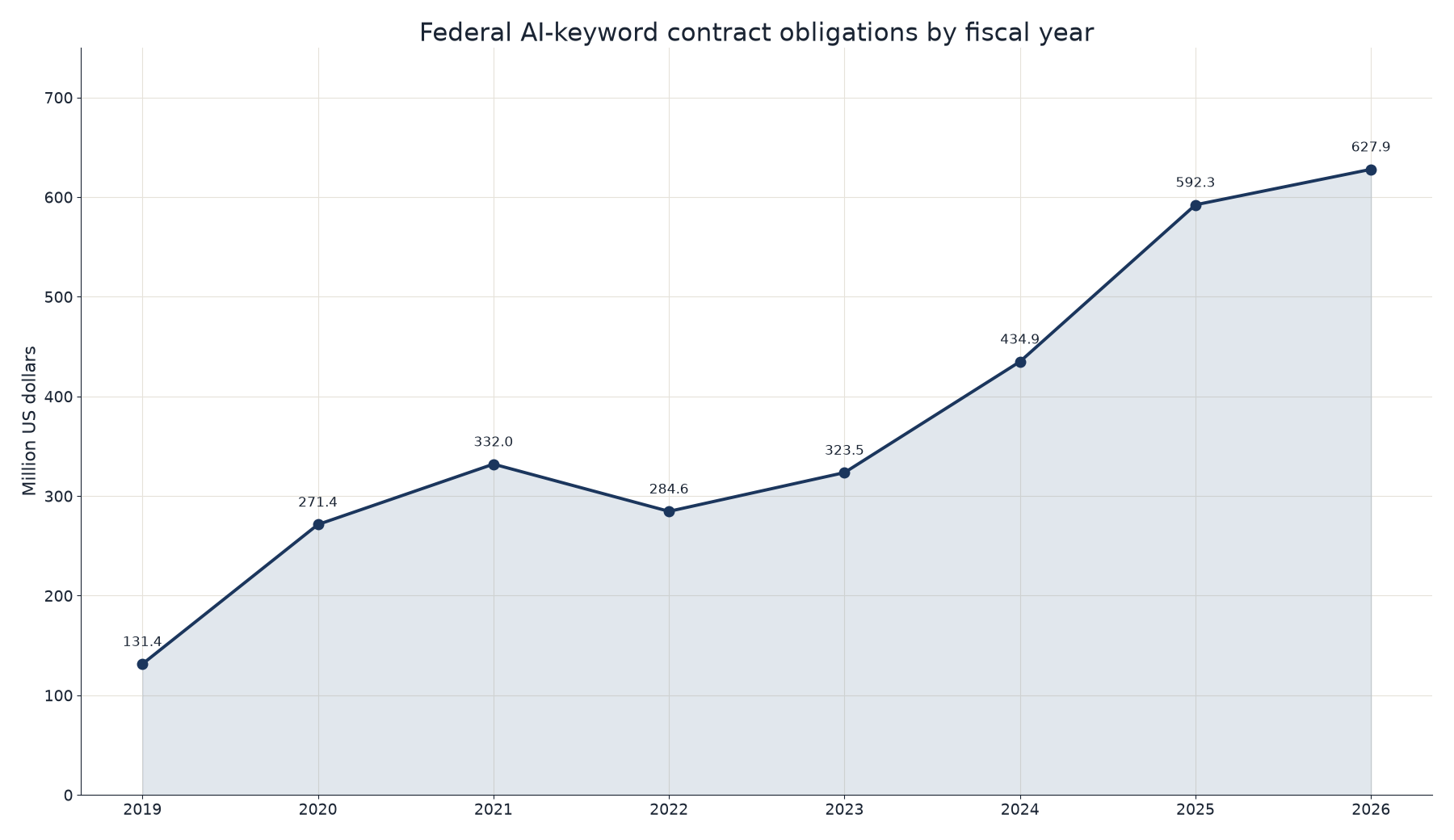
- Federal agencies obligated $627.9 million on AI-keyword contracts in fiscal year 2026, up 6.0% from $592.3 million in fiscal year 2025.
- The yearly total has grown almost fivefold since fiscal year 2019, when obligations were $131.4 million.
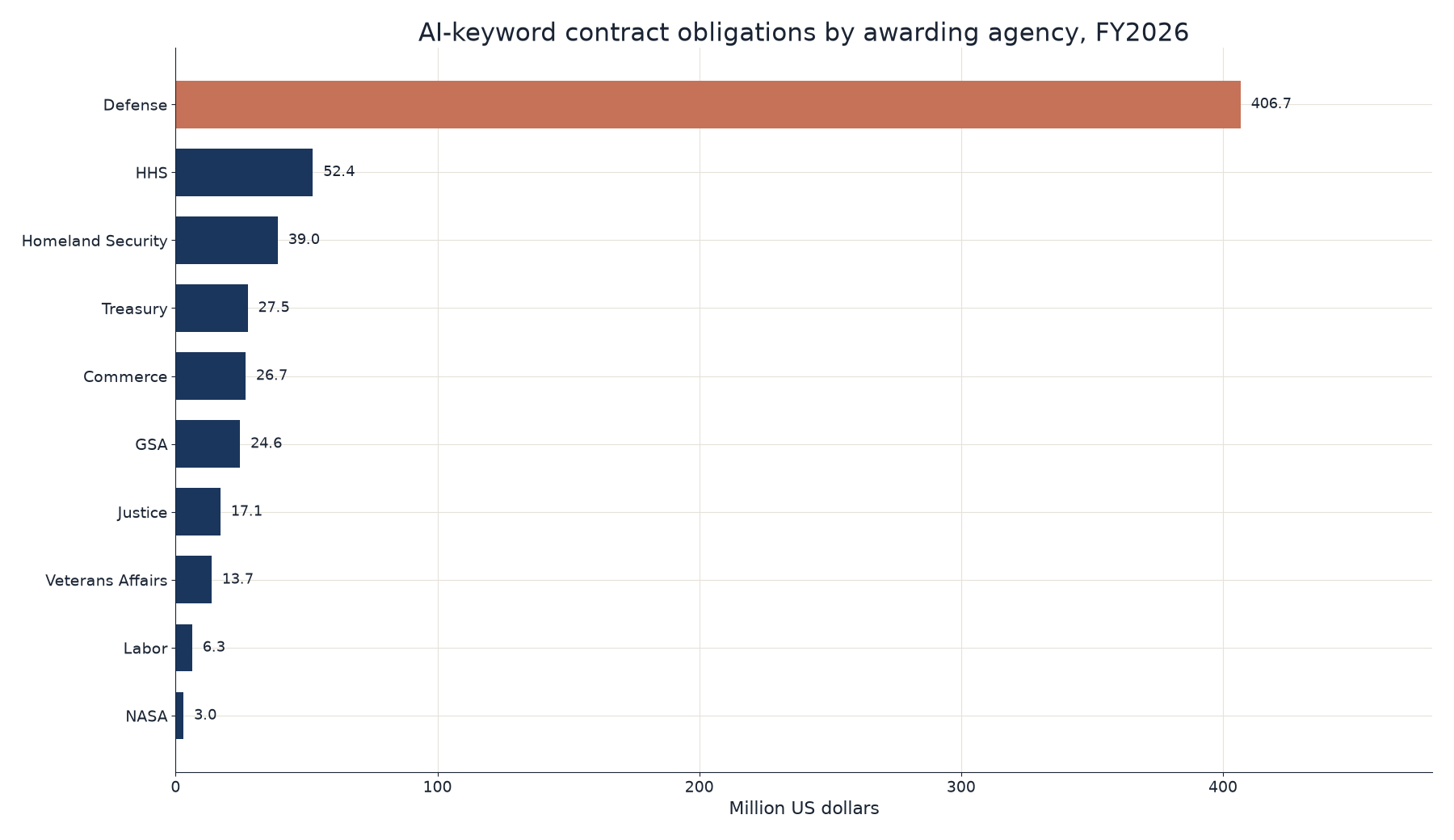
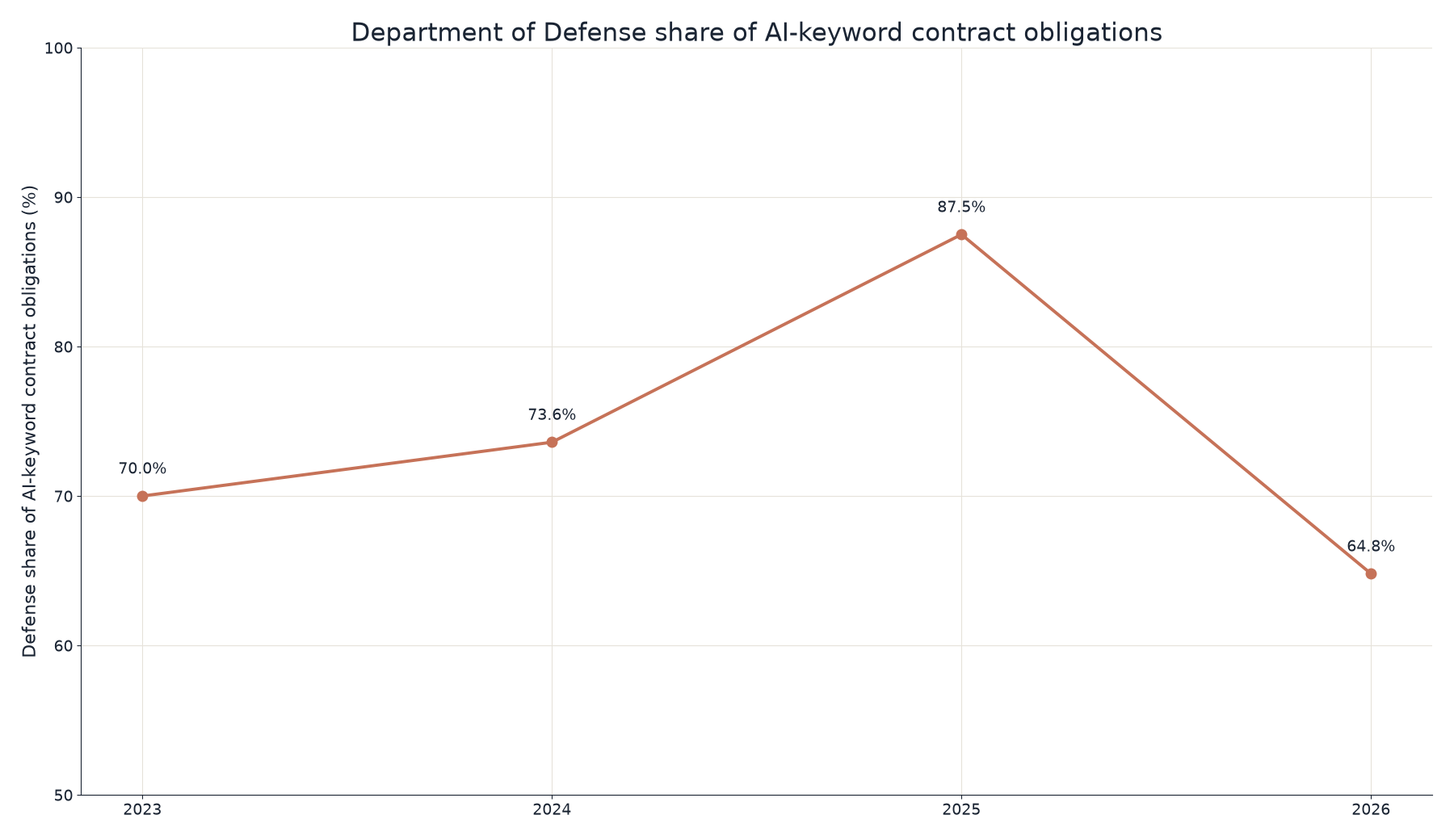
- The Department of Defense accounted for $406.7 million, or 64.8%, of the fiscal year 2026 total, down from 87.5% in fiscal year 2025.
- Health and Human Services obligations rose from $12.5 million to $52.4 million, and Homeland Security's from $4.8 million to $39.0 million.
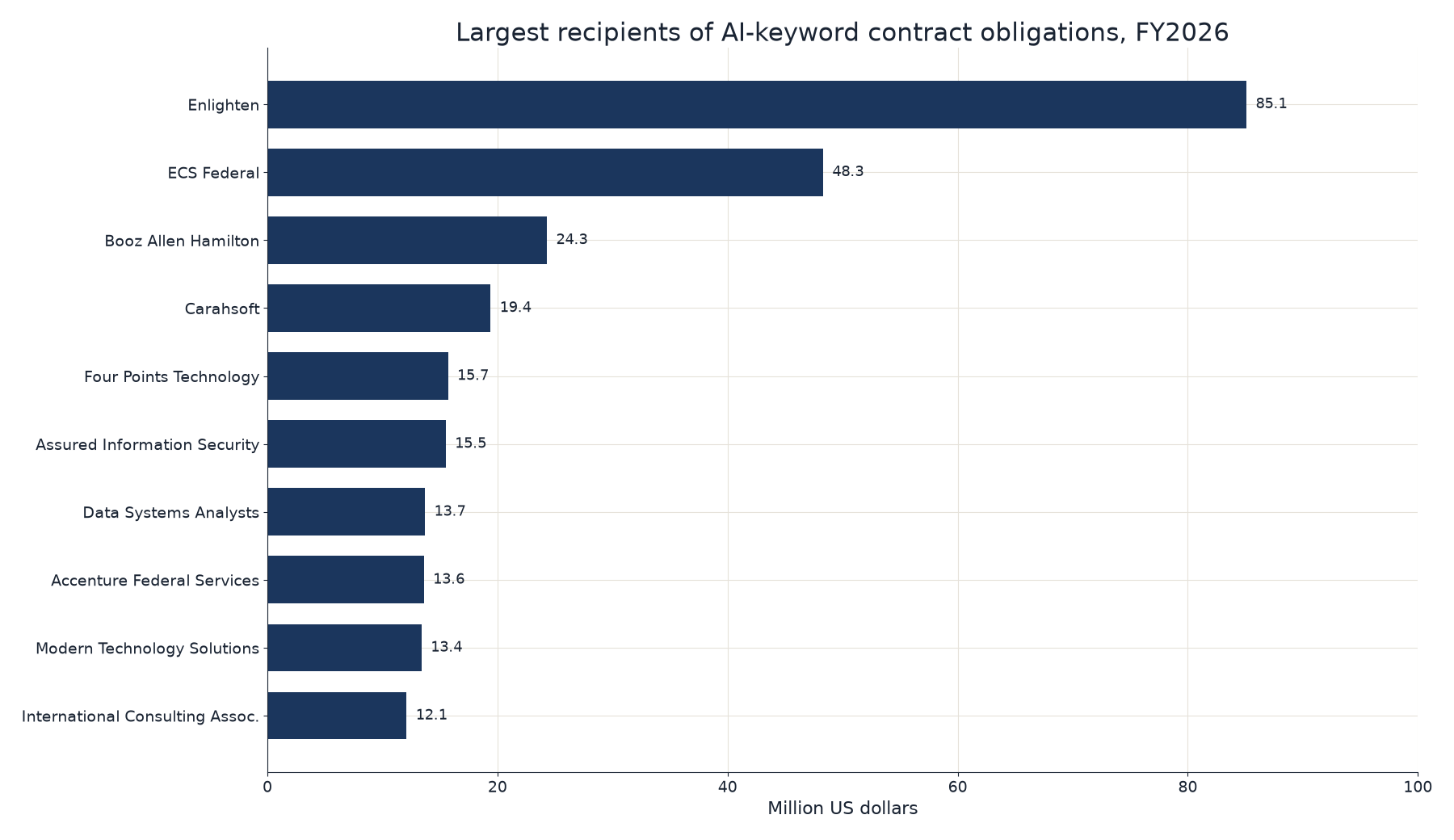
- Enlighten, LLC, received the most, $85.1 million, followed by ECS Federal, LLC, at $48.3 million and Booz Allen Hamilton Inc. at $24.3 million.
Federal agencies buy AI the same way they buy other services and products: by awarding contracts and recording the dollars they obligate on those awards. An obligation is a legal commitment to spend, not a cash payment and not the full potential value of a multi-year contract. Public US contract data has no single official "AI contract" flag, so any yearly total depends on how awards are identified. We matched award descriptions and titles in USAspending.gov against a fixed list of AI keywords and limited the search to contracts, so these figures are separate from published totals for AI research grants.
In the following sections, we set out the yearly totals, compare awarding agencies, and report the vendors that received the most keyword-matched obligations in fiscal year 2026.
How Much Have Agencies Obligated on AI Contracts Each Year?
We totaled contract obligations by fiscal year to show how fast federal AI buying has grown. Federal fiscal years end on September 30. Fiscal year 2026 ended six weeks before we ran the query, so later corrections and late-reported transactions can still change the total.
Federal contract obligations on AI-keyword awards, fiscal years 2019 to 2026
| Fiscal year | Contract obligations | Change from the prior year |
|---|---|---|
| 2019 | $131.4 million | |
| 2020 | $271.4 million | 106.5% |
| 2021 | $332.0 million | 22.3% |
| 2022 | $284.6 million | -14.3% |
| 2023 | $323.5 million | 13.7% |
| 2024 | $434.9 million | 34.4% |
| 2025 | $592.3 million | 36.2% |
| 2026 | $627.9 million | 6.0% |
Key Findings
- Obligations rose in six of the seven year-to-year steps, with the one decline in fiscal year 2022. The largest dollar increases were in fiscal years 2024 and 2025, when the total moved from $323.5 million to $592.3 million over two years.
- The fiscal year 2026 increase was much smaller, 6.0%, after two years of gains above 30%. A late-reporting adjustment could still move that latest total, but it would have to be large to change the shape of the series.
- A vendor's announced contract ceiling and this series measure different things. A single award can carry a current value of hundreds of millions of dollars and still add only the amount obligated in that fiscal year to the totals above.
Which Agencies Award These Contracts?
We split the fiscal year 2026 total by awarding agency, the department that made the award, to show where the dollars came from. In many defense-related buys, that is the Department of Defense. Some awards that support defense customers are made by the General Services Administration, and those dollars are credited to GSA.
AI-keyword contract obligations by awarding agency, fiscal year 2026
| Awarding agency | FY2026 obligations | Share of the FY2026 total |
|---|---|---|
| Department of Defense | $406.7 million | 64.8% |
| Department of Health and Human Services | $52.4 million | 8.3% |
| Department of Homeland Security | $39.0 million | 6.2% |
| Department of the Treasury | $27.5 million | 4.4% |
| Department of Commerce | $26.7 million | 4.3% |
| General Services Administration | $24.6 million | 3.9% |
| Department of Justice | $17.1 million | 2.7% |
| Department of Veterans Affairs | $13.7 million | 2.2% |
| Department of Labor | $6.3 million | 1.0% |
| National Aeronautics and Space Administration | $3.0 million | 0.5% |
AI-keyword contract obligations at selected agencies, fiscal years 2023 to 2026
| Awarding agency | FY2023 | FY2024 | FY2025 | FY2026 |
|---|---|---|---|---|
| Department of Defense | $226.4 million | $320.2 million | $518.0 million | $406.7 million |
| Department of Health and Human Services | $22.7 million | $25.1 million | $12.5 million | $52.4 million |
| Department of Homeland Security | $7.9 million | $19.1 million | $4.8 million | $39.0 million |
| Department of the Treasury | $3.9 million | $26.2 million | $5.4 million | $27.5 million |
| Department of Commerce | $14.2 million | $17.1 million | $5.8 million | $26.7 million |
| Department of Veterans Affairs | $22.6 million | $15.9 million | $18.4 million | $13.7 million |
Key Findings
- The Defense Department remained the largest awarding agency, but its fiscal year 2026 obligations fell $111.2 million from the year before, while the overall total rose. Defense's share dropped from 87.5% to 64.8%.
- Several civilian agencies moved in the other direction. Health and Human Services rose from $12.5 million to $52.4 million, Homeland Security from $4.8 million to $39.0 million, and Commerce from $5.8 million to $26.7 million. The General Services Administration, which was not among the 20 largest awarding agencies in fiscal years 2023 through 2025, accounted for $24.6 million in fiscal year 2026.
- Defense procurement led the 2025 total, while 2026 drew on a broader mix of agencies. A comparison that looks only at Defense misses where the new dollars went.
Which Vendors Received the Most AI-Keyword Obligations in Fiscal Year 2026?
We ranked the companies that received the most keyword-matched obligations in fiscal year 2026. Vendor names are the recipient legal entities in USAspending. As with the agency table, the dollars are fiscal year 2026 obligations, not current award ceilings.
Largest recipients of AI-keyword contract obligations, fiscal year 2026
| Recipient | FY2026 obligations |
|---|---|
| Enlighten, LLC | $85.1 million |
| ECS Federal, LLC | $48.3 million |
| Booz Allen Hamilton Inc. | $24.3 million |
| Carahsoft Technology Corp. | $19.4 million |
| Four Points Technology, L.L.C. | $15.7 million |
| Assured Information Security, Inc. | $15.5 million |
| Data Systems Analysts Inc. | $13.7 million |
| Accenture Federal Services LLC | $13.6 million |
| Modern Technology Solutions, Inc. | $13.4 million |
| International Consulting Associates, Inc. | $12.1 million |
Key Findings
- The fiscal year 2026 vendor list is led by systems integrators and resellers, not by the foundation-model companies that dominate private AI spending.
- Award-level current values can be much larger than these rows. A fiscal year 2026 GSA award to Booz Allen Hamilton, identified in USAspending as 47QFCA26F0018, had a current award amount of $246.3 million, while Booz Allen's keyword-matched obligations in the fiscal year were $24.3 million.
- A headline about a large AI award differs from that vendor's dollars obligated in the year. For a budget or market-size figure, the obligation series can be added across vendors without double-counting future-year ceilings.
How Concentrated Is AI Contract Spending at the Defense Department?
We tracked the Defense Department's share of the yearly total from fiscal year 2023 to 2026. It rose from 70.0% to 73.6% and then to 87.5% in fiscal year 2025, before falling to 64.8% in fiscal year 2026.
What These Contract Totals Mean for Federal AI Buying
The keyword series shows a federal contract market that is still measured in hundreds of millions of dollars a year, not billions, once the figure is limited to contracts and to dollars obligated in that year. It grew quickly through fiscal year 2025 and more slowly in fiscal year 2026, and it is no longer as concentrated in the Defense Department as it was a year earlier.
The totals are also only as wide as the keyword list. Awards that describe a project in other words, or that buy cloud or software in a way that never mentions AI in the record, are outside the count. Grant obligations, which are much larger in a combined search of the same keywords, are also outside it.
Anyone citing federal AI contract spending should describe the figure as fiscal-year contract obligations on awards that match an AI keyword list, $627.9 million in fiscal year 2026, and should not treat a contract's current value as a yearly spending total.
Methodology
Scope. This report covers US federal contract obligations on awards whose USAspending records matched at least one phrase in a fixed AI keyword list, for fiscal years 2019 through 2026. It does not include grant, loan, or other assistance obligations, and it does not include the current or potential value of a contract except as a comparison in the vendor section. It is not a count of every contract that uses AI, only of awards that used these phrases in the fields USAspending searches. The series is separate from AIR's published figures on federal AI research grants and on SBIR and STTR awards.
Keyword list and award types. The keywords were: artificial intelligence, machine learning, generative AI, large language model, AI/ML, deep learning, neural network, and foundation model. Award type codes were A, B, C, and D (contracts). Fiscal years run from October 1 to September 30. The USAspending API was queried on November 13, 2026. Fiscal year 2026 had ended on September 30, 2026; late-reported transactions can still revise the total.
Spending level. Yearly totals come from the spending_over_time endpoint. Agency and vendor breakdowns come from the spending_by_category endpoint with spending_level set to transactions, because the same endpoint at the award level returns current award amounts and does not add to the yearly obligation total. A current award amount is reported only for 47QFCA26F0018, as a worked example of that difference.
Rounding. Dollar figures were rounded once, to one decimal million, from the raw API amounts. Shares were rounded once from unrounded dollars divided by the unrounded yearly total from spending_over_time. The Department of Defense share in fiscal year 2026 is $406,739,571.31 / $627,853,615.78 = 64.8%. In fiscal year 2025 it is $517,965,507.25 / $592,267,173.50 = 87.5%. Health and Human Services' fiscal year 2026 share is $52,425,600.45 / $627,853,615.78 = 8.3%. Year-to-year percentages in Table 1 were rounded once from the unrounded totals. The $111.2 million Defense decline is $517,965,507.25 minus $406,739,571.31, rounded once to one decimal million.
Agency coverage. Table 3 includes agencies that appeared in the transaction-level awarding-agency results in each of fiscal years 2023 through 2026. The General Services Administration's $24.6 million is reported for fiscal year 2026; it was not among the 20 largest awarding agencies in fiscal years 2023 through 2025. The Department of Justice appeared in 2023, 2025, and 2026, and not among the 20 largest in 2024, so it is in Table 2 only. Grant obligations are outside this report.
Sources
- AI Industry Reviews, Federal AI Contract Statistics: 2026 Report, analysis of USAspending.gov contract obligations matching a fixed AI keyword list, conducted November 13, 2026 (this study).
- USAspending.gov API, spending over time and spending by category (transactions), queried November 13, 2026, for fiscal years 2019 through 2026, contract award types only: https://api.usaspending.gov/
- USAspending.gov, award record for 47QFCA26F0018 (Booz Allen Hamilton Inc.), opened as part of the same November 13, 2026 pull, used only to compare current award amount with fiscal-year obligations.