
Home / Research / Enterprise AI Spending Statistics
Enterprise AI Spending Statistics: 2026 Report
 By Darin ten Bruggencate, Founder, AI Industry Reviews · November 17, 2026
Our analysts compared four published sources retrieved in November 2026: Menlo Ventures' 2026 State of Enterprise AI report, released November 3, 2026, which estimates enterprise spending to use AI as of September; Gartner's September 16, 2026 forecast of worldwide AI spending, including infrastructure; IDC's Worldwide Quarterly AI Infrastructure Tracker for the second quarter of 2026, discussed in a November 6, 2026 IDC article; and McKinsey's State of AI Global Survey 2026, fielded May 4 to June 8, 2026. We put the US-centered enterprise figures first, set them beside the worldwide forecasts, and calculated shares only from the published dollar amounts. Menlo's market-size figures are the firm's estimates, not a census of invoices, and Menlo is an investor in some of the companies the report discusses.
Key Findings
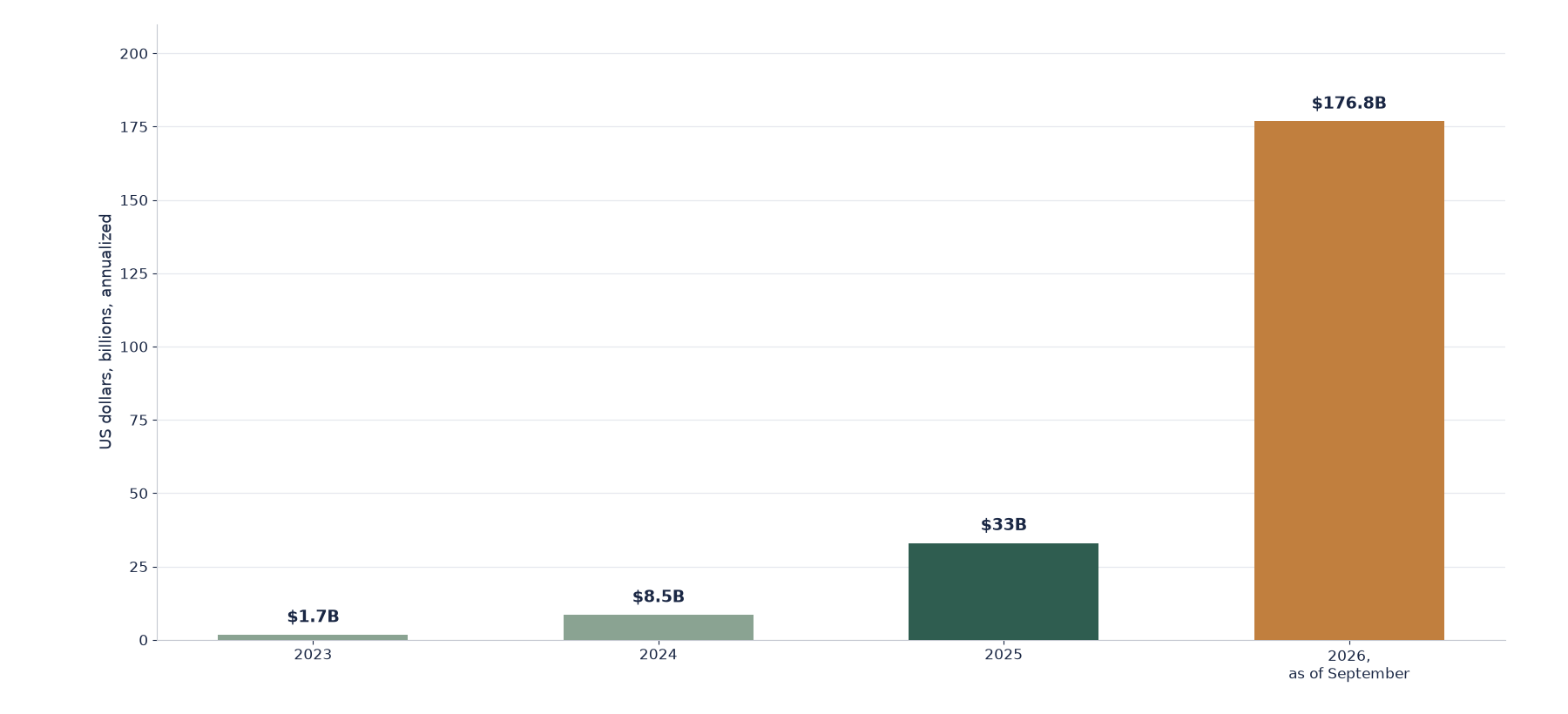
- Menlo Ventures estimates enterprise spending to use AI reached $176.8 billion by September 2026, up from $33 billion in 2025 and $1.7 billion in 2023.
- That 2026 figure is an annualized run rate, and it is separate from the $102.5 billion Menlo estimates was spent on building models.
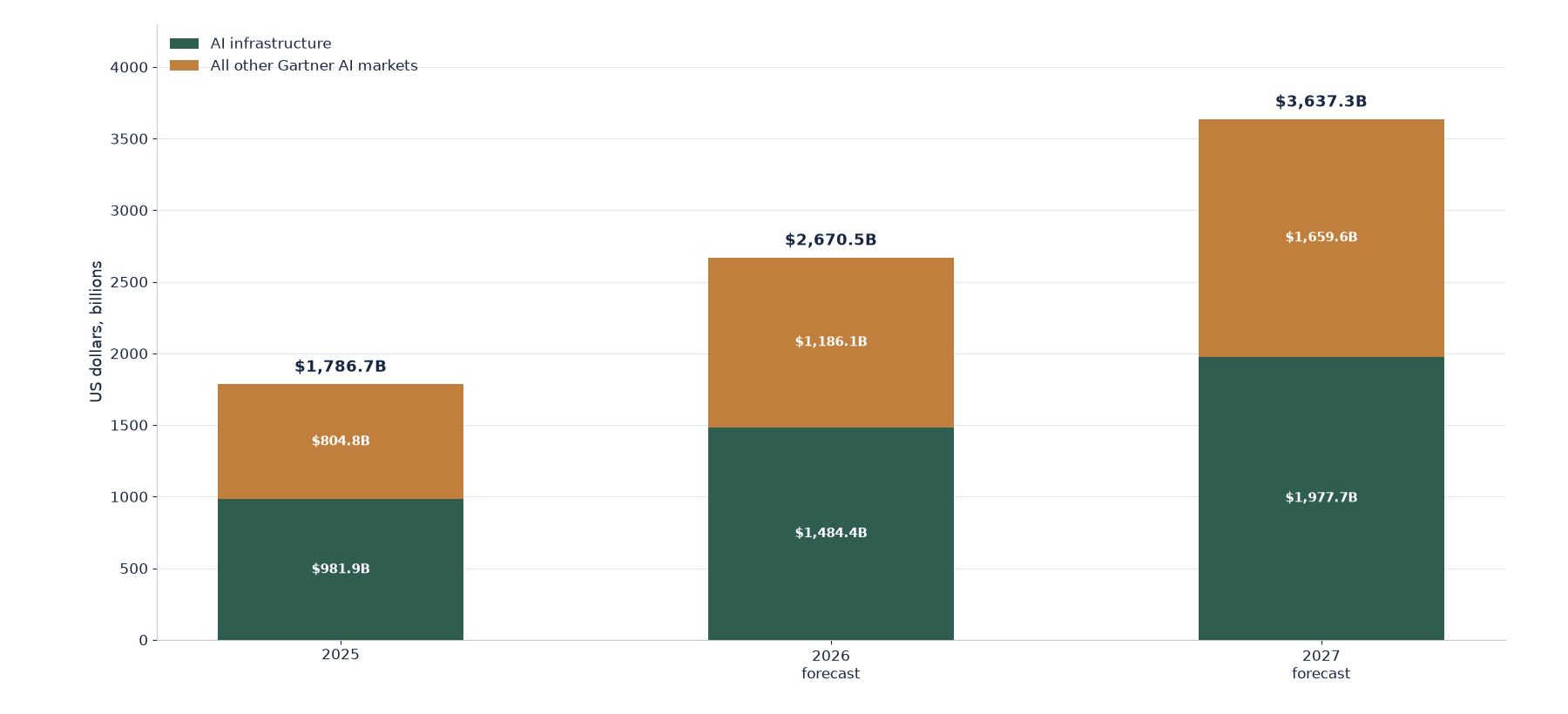
- Gartner forecasts $2,670.5 billion in worldwide AI spending in 2026, of which $1,484.4 billion is infrastructure.
- IDC recorded $121.4 billion of AI infrastructure spending in the second quarter of 2026, $92.8 billion of it in the United States, and raised its 2026 infrastructure forecast to $521 billion.
- Menlo splits the $176.8 billion of deployment spending into $99.5 billion of infrastructure and $77.3 billion of applications, with coding and workplace assistants the largest application categories.
Enterprises spend money on AI in two different ways, and the published totals often mix them. One is what companies pay to use AI at work: models, applications, and the inference and tools that run them. The other is the much larger market for the servers, chips, and data-center equipment that make those systems possible, a market in which large cloud providers are the main buyers. Those two figures are not interchangeable, which is why the published totals need to be read with their scope attached. The tables below keep those scopes separate and use each source's own figures.
In the following sections, we set out Menlo's enterprise totals and their growth, show how those totals are split between infrastructure and applications, compare them with Gartner's broader worldwide forecast and IDC's infrastructure tracker, and report what McKinsey's survey says about budgets and results.
How Much Are Enterprises Paying to Use AI?
Menlo's series is the closest published estimate we opened of what enterprises spend to deploy and use AI, as opposed to what the industry spends to train models or buy servers for cloud regions. The 2026 figure is an annualized run rate as of September, built from a survey of nearly 400 US enterprise decision-makers, public filings, and third-party reports. The survey was fielded by Morning Consult from September 8 to 26, 2026, and covered people responsible for more than $4 billion in AI spending.
Menlo Ventures estimates of enterprise AI deployment spending
| Period | Deployment spending, using AI | Change from the prior year (Menlo) | Development spending, building models |
|---|---|---|---|
| 2023 | $1.7 billion | Not stated | Not stated |
| 2024 | $8.5 billion | 5.0 times | Not stated |
| 2025 | $33 billion | 3.9 times | Not stated |
| 2026, as of September, annualized | $176.8 billion | 5.4 times | $102.5 billion, 5.3 times (2026 only) |
Menlo Enterprise AI Deployment Spending, 2023 to September 2026
Key Findings
- Menlo describes the 2023 to 2026 rise as growth of roughly 100 times in three years. The latest step, from $33 billion to $176.8 billion, adds $143.8 billion and is faster than the 3.9 times increase a year earlier.
- The share of enterprises paying for AI rose only from 55% to 65%. Menlo's report says the growth is coming mainly from higher spending among companies that already pay for AI, not from a comparable wave of new buyers. On average, surveyed companies spent 4.7 times their 2025 level against a planned 1.9 times, and the median was 2.2 times against a planned 1.8 times.
- The implication for budget planning is that a company average can be pulled up by a smaller group of heavy users. Menlo itself flags that gap between the average and the median, and it is one reason a single "enterprises spent X times more" line needs both figures.
Where Does That Enterprise Spending Go?
Menlo splits the $176.8 billion of deployment spending into infrastructure that runs models and agents, $99.5 billion, and applications, $77.3 billion. A separate $102.5 billion estimate covers development, meaning training compute and training data, and is not part of the $176.8 billion.
Menlo's split of 2026 enterprise AI spending
| Category | Amount | What it includes in Menlo's taxonomy |
|---|---|---|
| Deployment: infrastructure | $99.5 billion | Inference from frontier model providers and inference and agent platforms |
| Deployment: applications | $77.3 billion, up from $19 billion last year | AI products enterprises use |
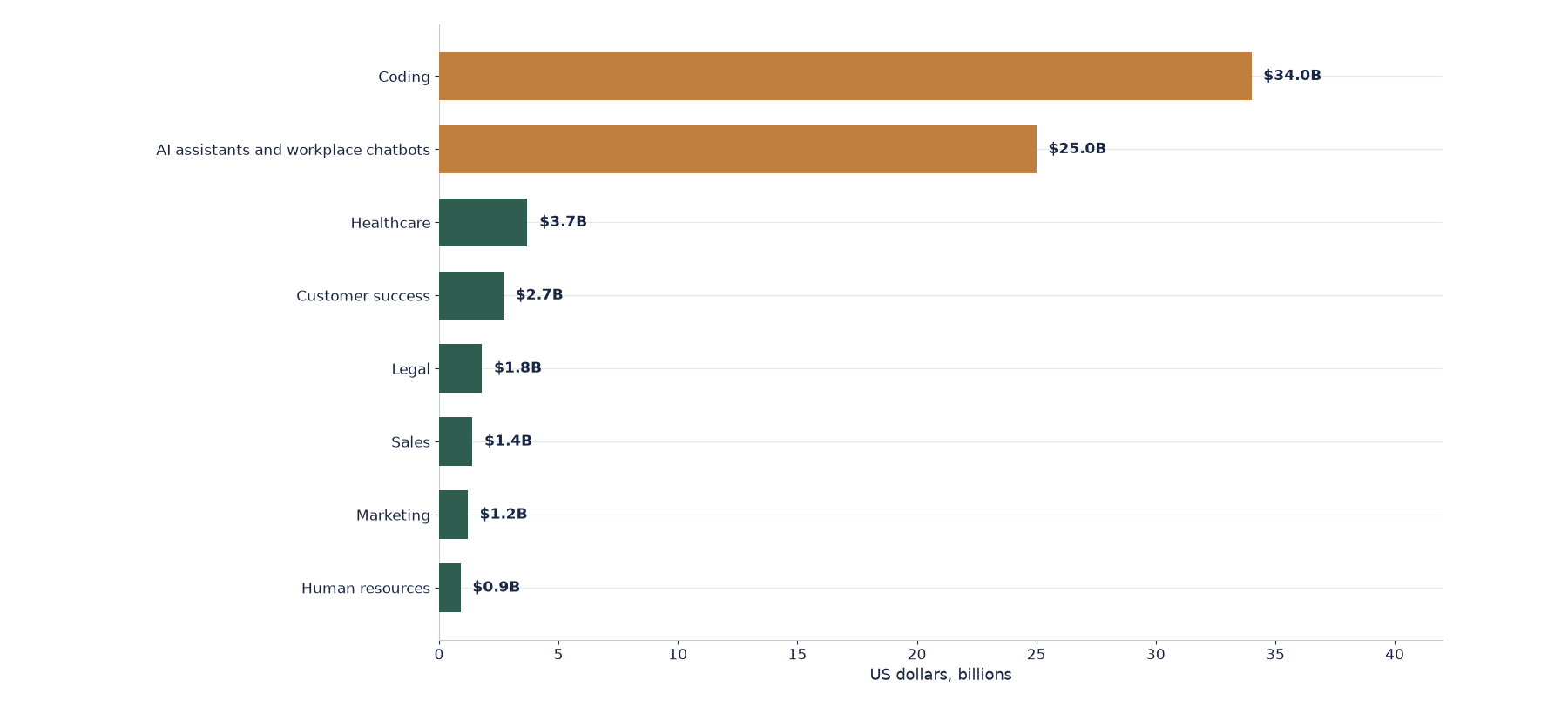
| Of which: coding | $34.0 billion, up 7.7 times | Including Claude Code and Codex, which Menlo puts at $24.0 billion, or 70% of coding spend |
| Of which: AI assistants and workplace chatbots | $25.0 billion, up 3.0 times | Including enterprise Claude, ChatGPT, Gemini, and Microsoft Copilot. Menlo puts the three lab assistants at $15.5 billion, or 62% of this category |
| Of which: healthcare | $3.7 billion, up 2.5 times | Largest vertical industry market, 37% of Menlo's $10.1 billion vertical total |
| Of which: legal | $1.8 billion, up 2.8 times | Second among verticals |
| Of which: customer success | $2.7 billion, up 4.3 times | Horizontal function |
| Of which: sales | $1.4 billion, up 3.6 times | Horizontal function |
| Of which: marketing | $1.2 billion, up 1.8 times | Horizontal function |
| Of which: human resources | $0.9 billion, up 2.5 times | Horizontal function |
| Development: training compute | $87.2 billion | Hyperscalers and specialized clouds |
| Development: training data and services | $15.3 billion | Expert data, evaluations, and related services |
| Development total | $102.5 billion | Building models, not counted in the $176.8 billion deployment total |
Enterprise AI Application Spending by Category, 2026
Key Findings
- Coding and workplace assistants account for most application spending. Healthcare, the largest industry category in Menlo's vertical group, is $3.7 billion, which is larger than Menlo's entire vertical market last year ($3.5 billion) and still small next to coding.
- Anthropic, OpenAI, and Google together account for $122.7 billion, or 69% of deployment spending, up from 50% in 2025, in Menlo's estimates. Within enterprise LLM API spending, Menlo puts Anthropic at 55%, up from 40%, OpenAI at 31%, up from 27%, and Google at 9%, down from 21%. Menlo is an investor in Anthropic and in OpenRouter, the routing service that supplies some of its token-share data, and those relationships are disclosed in the report.
- The implication for software buyers is that most of the new application money is going to a few workplace tools, especially coding, and is not spread evenly across industries. Menlo also says 55% of incremental AI spending came from new budgets and 22% from existing software budgets, with $12.6 billion, or 9%, moving to AI-native vendors.
How Do the Worldwide Forecasts Compare?
Gartner and IDC measure something wider than Menlo's enterprise deployment estimate. Gartner's forecast is worldwide AI spending, including the infrastructure sold to build and run AI data centers. IDC tracks AI infrastructure only. Neither should be added to Menlo's $176.8 billion, and Gartner's total should not be read as what a typical enterprise is spending on software.
Gartner worldwide AI spending forecast by market, 2025 to 2027, in billions of US dollars
| Market | 2025 | 2026 | 2027 |
|---|---|---|---|
| AI infrastructure | 981.9 | 1,484.4 | 1,977.7 |
| AI services | 434.0 | 576.5 | 745.7 |
| AI software | 288.2 | 461.6 | 656.4 |
| AI cybersecurity | 25.9 | 51.3 | 86.0 |
| AI agents and assistants | 16.5 | 29.2 | 65.5 |
| Generative AI models | 13.0 | 28.3 | 51.6 |
| AI platforms for data science and machine learning | 19.4 | 26.4 | 35.6 |
| AI application development platforms | 6.9 | 9.5 | 12.5 |
| AI data | 0.8 | 3.1 | 6.5 |
| Total AI spending | 1,786.7 | 2,670.5 | 3,637.3 |
Gartner Worldwide AI Spending, Infrastructure vs Other Markets, 2025 to 2027
Key Findings
- Infrastructure is 55.6% of Gartner's 2026 total (our calculation from $1,484.397 billion and $2,670.460 billion). The remaining $1,186.1 billion covers services, software, cybersecurity, models, platforms, and data. That non-infrastructure remainder is still several times Menlo's $176.8 billion enterprise deployment estimate, because the two firms define the market differently.
- Gartner's September release put the 2026 total at $2,670.460 billion, above the $2,595.667 billion in its May 19, 2026 forecast. The two releases are not a pure like-for-like revision: the September forecast also separated agents and assistants from AI software and added consumer agents and assistants to the total. John-David Lovelock, a Gartner analyst, said in the September release that demand for AI infrastructure "remains strong and inelastic to pressures from memory-related pricing increases," and that "the capacity growth from hyperscalers and service providers purchasing AI-optimized servers will continue to be the largest single area of spending."
- The implication for anyone quoting a $2.7 trillion AI spending figure is that most of it is infrastructure, not the software and services an enterprise finance team would recognize as an AI budget. Menlo's $176.8 billion is the better published proxy we opened for that narrower question, with the caveat that it is an estimate as of September.
IDC AI infrastructure spending
| Period | Amount | US amount and share | Notes |
|---|---|---|---|
| 2024, full year | $153.9 billion | Not stated in the article we opened | IDC Worldwide Quarterly AI Infrastructure Tracker |
| 2025, full year | $318.7 billion, up 107.2% | Not stated in the article we opened | |
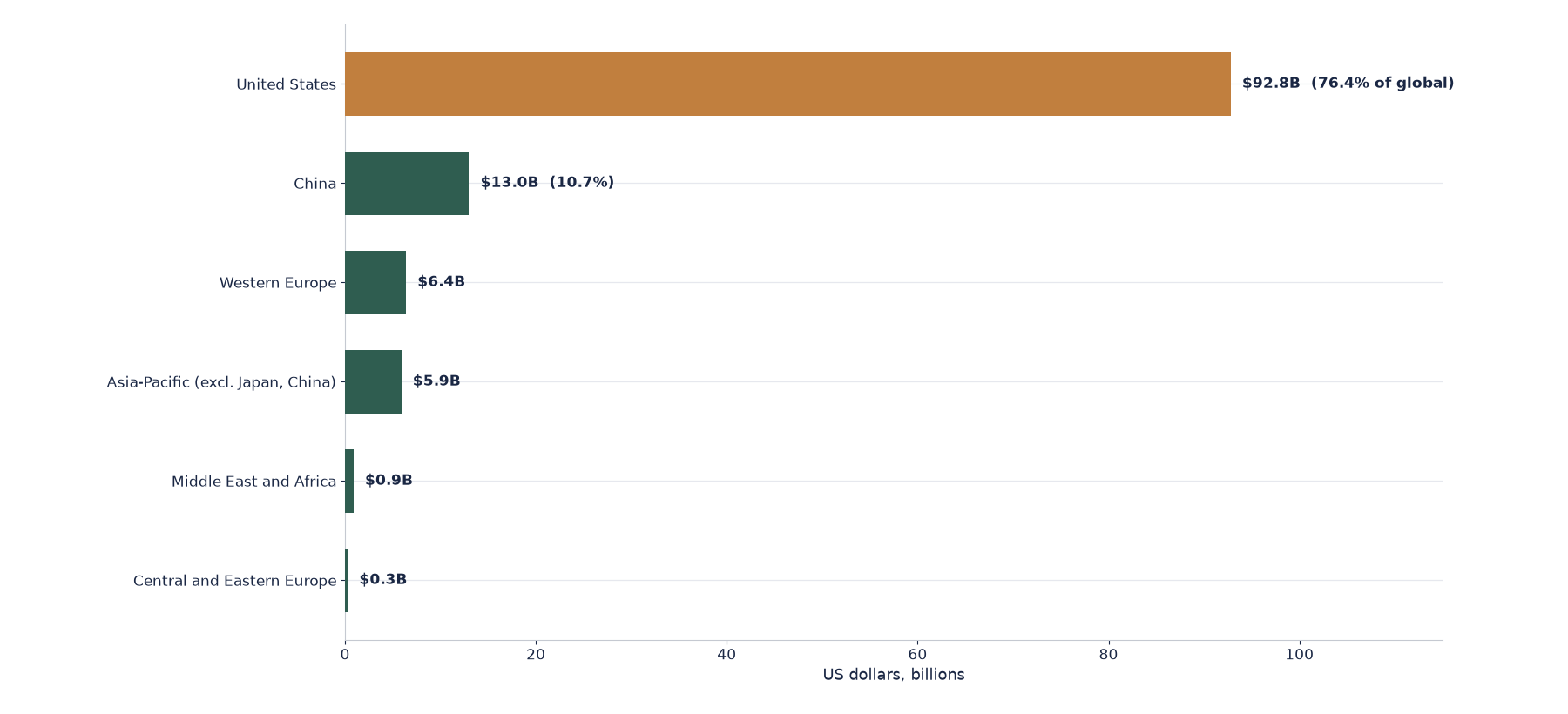
| 2026, Q2 | $121.4 billion, up 53.3% from Q2 2025 and 34% from Q1 2026 | $92.8 billion, 76.4% of the global total, up 58.7% from a year earlier | Accelerated systems $105.8 billion; non-accelerated infrastructure $15.6 billion; servers $119.0 billion; storage $2.5 billion |
| 2026, full year forecast | $521 billion, up from $497 billion in IDC's prior quarterly outlook | Not stated as a full-year US figure | Implies about $309 billion in the second half of 2026, per IDC |
IDC AI Infrastructure Spending by Region, Q2 2026
Key Findings
- The United States accounted for $92.8 billion of IDC's second-quarter total, far ahead of China at $13.0 billion and Western Europe at $6.4 billion. That US share, 76.4%, is the clearest geographic split we opened in the infrastructure series.
- IDC raised its 2026 forecast in part because of higher component prices and stronger demand for CPU-based systems used in agent orchestration and data pipelines, not only because of more GPU servers. It also said first-quarter shipments had been paused and then resumed.
- These infrastructure figures overlap in subject with capital-expenditure reports on large cloud providers, and they should be read as the equipment market, not as a second count of the same enterprise software spending in Tables 1 and 2.
What Do Enterprise Surveys Say About Budgets and Results?
McKinsey's latest global survey, fielded from May 4 to June 8, 2026, asked 1,719 people in 97 countries about their organizations' use of AI. Thirty-six percent of respondents said they work for organizations with more than $1 billion in annual revenue. The results are weighted by each respondent's country's share of global GDP. This is a survey of practice and opinion, not a market-size estimate, and it should not be added to the dollar tables above.
Selected McKinsey State of AI 2026 survey results
| Measure | 2026 survey | Comparison in the survey |
|---|---|---|
| Respondents whose organizations spend more than 10% of their enterprise-wide information and communication technology budget on AI | 28% | High performers, defined as those attributing at least 5% of EBIT to AI with a "significant" impact, were more than twice as likely as others to spend more than 15% of that budget on AI |
| Respondents who expect their organizations to increase AI investment over the next year | 60% | Pharmaceuticals and medical products, insurance, and banking were the most likely to expect an increase |
| Respondents who say AI-related operating costs, including token costs, have constrained AI use | About 20% | Broadly consistent across organization sizes and many industries |
| Respondents attributing at least some EBIT impact to AI use | 37% | Essentially unchanged from 2025 |
| High performers as defined above | About 6% of respondents | Unchanged from 2025 |
| Respondents reporting that AI is scaling across the enterprise | 44% | Up from 38% a year earlier |
| Respondents at organizations with at least $1 billion in revenue who report scaling AI agents in one or more functions | 40% | Up from 27% last year. The share at smaller organizations was flat at 22% |
| Respondents whose organizations decided against buying at least one software product or feature because it could be built internally with agentic coding tools | 32% |
- Spending is rising in the survey even though the share of respondents who can point to an EBIT effect has not. Eight in ten respondents said AI had improved their own productivity, which McKinsey contrasts with the unchanged 37% reporting enterprise-level financial impact.
- Cost is starting to show up as a limit, but not as a reason most companies plan to cut back. About one in five respondents said operating costs had constrained use, and 60% still expected investment to rise over the next year.
- The implication for a company comparing itself with "the market" is that budget share and scale vary widely. A 28% group already puts more than a tenth of its ICT budget into AI, while the typical financial result in the survey has not moved in a year.
What These Numbers Mean for Enterprise AI Spending
The 2026 figures only make sense when the question is specified. If the question is what enterprises are paying to use AI, the best published estimate we opened is Menlo's $176.8 billion as of September, up sharply from $33 billion in 2025, and still far below Gartner's worldwide total. If the question is how large the infrastructure buildout has become, Gartner's $1,484.4 billion forecast and IDC's $121.4 billion second-quarter reading are the relevant series, and they are led by the United States.
The application dollars inside the enterprise estimate are concentrated as well. Coding and workplace assistants account for most of Menlo's application total, and three model providers account for most deployment spending. McKinsey's survey, taken a few months earlier, suggests that many organizations are still raising their budgets faster than they can show an earnings effect.
Those patterns can change as 2026 closes and as the firms update their forecasts. Menlo's figure is a September run rate, Gartner's is a forecast, and IDC's full-year $521 billion is also a forecast. A full-year invoice total for enterprise use is not in the sources we opened.
So if you are citing enterprise AI spending in 2026, say whether the figure is what companies pay to use AI, what they spend to train models, or what the world is spending on AI infrastructure, and name the source and date.
Methodology
Scope. This report compares published estimates of enterprise spending to use AI, worldwide AI spending forecasts, AI infrastructure spending, and a global survey of organizational practice. It does not include a new survey or a new invoice-level dataset. US-centered enterprise figures lead. All amounts are in US dollars.
Menlo Ventures. Menlo's deployment totals are the firm's estimates of enterprise spending to use AI, shown as an annualized run rate as of September 2026. The 2026 edition combines a survey of nearly 400 US enterprise decision-makers, fielded by Morning Consult from September 8 to 26, 2026, with a bottoms-up model informed by survey responses, public filings, and third-party reports. Prior-year figures were reclassified by Menlo to this year's taxonomy. Menlo is an investor in Anthropic, OpenRouter, and other companies named in the report, and it discloses those relationships. Token-share figures that use OpenRouter data reflect a channel Menlo says skews more toward individual developers and startups than the enterprise buyers in the survey. We use Menlo's dollar estimates and stated percentages as published, and we calculate only the $143.8 billion increase from 2025 to 2026 and the $59.0 billion combined coding and chatbot application total.
Gartner. Gartner figures come from the September 16, 2026 news release table, which is denominated in millions of US dollars. We converted each figure to billions and rounded once to one decimal place. The 55.6% infrastructure share and the $1,186.1 billion non-infrastructure remainder are our calculations from the unrounded million-dollar totals of $1,484,397 million and $2,670,460 million. The May 19, 2026 release is used only to show that Gartner later raised the 2026 total.
IDC. IDC figures come from the firm's November 6, 2026 article on the Q2 2026 Worldwide Quarterly AI Infrastructure Tracker, released in October 2026. We did not have the underlying tracker file. Full-year 2026 and later-year figures are IDC forecasts.
McKinsey. Survey results are taken from the published 2026 State of AI article. The online survey ran from May 4 to June 8, 2026, and received 1,719 responses in 97 countries, weighted by each respondent nation's contribution to global GDP. It is not a market-size series.
Calculations and limits. Shares and remainders are rounded once from the raw published values. We did not add Menlo, Gartner, and IDC totals, because they measure different markets. We did not treat Menlo's September run rate as a full-year invoice total, and we did not produce our own 2026 full-year enterprise forecast.
Sources
- AI Industry Reviews, Enterprise AI Spending Statistics: 2026 Report, comparison of Menlo Ventures, Gartner, IDC, and McKinsey published figures, November 17, 2026 (this study).
- Menlo Ventures, 2026: The State of Enterprise AI, Tim Tully, Joff Redfern, Deedy Das, and Derek Xiao, November 3, 2026: https://menlovc.com/perspective/2026-the-state-of-enterprise-ai/
- Menlo Ventures, press release via GlobeNewswire, Menlo Ventures' 2026 State of Enterprise AI Report: Enterprise AI Spending Hits $177B, Up 5.4x in One Year as Agents Take Over, November 3, 2026: https://www.globenewswire.com/news-release/2026/11/03/3394279/0/en/menlo-ventures-2026-state-of-enterprise-ai-report-enterprise-ai-spending-hits-177b-up-5-4x-in-one-year-as-agents-take-over.html
- Gartner, Gartner Forecasts Worldwide AI Spending to Grow 49.5% in 2026, September 16, 2026, citing Forecast: AI Spending, Worldwide, 2025-2030, 2Q26: https://www.gartner.com/en/newsroom/press-releases/2026-09-16-gartner-forecasts-worldwide-ai-spending-to-grow-49-point-5-percent-in-2026
- Gartner, Gartner Forecasts Worldwide AI Spending to Grow 47% in 2026, May 19, 2026 (earlier 2026 forecast, used only for the revision comparison): https://www.gartner.com/en/newsroom/press-releases/2026-05-19-gartner-forecasts-worldwide-ai-spending-to-grow-47-percent-in-2026
- IDC, AI Infrastructure Spending Jumps to $121 Billion in Q2 2026 as Pricing and CPU-Based AI Demand Broaden Growth; 2026 Forecast Raised to $521 Billion, November 6, 2026, citing IDC Worldwide Quarterly Artificial Intelligence Infrastructure Tracker, Q2 2026, released October 2026: https://www.idc.com/resource-center/blog/ai-infrastructure-spending-jumps-to-121-billion-in-q2-2026/
- McKinsey & Company, The state of AI in 2026: On the road to ROI, August 25, 2026, survey fielded May 4 to June 8, 2026: https://www.mckinsey.com/capabilities/quantumblack/our-insights/the-state-of-ai