
Home / Research / Deepfake Fraud Loss Statistics
Deepfake Fraud Loss Statistics: 2026 Report
 By Darin ten Bruggencate, Founder, AI Industry Reviews · November 12, 2026
Our analysts compiled the published US loss figures for deepfake, voice clone and other AI-enabled fraud from the FBI's Internet Crime Complaint Center (IC3), the Federal Trade Commission's Consumer Sentinel releases, FinCEN, federal law enforcement releases, insurer reports and press accounts. For each figure we noted whether it measures AI-linked fraud or all impersonation and fraud, because most published numbers are the second kind. The result is a single view of what deepfake fraud costs Americans as of Q4 2026.
Key Findings
- Americans lost $893.3 million in 2025 on 22,364 FBI complaints that mentioned AI, the first year the FBI tracked the figure.
- Investment fraud made up $632 million, or 71%, of AI-related losses, and business email compromise added $30.3 million on just 135 complaints.
- People 60 and older reported $352.5 million in AI-related losses, 39% of the total, an average of about $112,000 per complaint.
- Voice clone distress scams cost victims more than $5 million in 2025, and government impersonation losses reported to the IC3 nearly doubled to $797.9 million.
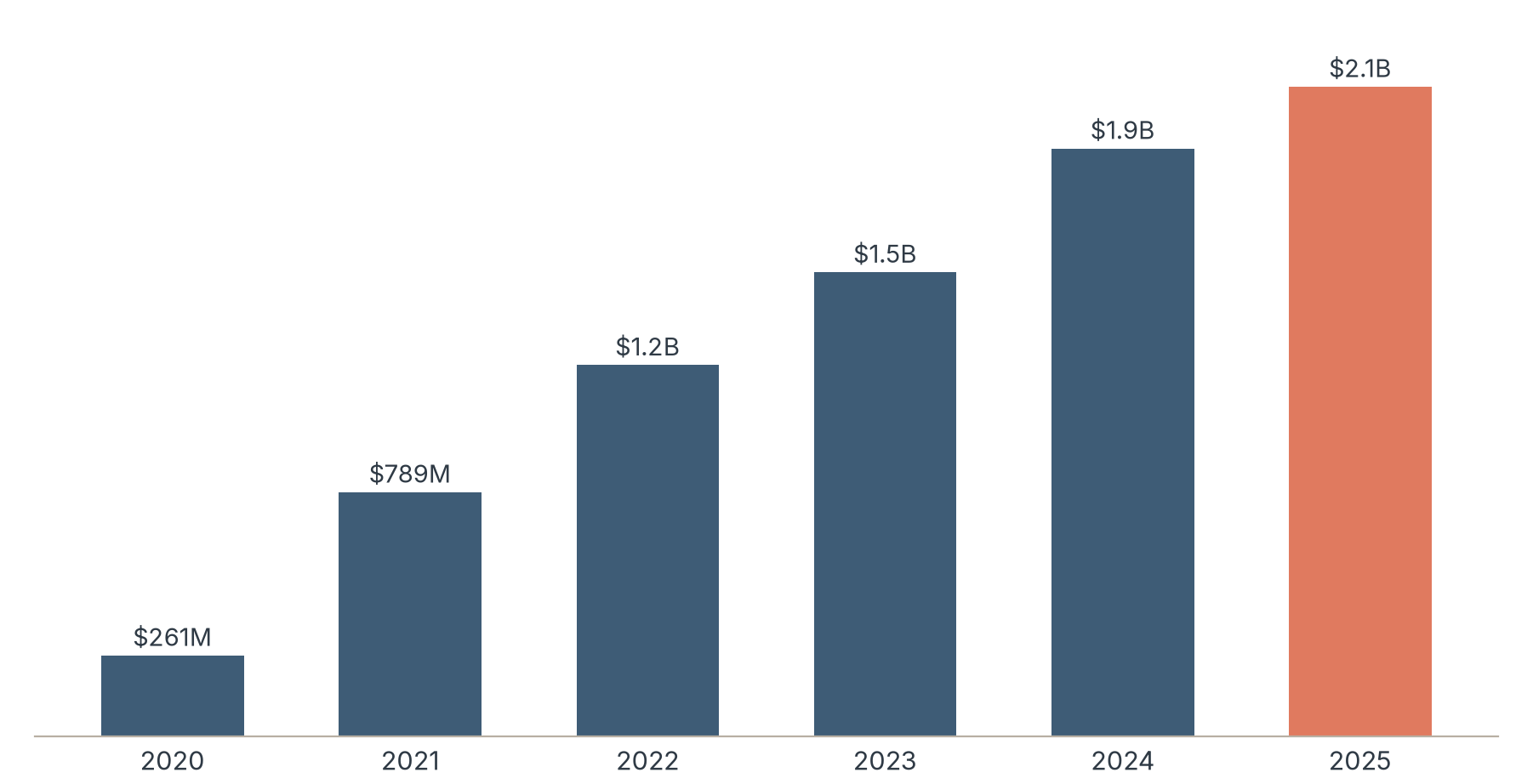
- Losses on scams that started on social media reached $2.1 billion in 2025, about eight times the 2020 level.
In July 2025, Sharon Brightwell of Dover, Florida, answered her phone and heard what she was sure was her daughter, crying after a car crash. A man posing as a public defender then asked for $15,000 in cash bail, which Brightwell withdrew from her bank and handed to a courier. The callers came back for $30,000 more before she reached her real daughter. She believes the voice was cloned with AI from social media clips, though the sheriff's office had not confirmed that. Federal data counts cases like hers only when victims mention AI.
In the following sections, we break down the FBI's first AI-related loss figures by crime type, the categories where impersonation drives losses, elder fraud, FTC impersonation and contact method data, federal warnings including FinCEN's deepfake alert, notable cases with dollar amounts, and insurer figures and projections.
What Federal Data Counts as AI or Deepfake Fraud
No US agency publishes a count of losses to deepfakes as such. The closest measure is a new IC3 descriptor for 2025, "AI Related," applied when a complaint mentions artificial intelligence. It depends on what victims write in their complaints, so it misses cases where victims did not know AI was involved. AI-linked investment losses passed $632 million, while all investment losses exceeded $8 billion, a sign that many victims do not realize AI was involved.
The FTC's Consumer Sentinel data has no AI field. Its imposter scam, contact method and age figures cover all impersonation and all fraud, whatever tools were used. We use them to show the size of the fraud categories that voice clones and fake video feed into, not as deepfake losses.
AI-Related Losses Reported to the FBI in 2025
The IC3 received 22,364 complaints with the AI Related descriptor in 2025, with adjusted losses of $893,346,472. That works out to an average of $39,946 per complaint and 4.3% of the $20.877 billion in all losses reported to the IC3 that year.
IC3 complaints and losses with the AI Related descriptor, 2025
| Crime type | Complaints | Losses |
|---|---|---|
| Investment | 4,356 | $632,041,188 |
| Business email compromise (BEC) | 135 | $30,256,592 |
| Tech/customer support | 574 | $19,457,078 |
| Confidence/romance | 626 | $19,041,653 |
| Personal data breach | 1,204 | $18,767,964 |
| Employment | 691 | $12,550,185 |
| Phishing/spoofing | 803 | $10,283,732 |
| Government impersonation | 260 | $7,061,628 |
| Extortion | 1,764 | $2,940,642 |
| All AI Related complaints | 22,364 | $893,346,472 |
AI-Related Losses Reported to the FBI by Crime Type, 2025
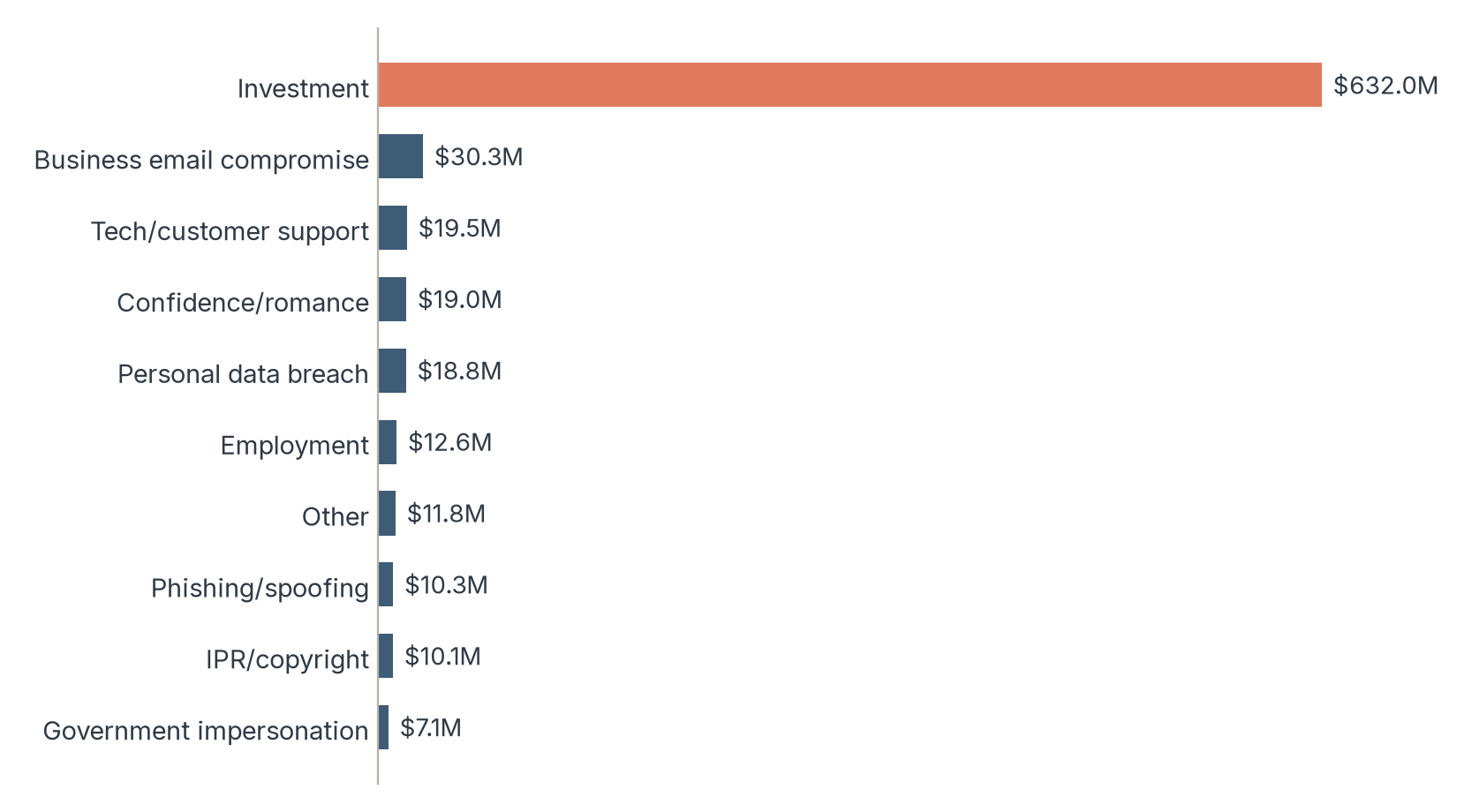
Scams that use cloned voices show up in the same report. Distress scams, in which "voice cloning technology is used to mimic the sound of a loved one in distress," produced reported losses of more than $5 million in 2025. These include grandparent scams and fall within the confidence/romance category, where AI-linked losses topped $19 million. Employment scams with an AI link, which include voice spoofing and possible voice deepfakes in online job interviews, cost victims almost $13 million.
Key Findings
- Investment fraud accounts for 71% of AI-related losses. Fake investment clubs use AI-generated videos and voices of celebrities, CEOs, or trusted figures to pitch fake opportunities.
- BEC drew only 135 AI-related complaints but the second-largest AI loss total. Scammers use chat generators to write emails that mimic a CEO, and cloned voices to request wire payments. Extortion shows the reverse pattern, with the second-most complaints and $2.9 million in losses.
- For fraud teams, the AI figure is a floor. It counts only complaints in which someone mentioned AI, in the first year the FBI tracked it.
FBI Losses in Impersonation-Heavy Categories, 2023 to 2025
AI tools show up most in a handful of IC3 crime types, and total losses in those categories, whether or not AI was reported, show how much money is at stake.
Total IC3 losses rose from $16.6 billion in 2024 to $20.877 billion in 2025, on 1,008,597 complaints. Cyber-enabled fraud made up $17.7 billion of the 2025 total.
IC3 losses by crime type, all complaints, and the AI-related share in 2025
| Crime type | 2023 | 2024 | 2025 | AI Related share of 2025 losses |
|---|---|---|---|---|
| Investment | $4,570,275,683 | $6,570,639,864 | $8,648,617,756 | 7.3% |
| BEC | $2,946,830,270 | $2,770,151,146 | $3,046,598,558 | 1.0% |
| Tech/customer support | $924,512,658 | $1,464,755,976 | $2,134,675,818 | 0.9% |
| Confidence/romance | $652,544,805 | $672,009,052 | $929,287,469 | 2.0% |
| Government impersonation | $394,050,518 | $405,624,084 | $797,943,193 | 0.9% |
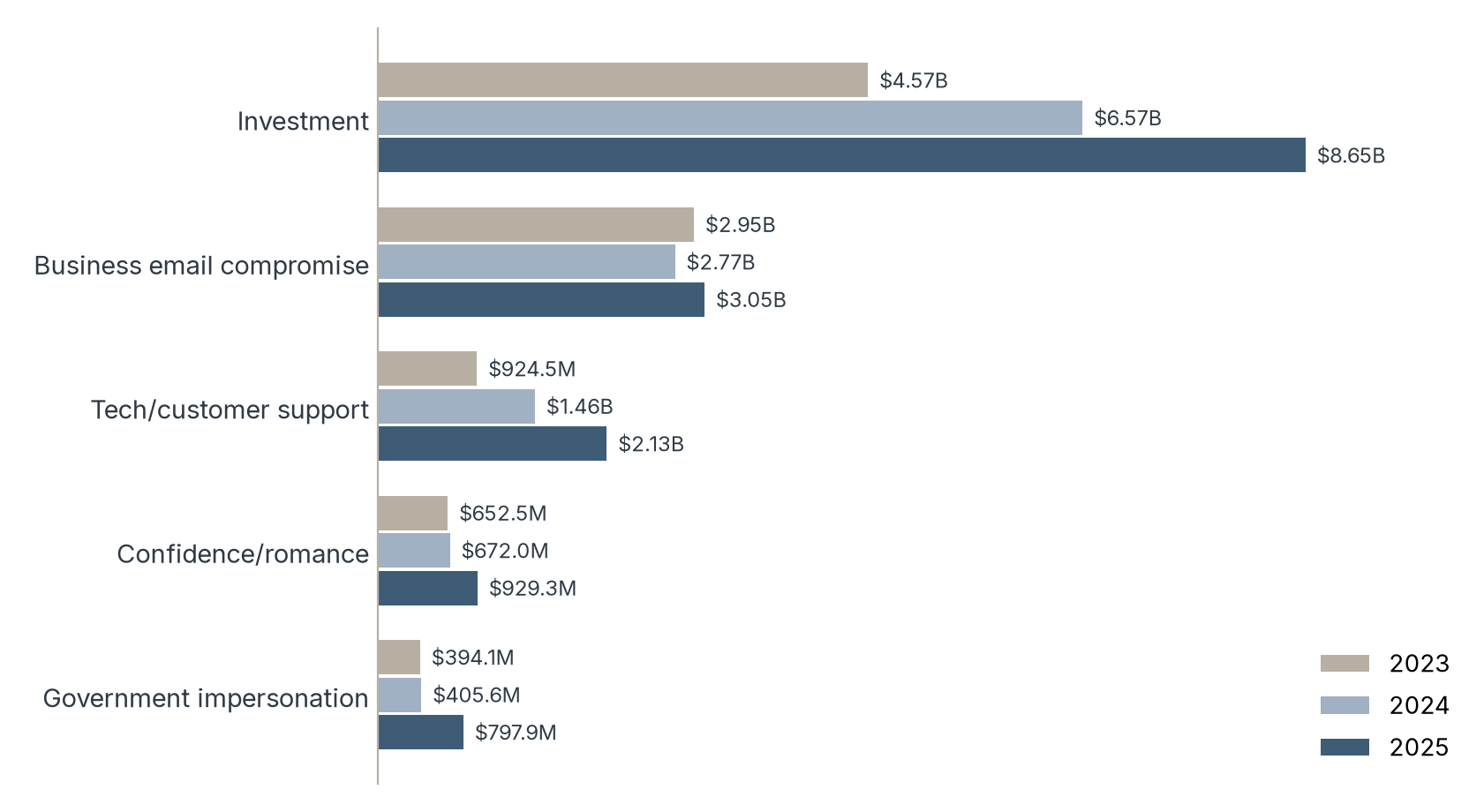
FBI IC3 Losses in Impersonation-Heavy Categories, 2023 to 2025
Key Findings
- Government impersonation losses nearly doubled from 2024 to 2025, up 97%, as complaints rose from 17,367 to 32,424. Tech support losses grew 131% from 2023 to 2025.
- BEC losses rose just 3% from 2023 to 2025, on 24,768 complaints in 2025. It is the one category in the table that did not grow sharply.
- For anyone reading AI loss claims, the AI share in every category is in single digits. The categories themselves are where the money is, and the FBI does not know how much of it involved synthetic media.
Elder Fraud and AI-Related Losses for Americans 60 and Older
People 60 and older filed 201,266 complaints in 2025, up 37% from 2024, and reported $7.748 billion in losses, up 59%. Their average loss was $38,500, and 12,444 of them lost more than $100,000.
IC3 complaints and losses for people aged 60 and older
| Measure | 2024 | 2025 |
|---|---|---|
| Complaints | 147,127 | 201,266 |
| Losses | $4.885 billion | $7.748 billion |
| Investment losses | n/a | $3,519,296,354 |
| Tech/customer support losses | n/a | $1,040,730,043 |
| BEC losses | $385,001,099 | $568,048,472 |
| Government impersonation losses | n/a | $413,206,251 |
| AI Related complaints | Not tracked | 3,143 |
| AI Related losses | Not tracked | $352,496,231 |
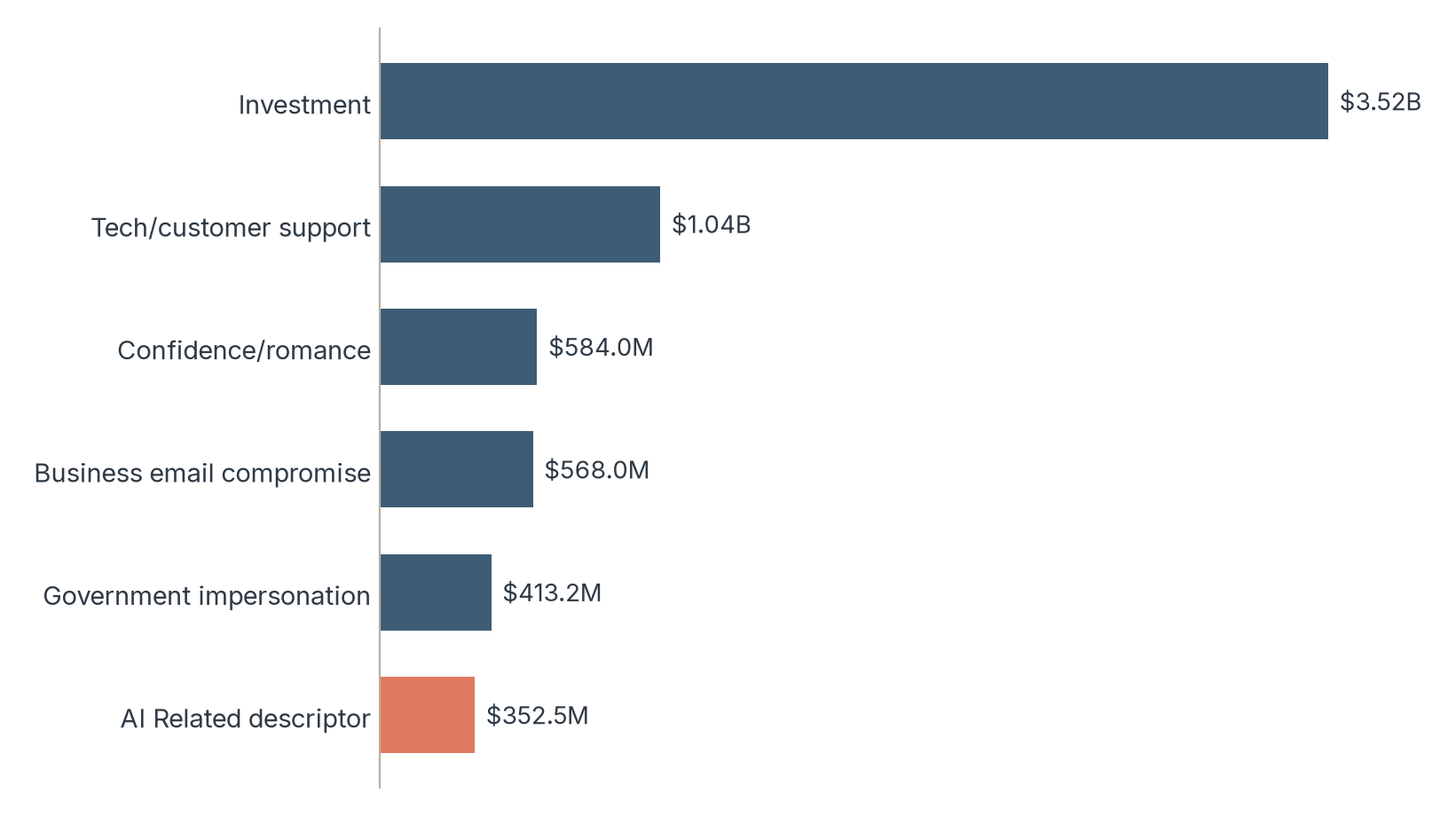
Losses Reported by Americans Aged 60 and Older by Crime Type, 2025
Key Findings
- People 60 and older account for 39% of all AI-related losses but 14% of AI-related complaints. Their AI-related losses averaged about $112,000 per complaint.
- Investment fraud makes up 45% of older adults' losses. Their BEC losses rose 48% from 2024.
- For families, the 60+ AI figure covers only cases where someone mentioned AI. The distress scam figure above is the one tied to cloned voices of relatives.
FTC Impersonation, Contact Method and Age Data
FTC Consumer Sentinel figures include all imposter scams and all fraud, with no AI field, so they show the size of the categories deepfakes feed into.
Consumers reported $15.9 billion in fraud losses to the FTC in 2025 on 3 million reports, up from more than $12 billion on 2.6 million reports in 2024. Reported losses have risen nearly 430% since 2020.
FTC Consumer Sentinel fraud and imposter figures, 2024 and 2025
| Measure | 2024 | 2025 |
|---|---|---|
| All reported fraud losses | More than $12 billion | $15.9 billion |
| Fraud reports | 2.6 million | 3 million |
| Imposter scam losses | n/a | More than $3.5 billion |
| Business impersonator losses | $866 million | Nearly $1 billion |
| Government impersonator losses | $789 million | About $920 million |
| Investment scam losses | n/a | $7.9 billion |
| Losses on scams that started on social media | $1.9 billion | $2.1 billion |
Reported Fraud Losses on Scams That Started on Social Media, 2020 to 2025
The FTC's latest loss figures by age are for 2024. People 60 and older reported nearly $2.4 billion in losses that year, up from about $600 million in 2020, and their median loss was $900. For people 80 and older the median was $1,650.
Key Findings
- Imposter scams were the most reported fraud type, nearly 1 in 3 reports, and losses to them have nearly tripled since 2020. Bank impersonators produced the highest losses among business imposters.
- In 2025, website or app was the contact method on 31% of loss reports, social media 28%, phone calls 11%, email 10%, and text 7%.
- Social media losses grew about eightfold from 2020 to 2025. Investment scams took $1.1 billion of the 2025 social media total, and romance scams $298 million.
- For anyone screening payments, the channel changes the risk. In 2024, older adults' median loss on phone fraud was $2,210, against $650 on scams that began on social media.
FBI Warnings and the FinCEN Deepfake Alert
Federal agencies have issued five warnings on AI-generated voice, video, and images since late 2024.
Federal alerts on deepfake and AI-enabled fraud
| Date | Agency and number | Subject |
|---|---|---|
| Nov. 13, 2024 | FinCEN, FIN-2024-Alert004 | Deepfake media used to defeat identity checks at financial institutions |
| Dec. 3, 2024 | FBI, I-120324-PSA | Criminals using generative AI text, images, voice and video for fraud |
| May 15, 2025 | FBI, I-051525-PSA | AI-generated voice messages impersonating senior US officials since April 2025 |
| Dec. 5, 2025 | FBI, I-120525-PSA | Altered proof-of-life photos and videos in virtual kidnapping scams |
| Dec. 19, 2025 | FBI, I-121925-PSA | Update: official impersonation activity dating back to 2023 |
Key Findings
- None of the four FBI announcements gives a dollar loss. The only FBI loss figures for AI-linked fraud are in the annual report.
- FinCEN saw an increase from 2023 into 2024 in suspicious activity reports (SARs) describing suspected deepfake media, often fake identity documents used to open accounts. It asked banks to tag such reports with the key term "FIN-2024-DEEPFAKEFRAUD" but did not publish a SAR count.
- For compliance teams, the alert's red flags include photos inconsistent with a customer's date of birth, third-party webcam plugins during live checks and images that match galleries of AI-generated faces.
Notable Deepfake and Voice Clone Cases
Three cases with published dollar amounts show how these scams play out, US cases first.
Cases with reported losses
| Case | Year | Amount | AI role |
|---|---|---|---|
| Sharon Brightwell, Dover, Florida | 2025 | $15,000 lost; $30,000 more demanded | Victim believes daughter's voice was cloned; not confirmed by police |
| Montreal call centers, Vermont federal indictment | 2021 to 2024 | More than $21 million from elderly victims in 40+ states | Grandparent scam by live callers; no AI alleged |
| Arup, Hong Kong office | 2024 | HK$200 million, about $25.6 million, in 15 transfers | Deepfake video call of the CFO and colleagues, confirmed by Arup |
Key Findings
- The Vermont case shows the scale of grandparent scams without AI: 25 Canadian nationals were charged in March 2025. The indictment describes callers posing as grandchildren and attorneys, and couriers collecting cash, the same script used in the Brightwell case.
- Arup is the largest confirmed deepfake loss in this report, and it happened outside the US. The worker joined a video call with recreations of the chief financial officer and other staff and then sent the money.
- No US company has publicly confirmed a dollar loss to a voice clone of its CEO, so the FBI's $30.3 million in AI-linked BEC losses is the only US measure for that kind of scam.
Insurer Claims and Industry Projections
At Coalition, a cyber insurer with more than 100,000 policyholders in five countries, funds transfer fraud made up 27% of 2025 claims, with an average loss of $141,000. BEC claims averaged $27,000. These figures cover all such claims and do not separate deepfakes.
Deloitte's Center for Financial Services projects that generative AI could push US fraud losses to $40 billion by 2027, from $12.3 billion in 2023, a 32% annual growth rate. This is a projection built from Deloitte's risk scores for IC3 crime types, not reported losses.
The FTC also estimates that, adjusting for underreporting, overall fraud could have cost consumers as much as $195.9 billion in 2024, with a conservative estimate of $31.3 billion. These are FTC model estimates for all fraud.
What Deepfake Fraud Loss Figures Mean for Consumers and Businesses
The first federal count puts reported AI-linked fraud losses at $893.3 million in 2025, most of it in investment scams. That is a small share of the $20.9 billion reported to the IC3 and the $15.9 billion reported to the FTC. The gap reflects how the data is collected as much as how fraud works: a voice clone or fake video only shows up in the data when the victim knows to mention it.
The broader figures show where synthetic media has room to grow. Government impersonation losses at the IC3 nearly doubled in a year, imposter scams cost FTC reporters more than $3.5 billion, and older adults reported $7.7 billion in losses to the IC3. FinCEN has a SAR tag for deepfakes but has published no count, and the FBI's warnings describe methods, not losses.
So if you are tracking deepfake fraud, cite the IC3's AI Related figures as a reported minimum, label FTC imposter totals as all impersonation, and treat any figure above those as an estimate or projection.
Methodology
Scope. We compiled published US loss figures for fraud involving AI-generated voice, video, images, or text, plus the broader impersonation and fraud totals they sit within, for 2023 to 2025. Arup is included as non-US context. All amounts are in US dollars as reported; the Arup amount is the published conversion of HK$200 million.
AI versus all fraud. Only the IC3's AI Related descriptor measures AI-linked losses. It is applied when a complaint mentions AI, overlaps with crime types, and was new in 2025, so it has no prior years. FTC figures, IC3 crime type totals, and Coalition claims figures cover all fraud of each type. The Deloitte figure is a projection and the FTC's underreporting figures are model estimates; neither is a reported loss.
Calculations. Shares, averages, and growth rates are our calculations from the reported figures. IC3 losses are adjusted losses as published. The FTC's latest age breakdown is for 2024. FinCEN has published no count of deepfake-tagged SARs.
Sources
- AI Industry Reviews analysis of US deepfake and AI-enabled fraud losses, from FBI IC3 annual reports, FTC Consumer Sentinel releases, FinCEN and federal law enforcement releases, insurer reports, and press accounts, 2023 to 2025 data, conducted November 2026.
- FBI Internet Crime Complaint Center, "2025 Internet Crime Report." ic3.gov
- FBI Internet Crime Complaint Center, "2024 Internet Crime Report." ic3.gov
- FBI, "Criminals Use Generative Artificial Intelligence to Facilitate Financial Fraud," I-120324-PSA, Dec 3, 2024. ic3.gov
- FBI, "Senior US Officials Impersonated in Malicious Messaging Campaign," I-051525-PSA, May 15, 2025. ic3.gov
- FBI, "Criminals Using Altered Proof-of-Life Media to Extort Victims in Virtual Kidnapping for Ransom Scams," I-120525-PSA, Dec 5, 2025. ic3.gov
- FBI, "Senior U.S. Officials Continue to be Impersonated in Malicious Messaging Campaign," I-121925-PSA, Dec 19, 2025. ic3.gov
- FTC, testimony before the Joint Economic Committee, "Hearing on the Rising Scam Economy," Mar 2026. ftc.gov
- FTC, "FTC Data Show People Reported Losing $3.5 Billion to Imposter Scams in 2025," Jun 15, 2026. ftc.gov
- FTC Data Spotlight, "Reported losses to scams on social media eight times higher than in 2020," Apr 27, 2026. ftc.gov
- FTC, "Protecting Older Consumers 2024-2025," Dec 1, 2025. ftc.gov
- FinCEN, "FinCEN Alert on Fraud Schemes Involving Deepfake Media Targeting Financial Institutions," FIN-2024-Alert004, Nov 13, 2024. fincen.gov
- FOX 13 Tampa Bay, "Dover woman loses $15K after scammers used artificial intelligence to impersonate daughter," Jul 17, 2025. fox13news.com
- US Immigration and Customs Enforcement, "25 Canadian nationals connected to nationwide multi-million dollar 'grandparent scam' charged in Vermont," Mar 5, 2025. ice.gov
- CNN, "British engineering giant Arup revealed as $25 million deepfake scam victim," May 16, 2024. cnn.com
- Deloitte Insights, "Generative AI is expected to magnify the risk of deepfakes and other fraud in banking," May 29, 2024. deloitte.com
- Coalition, "Coalition's 2026 Cyber Claims Report Finds Initial Ransom Demands Surged 47% But Most Businesses Refuse to Pay," Mar 5, 2026. coalitioninc.com