
Home / Research / Data Center Air Permit Statistics
Market research · October 28, 2026
Data Center Air Permit Statistics: 2026 Report
 By Darin ten Bruggencate, Founder, AI Industry Reviews
Our analysts reviewed 479 data center air facility records from the EPA's national compliance database and 194 air permit records from Virginia's Department of Environmental Quality, plus state agency presentations and news investigations from 2025 and 2026, to understand how data center air permits stand as of Q4 2026.
Key Findings
- EPA's compliance database lists 403 active data center air facilities as of October 2026, and Virginia holds 125 of them, or 31% [1].
- Virginia's list shows 45 data center air permit records dated 2026 through September, up from 11 in 2022 [2].
- Virginia's State Corporation Commission counted 13,767 permitted data center generator sets with 33,132 megawatts (MW) of capacity in its 2026 report, and 81% of that capacity is Tier 2 or earlier [3].
- Data centers emitted 842.3 tons of nitrogen oxides (NOx) in Loudoun County in 2025, 14% of the county total [4].
- EPA records show $482,389 in air penalties at 21 data center facilities over five years, and 82% of it was assessed in Virginia [1].
Data centers keep rows of diesel or gas-fired generators on site to carry the load through a power failure, and the AI build-out has made both the generators and the sites that house them larger. Virginia's air regulator describes data centers of the early 2000s with about 25 generators of 1.75 MW each and current ones with about 100 generators of 2.5 to 3 MW [5]. Some AI campuses now generate their own power with gas turbines. The permits that cover all of this sit in separate federal, state, and county files, so no single list shows the whole picture.
We downloaded every facility that EPA's Enforcement and Compliance History Online (ECHO) database codes under NAICS 518210, data processing, hosting, and related services, and counted the active ones by state, permit class, federal engine rule, violation status, enforcement action, and penalty. We copied each record on Virginia's list of air permits issued to data centers and counted them by year, county, and operator. We added generator counts, emission limits, and permit details from state agency reports and news investigations, each cited where it appears.
In the following sections, we compare active data center air facilities by state, permit class, and federal rule, Virginia permit records by year and county, Virginia generator capacity by emissions tier, data center NOx in Loudoun County, engine and turbine counts in notable permits, generator counts in Texas and Georgia, run-hour and emission-rate rules, ECHO penalties, state enforcement outside ECHO, and recent federal rule changes.
Virginia Holds 31% of Active Data Center Air Facilities in EPA Records
This section shows where regulated data center air facilities are located, using the facility records in EPA's national compliance database.
ECHO holds 479 records under the data center industry code. Of these, 403 are active (401 operating and 2 temporarily closed), 35 are permanently closed, 23 are planned or under construction, and 18 carry no operating status. The table ranks states by active facilities and shows how many are major sources and how many have had a violation reported in the past three years.
Active data center air facilities by state, 16 largest states
| State | Active facilities | Share of 403 | Major sources | Facilities with a violation, past 3 years |
|---|---|---|---|---|
| Virginia | 125 | 31% | 2 | 13 |
| Illinois | 27 | 7% | 4 | 1 |
| Ohio | 23 | 6% | 9 | 2 |
| Colorado | 21 | 5% | 2 | 2 |
| Nebraska | 18 | 4% | 2 | 2 |
| Iowa | 16 | 4% | 4 | 2 |
| Pennsylvania | 15 | 4% | 0 | 7 |
| Arizona | 15 | 4% | 0 | 5 |
| Texas | 12 | 3% | 12 | 1 |
| Minnesota | 12 | 3% | 0 | 0 |
| Georgia | 11 | 3% | 1 | 2 |
| Maryland | 10 | 2% | 0 | 0 |
| New Jersey | 10 | 2% | 0 | 0 |
| Indiana | 9 | 2% | 5 | 2 |
| North Carolina | 9 | 2% | 2 | 1 |
| Tennessee | 9 | 2% | 1 | 1 |
Source: AI Industry Reviews analysis of EPA ECHO air facility records for NAICS code 518210, October 2026 [1]. Indiana, North Carolina, and Tennessee tie at 9 active facilities.
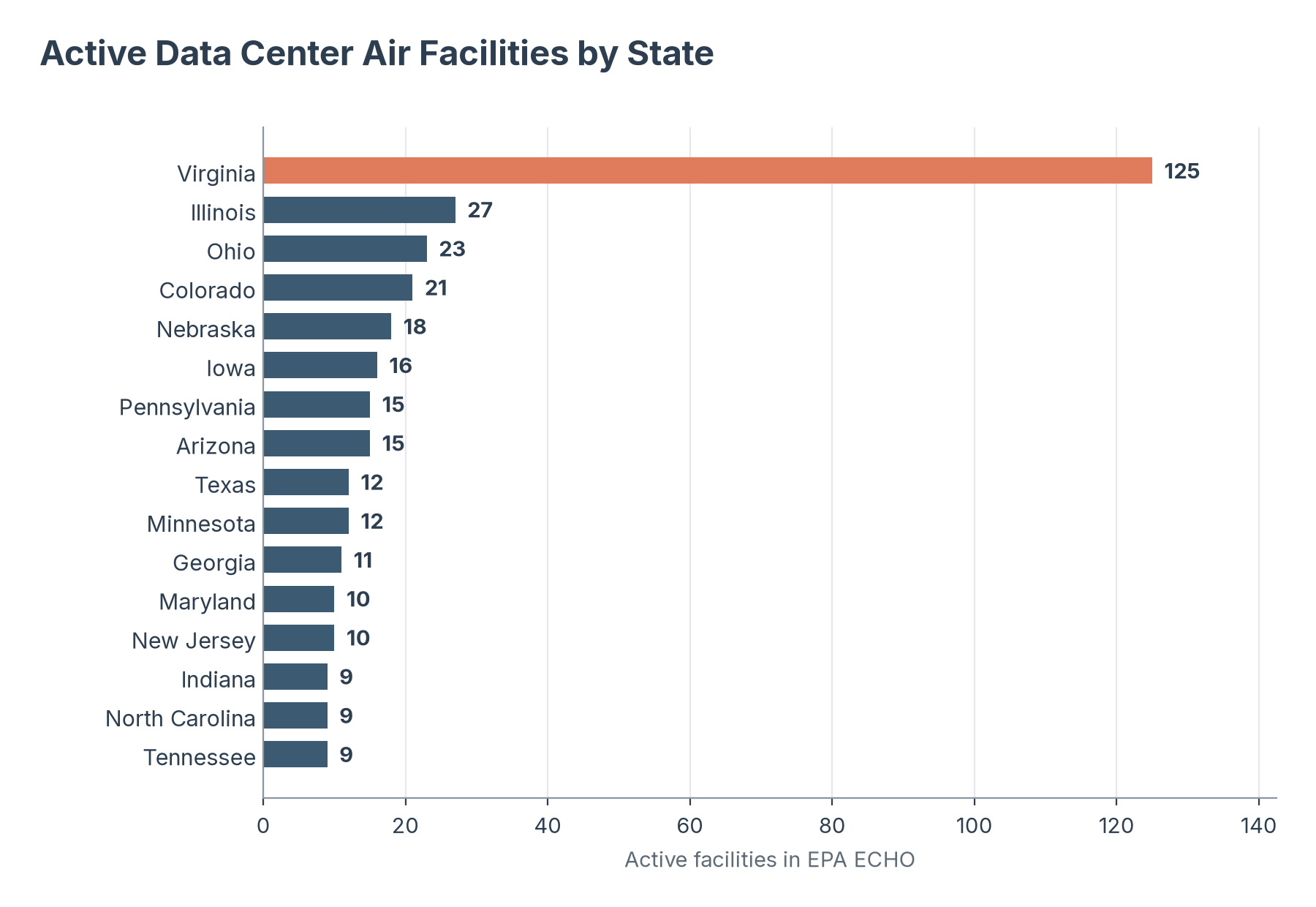
Source: AI Industry Reviews analysis of EPA ECHO air facility records for NAICS code 518210, October 2026 [1].
Key Findings
- Virginia has more than four times as many active facilities as Illinois, the next state with 27 [1]. The Texas Tribune reports that Texas, with roughly 300 operating data centers, is expected to pass Virginia as the leading data center market by 2030 [6].
- ECHO's Texas count is smaller than the permit tallies. It lists 12 active Texas facilities, while a Floodlight analysis found at least 38 Texas data centers that received minor permits for on-site power sources since 2024 [6].
- Georgia shows a similar gap. Georgia's Environmental Protection Division estimated 165 data centers operating in the state in March 2026, of which 16 held air permits and 149 were permit exempt [7], against 11 Georgia facilities in ECHO [1].
Over Half of Active Data Center Air Facilities Hold Synthetic Minor Status
This section looks at how regulators classify data center air facilities and which federal engine and turbine rules apply to them, using the classification and rule fields in EPA's records.
Classification sets how much review a facility gets before it builds. Major sources face the most review, with thresholds such as 100 or 250 tons per year of a pollutant depending on the area [6]. ECHO treats major, 80% synthetic minor, and synthetic minor facilities as federally reportable classes [8].
Permit class and federal rules, 403 active data center air facilities
| Measure | Facilities | Share of 403 |
|---|---|---|
| 80% synthetic minor | 165 | 41% |
| Minor | 121 | 30% |
| Major source | 55 | 14% |
| Synthetic minor | 47 | 12% |
| Other or unclassified | 15 | 4% |
| Title V operating permit program | 39 | 10% |
| NSPS Subpart IIII (diesel engines) | 144 | 36% |
| NESHAP Subpart ZZZZ (engine air toxics) | 86 | 21% |
| NSPS Subpart IIII or ZZZZ | 156 | 39% |
| NSPS Subpart JJJJ (spark-ignition engines) | 11 | 3% |
| NSPS Subpart KKKK or GG (combustion turbines) | 5 | 1% |
Source: AI Industry Reviews analysis of EPA ECHO air facility records for NAICS code 518210, October 2026 [1]. NSPS is New Source Performance Standards and NESHAP is National Emission Standards for Hazardous Air Pollutants.
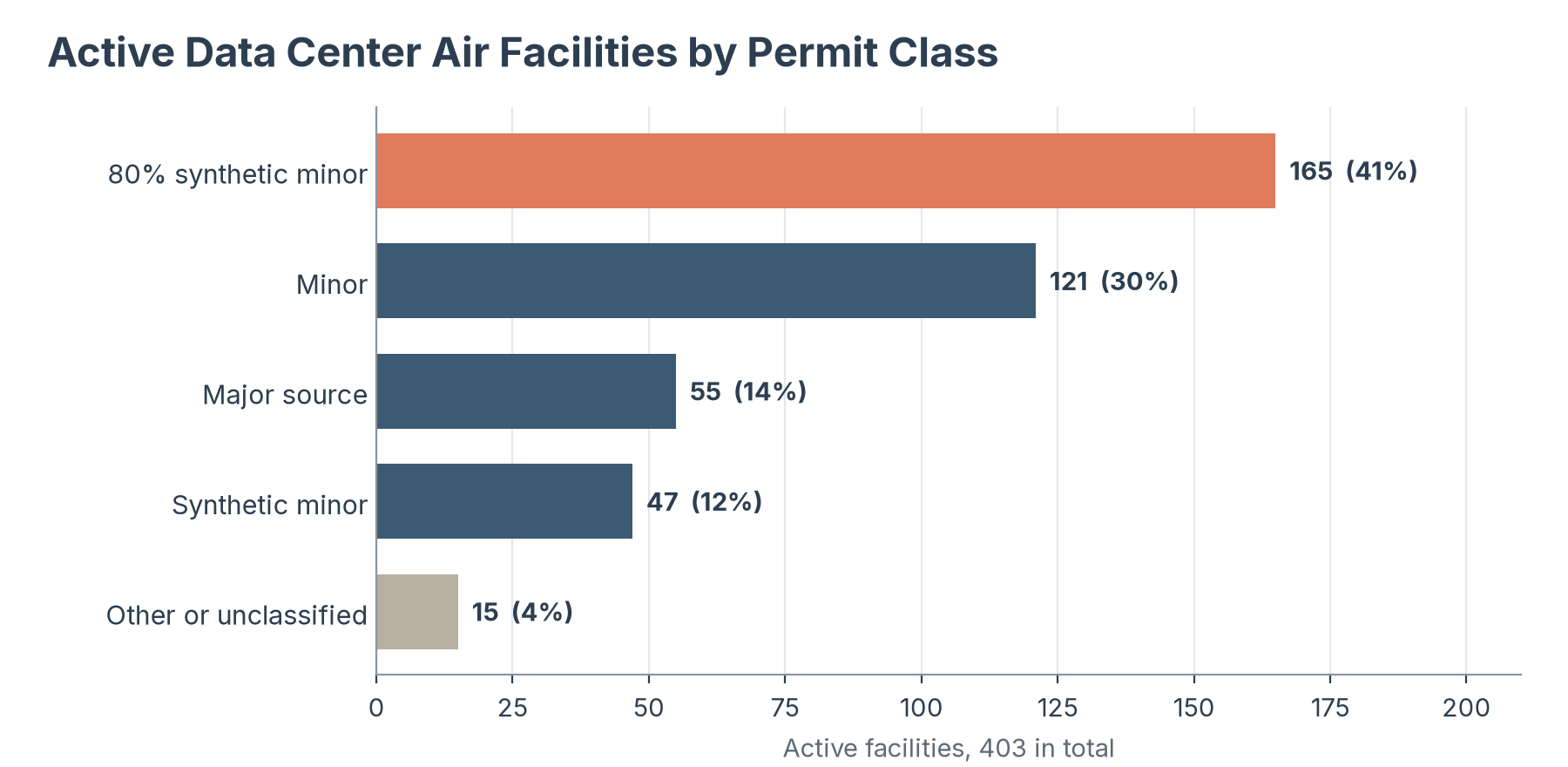
Source: AI Industry Reviews analysis of EPA ECHO air facility records for NAICS code 518210, October 2026 [1].
Key Findings
- Synthetic minor and 80% synthetic minor facilities number 212, or 53% of active facilities, while 55, or 14%, are major sources [1].
- The engine rules reach 156 facilities, or 39%, against 5 under the turbine standards, one of which is the Colossus data center in Memphis, Tennessee [1].
- Major-source status varies by state. All 12 active Texas facilities and 9 of 23 in Ohio are major sources, against 2 of 125 in Virginia [1].
Virginia Data Center Air Permit Records Reached 45 in 2026, up From 11 in 2022
This section tracks when Virginia has issued data center air permits, using the state environmental agency's public list of permits issued to data centers.
The list holds 194 records as of October 2026, each with a permit type, county, and issuance date. The table groups the records by the year of issuance, and the county table follows in the next section.
Virginia data center air permit records by year of issuance
| Year | Permit records | Share of 194 |
|---|---|---|
| 2000 to 2021 | 60 | 31% |
| 2022 | 11 | 6% |
| 2023 | 16 | 8% |
| 2024 | 28 | 14% |
| 2025 | 34 | 18% |
| 2026 (through September 29) | 45 | 23% |
| Total | 194 | 100% |
Source: AI Industry Reviews analysis of the Virginia DEQ list of air permits issued to data centers, as of October 2026 [2]. Dates are the permit issuance dates DEQ lists.
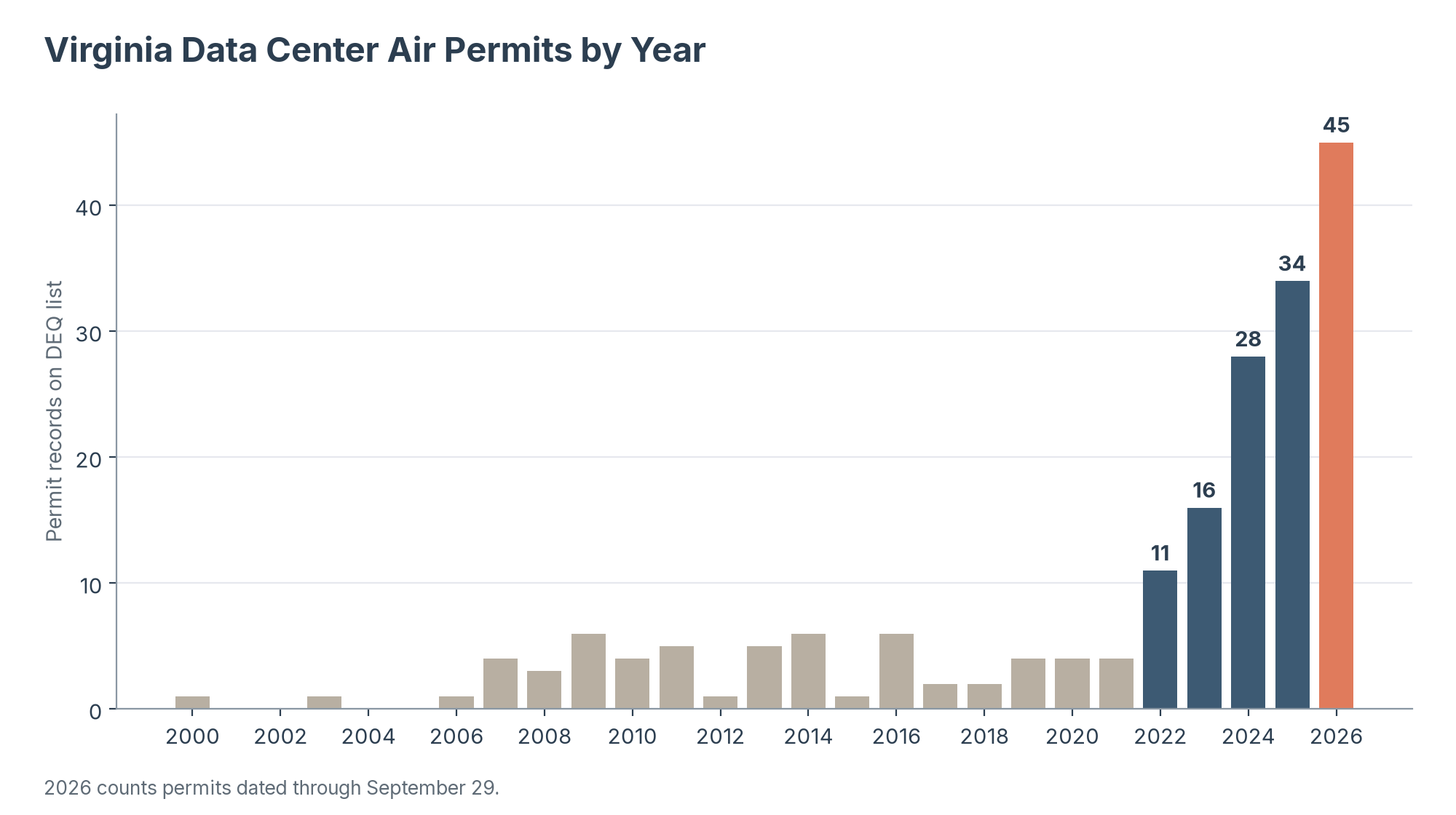
Source: AI Industry Reviews analysis of the Virginia DEQ list of air permits issued to data centers, as of October 2026 [2].
Key Findings
- Records dated 2024 through 2026 total 107, or 55% of the 194, and the 2026 count has already passed every full prior year [2].
- Amazon holds 54 of the records and Microsoft holds 15, together 69, or 36% [2].
- Of the 194 records, 186 are Article 6 minor new source review (mNSR) permits, 6 are Article 5 state operating permits, and 2 are Article 1 Title V permits [2].
Three Northern Virginia Jurisdictions Hold 77% of Virginia Data Center Air Permit Records
This section shows where in Virginia the data center air permits sit, using the county or city field on the same state list.
Virginia data center air permit records by county
| County or city | Permit records | Share of 194 |
|---|---|---|
| Loudoun | 91 | 47% |
| Fairfax | 29 | 15% |
| Prince William | 29 | 15% |
| Mecklenburg | 11 | 6% |
| Henrico | 8 | 4% |
| Other jurisdictions (14) | 26 | 13% |
| Total | 194 | 100% |
Source: AI Industry Reviews analysis of the Virginia DEQ list of air permits issued to data centers, as of October 2026 [2]. Manassas City and other independent cities are counted separately from the surrounding counties.
Key Findings
- Loudoun, Fairfax, and Prince William counties hold 149 of the 194 records, or 77%, and Loudoun alone holds 91, or 47% [2].
- Mecklenburg County in southern Virginia has 11 records, ahead of Henrico County near Richmond with 8 [2].
- The list includes 14 jurisdictions with 1 to 4 records each, including Culpeper, Fauquier, Spotsylvania, Stafford, Louisa, and Caroline [2].
Three of Four Virginia Data Center Generator Sets Are Tier 2 or Earlier
This section looks at the generator fleet behind Virginia's data center permits, using the report that the General Assembly required of the State Corporation Commission staff on data center electricity, water, and generators.
The report splits permitted generator sets by emissions tier. Tier 4 and Tier 4-equivalent units carry controls that cut NOx, while Tier 2 and earlier units do not. We summed the two tiers to reach the totals in the table.
Virginia data center generator sets by emissions tier
| Tier | Generator sets | Share of sets | Capacity (MW) | Share of capacity |
|---|---|---|---|---|
| Tier 2 or earlier | 10,290 | 75% | 26,718 | 81% |
| Tier 4 or Tier 4-equivalent | 3,477 | 25% | 6,414 | 19% |
| Total | 13,767 | 100% | 33,132 | 100% |
Source: Virginia State Corporation Commission staff, report to the General Assembly (RD637, 2026) [3]; totals and shares are AI Industry Reviews calculations.
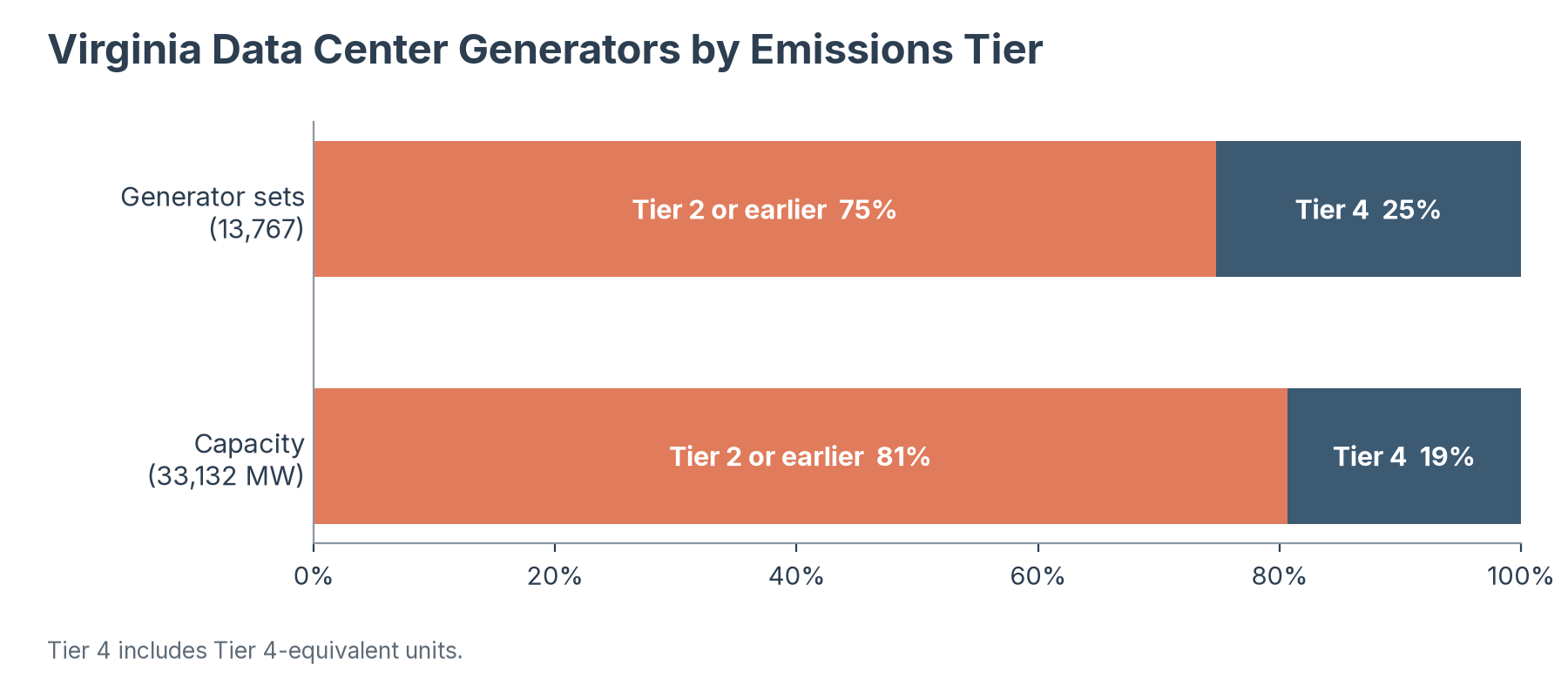
Source: Virginia State Corporation Commission staff, report to the General Assembly (RD637, 2026) [3].
Key Findings
- Permitted generator capacity of 33,132 MW is about 1.5 times the 21,791 MW of contracted data center demand, the sum of five utilities' figures in the same SCC report [3]. The two figures measure different things, backup capacity and contracted load.
- Sites have grown. DEQ describes about 60 MW and 25 generators per data center in the early 2000s, and 200 to 300 MW and about 100 generators now, with 1,750 MW the largest proposal [5].
- Virginia now requires Tier 4-equivalent or better for new data center generators, under DEQ guidance effective April 9, 2026 and a law effective July 1, 2026 [4][2].
Data Centers Emitted 14% of Loudoun County's NOx in 2025
This section shows how much of one county's air pollution comes from data centers, using DEQ's 2025 emissions inventory for Loudoun County, the county with the most data center air permit records in Virginia.
Loudoun County NOx emissions by source, 2025
| Source | NOx (tons per year) | Share of county NOx |
|---|---|---|
| Dulles Airport | 1,872.5 | 32% |
| On-road vehicles | 1,059.5 | 18% |
| Non-point fuel combustion | 979.5 | 17% |
| Data centers | 842.3 | 14% |
| Non-road equipment | 624.0 | 11% |
| Non-point agriculture | 276.8 | 5% |
| Non-point other | 76.6 | 1% |
| Potomac Energy Center | 71.5 | 1% |
| Other point sources | 67.8 | 1% |
| County total | 5,871 | 100% |
Source: Virginia DEQ, Data Center Presentation to the Joint Subcommittee on Tax Policy (August 19, 2026) [4].
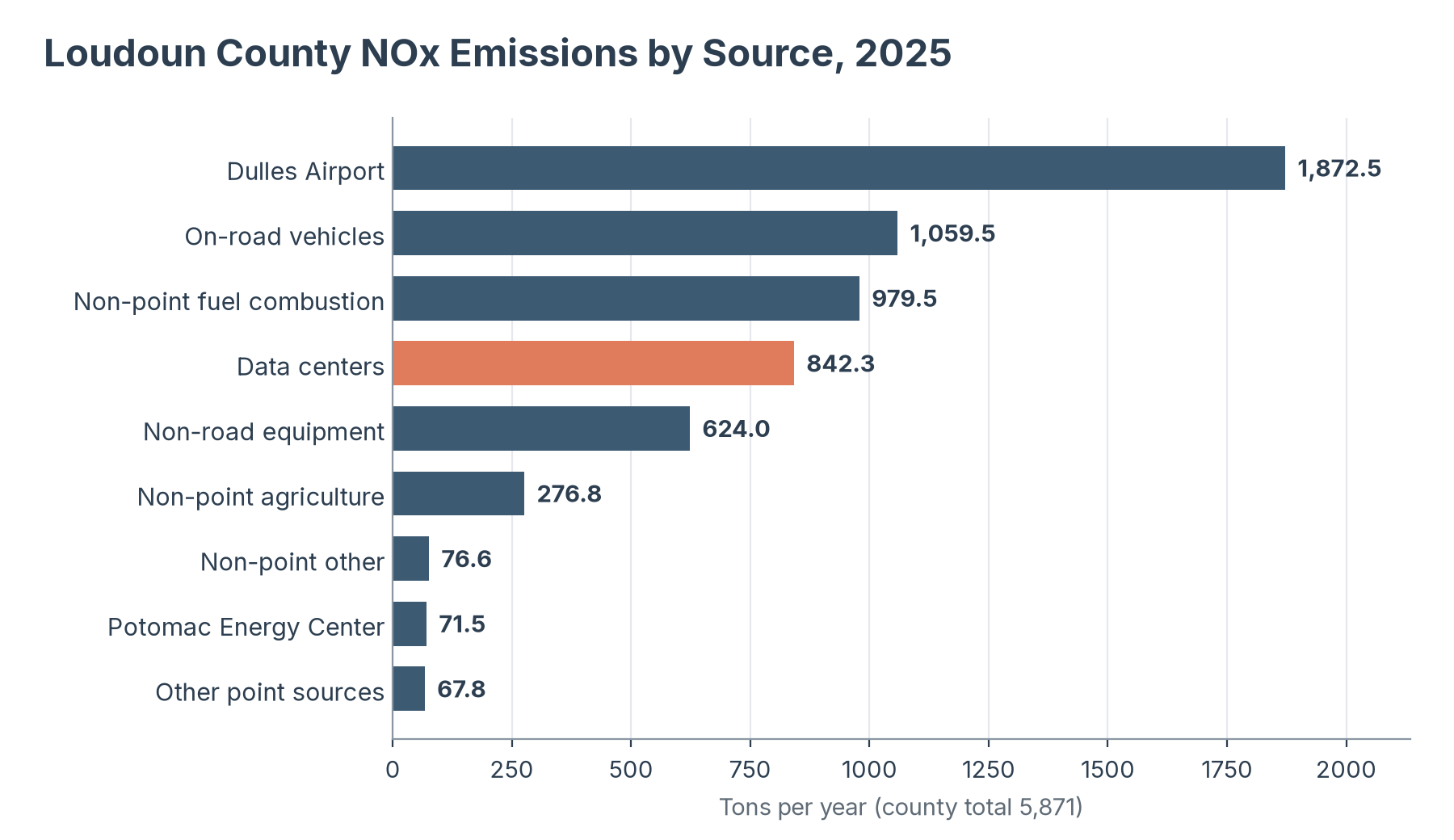
Source: Virginia DEQ, Data Center Presentation to the Joint Subcommittee on Tax Policy (August 19, 2026) [4].
Key Findings
- Data centers were the fourth-largest NOx source in Loudoun County, behind Dulles Airport, on-road vehicles, and non-point fuel combustion, and ahead of all non-road equipment [4].
- For fine particles the share is smaller. Data centers emitted 68.1 tons of PM2.5, 3% of the county total [4].
- DEQ has contracted for an online database where data centers report generator use and the public can build emission scenarios, with delivery estimated for January 2027 [4].
Single Data Center Permits Cover Up to 231 Engines or Turbines
This section collects the largest single-site permits and applications that state agencies and news investigations have reported, to show how many engines or turbines one campus can now be permitted to run.
The table lists each site with the equipment in its permit or application and the permit status the source gives. Coral bars in the chart mark gas turbines or gas generators, and slate bars mark diesel generators.
Engines and turbines in notable data center permit records
| Site | State | Equipment | Permit status |
|---|---|---|---|
| Georgia EPD permit case 1 | GA | 231 diesel emergency generators, 1.0 to 2.25 MW each | Case study in Georgia EPD permit review; facility-wide NOx limit 199.8 tons per year [7] |
| QTS Fayetteville | GA | 205 diesel generators | Approved in 2023 [9] |
| Project Pegasus | GA | 180 diesel generators | Permits dated May 2026 [9] |
| VoltaGrid for Serverfarm, Covington | GA | 33 gas generators (90 MW), plus 37 diesel backup generators in a separate application | Behind-the-meter power permitted; backup generators applied for [9] |
| xAI Colossus, Memphis | TN | 15 Solar SMT-130 gas turbines, up to 247 MW | Permit issued by the Shelby County Health Department, July 2, 2025 [10] |
| xAI and MZX Tech, Southaven | MS | 41 permanent gas turbines | PSD permit approved by the state permit board, March 2026 [11] |
| xAI and MZX Tech, Southaven | MS | 69 temporary mobile gas turbines | No air permit; state order sets retirement dates through July 14, 2027 [12] |
| Stargate, Abilene | TX | 10 gas turbines and 62 diesel generators built; 41 more turbines and 18 more generators sought | Minor permits obtained in 2024; major air permit applied for [6] |
| CyrusOne, Whitney | TX | Hundreds of generators, estimated 249.1 tons per year of NOx | Permit to operate issued [6] |
Source: Georgia EPD (April 2026) [7]; Georgia Public Broadcasting (August 5, 2026) [9]; TechCrunch (July 3, 2025) [10]; Mississippi Today (March 10 and July 31, 2026) [11][12]; Texas Tribune and Floodlight (July 9, 2026) [6].
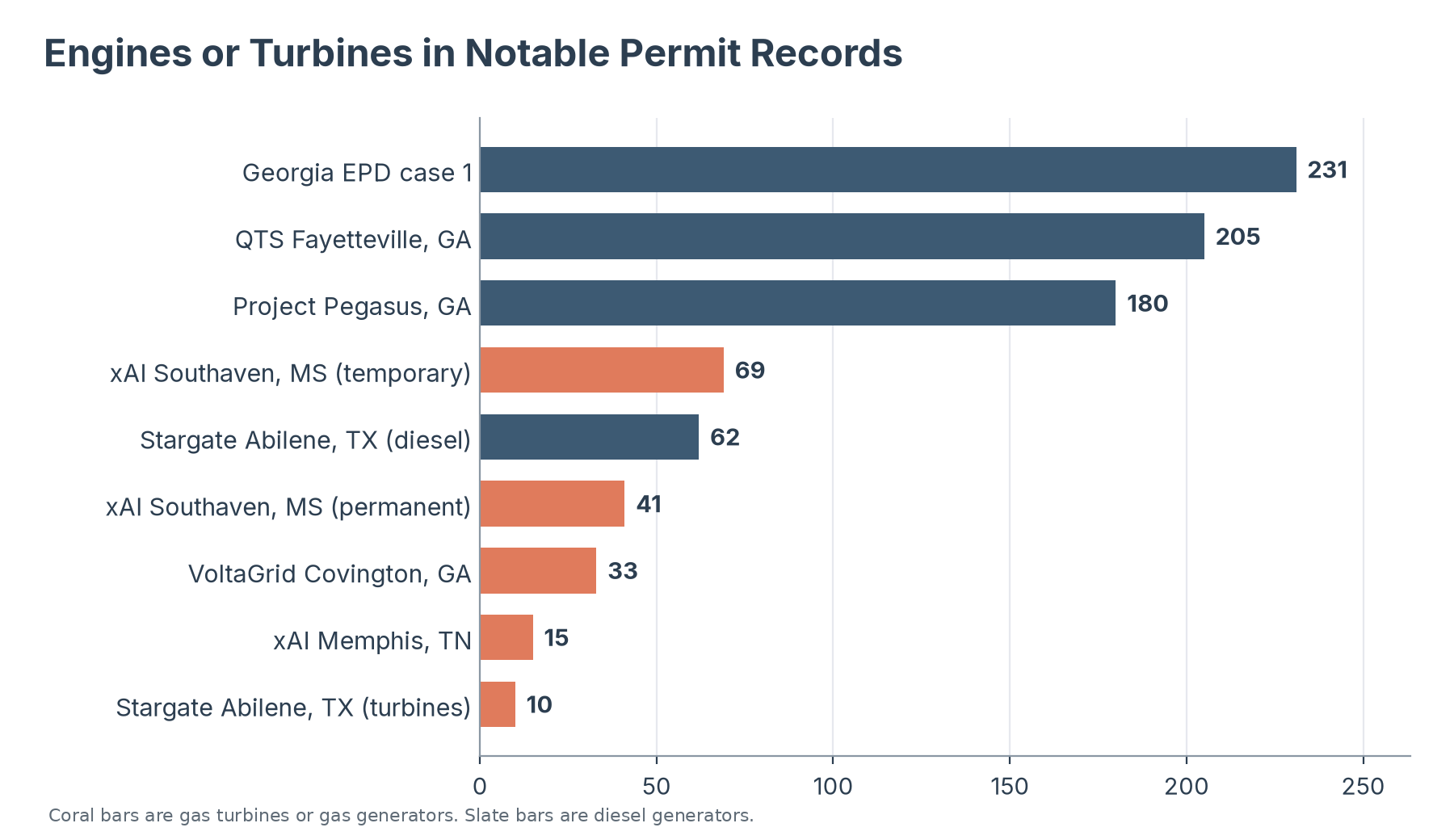
Source: Georgia EPD [7]; Georgia Public Broadcasting [9]; TechCrunch [10]; Mississippi Today [11][12]; Texas Tribune and Floodlight [6].
Key Findings
- xAI's Memphis permit allows up to 87 tons of NOx and 9.8 tons of formaldehyde on a rolling 12-month basis, and the Southern Environmental Law Center said xAI had operated as many as 35 generators there without permits [10].
- Some permits sit just under review thresholds. CyrusOne's Whitney estimate of 249.1 tons per year is under the 250-ton line, and a Vantage data center near San Antonio reported 99.8 tons against a 100-ton threshold. Floodlight found more than half of the data centers it identified reported NOx estimates just under such thresholds [6].
- Georgia issued 20 minor-source permits for data center diesel generators from January 2025, against 17 from 2014 through 2024 [9].
Texas and Georgia Permit Records Show More Than 2,000 Generators Each
This section compares generator counts across three states, using the best public tallies in each: a state agency report in Virginia, a Sierra Club analysis in Georgia, and a Floodlight analysis in Texas.
The counts come from different methods and periods, so the table lists what each source measured. Georgia EPD adds a classification of its permitted data centers and a growth projection.
Data center generator and permit counts in Virginia, Georgia, and Texas
| State | Measure | Figure |
|---|---|---|
| Virginia | Permitted generator sets, 2026 report | 13,767 [3] |
| Georgia | Diesel generators in approved minor-source data center permits, Sierra Club analysis, May 2026 | More than 2,600 [9] |
| Georgia | Operating data centers, March 2026 estimate | 165, of which 16 permitted and 149 permit exempt [7] |
| Georgia | Permitted data centers by class (minor, synthetic minor, transitional) | 3, 23, and 3, with no Title V or PSD permits [7] |
| Georgia | Potential NOx from all data centers, 2025 | About 2,845 tons per year [7] |
| Georgia | Potential NOx at 3 to 5 times as many data centers by 2031 | 8,535 to 14,225 tons per year [7] |
| Texas | Backup diesel generators in minor permits since 2024, Floodlight analysis | More than 2,100 [6] |
| Texas | Permitted NOx from the generators Floodlight identified | Nearly 2,500 tons per year [6] |
Source: Virginia SCC [3]; Georgia EPD [7]; Georgia Public Broadcasting [9]; Texas Tribune and Floodlight [6]. Georgia and Texas counts are tallies of permits reviewed by the analyst named, not statewide totals.
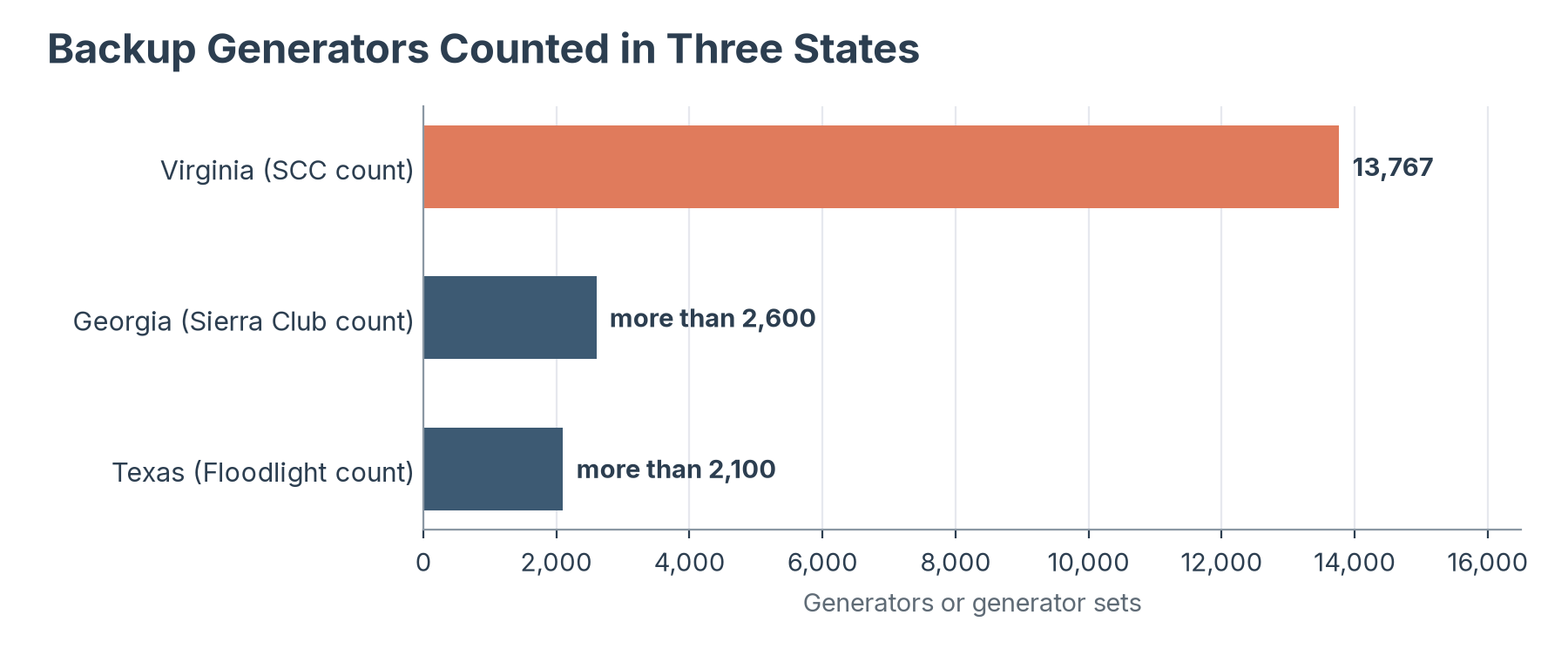
Source: Virginia SCC [3]; Georgia Public Broadcasting [9]; Texas Tribune and Floodlight [6].
Key Findings
- Georgia EPD expects roughly 3 to 5 times as many data centers by 2031, which would lift potential NOx from about 2,845 tons to 8,535 to 14,225 tons per year [7].
- Floodlight put the permitted NOx from the Texas generators it identified at nearly 2,500 tons per year, more than triple the state's newest coal-fired power plant [6]. Permitted amounts are ceilings, and actual emissions depend on run hours.
- Georgia EPD listed no Title V or PSD permits among its permitted data centers in March 2026, with 23 synthetic minor, 3 minor, and 3 transitional permits [7].
Tier 2 Diesel Generators Emit Up to 180 Times the NOx per Megawatt of Controlled Turbines
This section sets out the run-hour rules and emission rates that apply to data center engines and turbines, using federal rules, EPA guidance, and the comparison tables in Virginia DEQ's 2026 presentation.
The first table lists operating limits that cap how many hours generators run. The second table lists the NOx rate DEQ publishes for each power technology, in pounds per megawatt.
Run-hour rules for data center engines
| Rule | Limit |
|---|---|
| Federal rule, emergency operation | Unlimited hours [4] |
| Federal rule, readiness and maintenance | 100 hours per year [4] |
| Federal rule, other non-emergency operation | 50 hours per year, counted within the 100 [4][13] |
| EPA clarification, May 2025 | Certain engines may run up to 50 hours per year in non-emergency conditions to supply power to the grid under a financial arrangement [14] |
| Virginia, all purposes | 500 hours per year in total, with 0 hours for other non-emergency operation [4] |
| Virginia, defense exemption | About 1,066 generators covered as of August 12, 2026, allowed 50 hours of non-emergency use if certified [4] |
Source: Virginia DEQ [4]; electronic Code of Federal Regulations, 40 CFR 60.4211 [13]; US EPA news release (May 2025) [14].
NOx emission rates by power technology, Virginia DEQ comparison
| Technology | NOx rate (lb per MW) |
|---|---|
| Tier 2 emergency diesel engine | 18.0 |
| Natural gas engine, emergency | 6.0 |
| Natural gas engine, non-emergency | 3.0 |
| Tier 4 diesel or Tier 2 with SCR | 1.8 |
| Natural gas engine, controlled | 0.3 to 1.5 |
| Simple-cycle turbine, low-NOx | 0.3 to 0.5 |
| Simple-cycle turbine, low-NOx with SCR | 0.1 |
Source: Virginia DEQ, Data Center Presentation to the Joint Subcommittee on Tax Policy (August 19, 2026) [4]. SCR is selective catalytic reduction. The chart shows the upper end of each range.
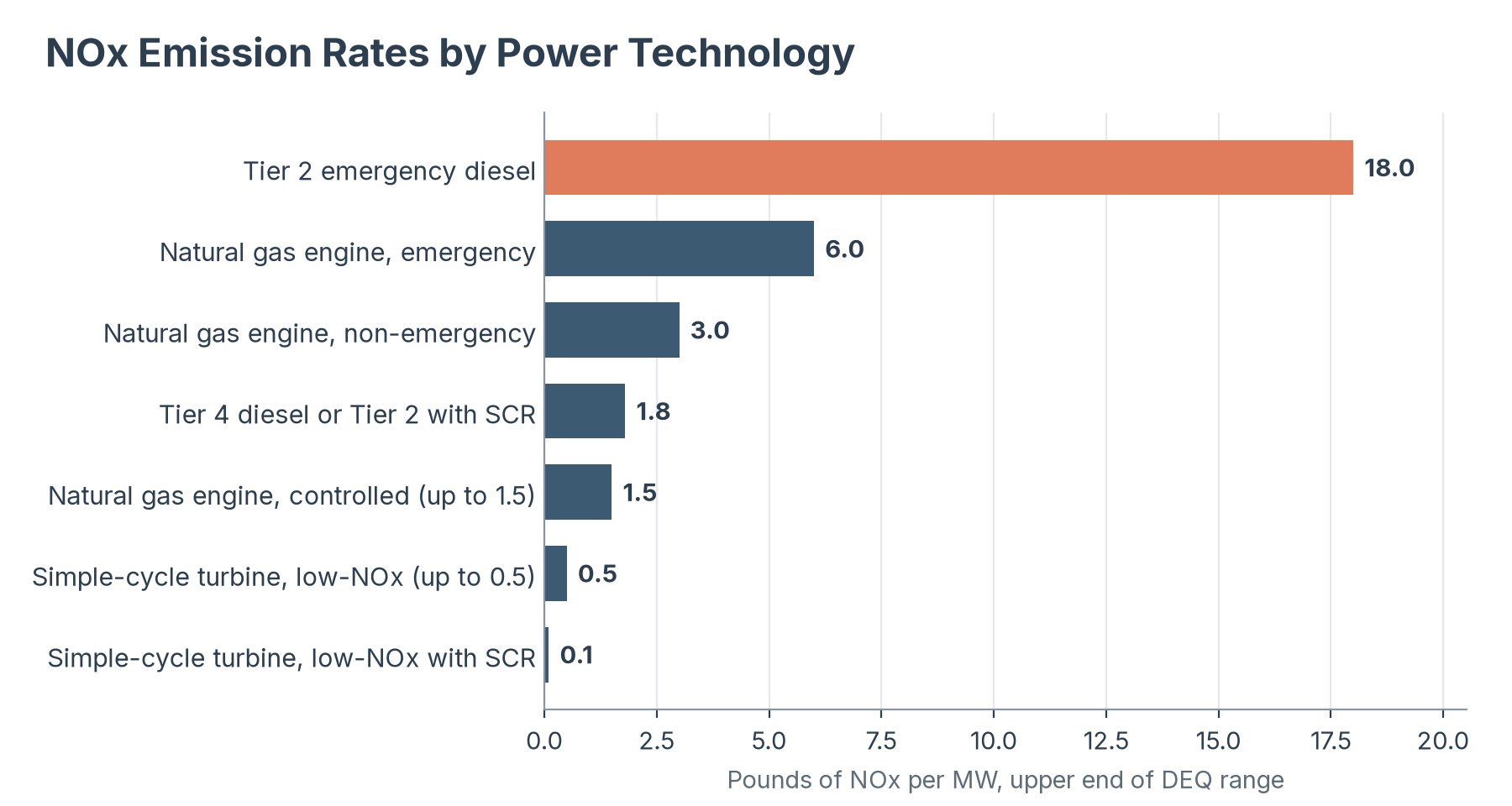
Source: Virginia DEQ [4].
Key Findings
- A Tier 2 emergency diesel emits 10 times the NOx per megawatt of a Tier 4 diesel, 18.0 pounds against 1.8 [4]. Tier 2 or earlier units are 81% of Virginia's permitted generator capacity [3].
- Virginia caps generators at 500 hours per year for all purposes, five times the federal 100 hours for readiness and maintenance, and allows no separate non-emergency hours except under the defense exemption [4].
- The May 2025 EPA clarification allows certain engines to run up to 50 non-emergency hours per year to supply the grid under a financial arrangement [14].
Virginia Accounts for 82% of Data Center Air Penalties in EPA Records
This section covers the compliance and enforcement record of active data center air facilities in ECHO, which treats violation findings that a court or agency has not finalized as alleged [8].
The first table summarizes violations, enforcement actions, and penalties. The second table lists the ten largest penalties from the past five years.
Enforcement record, 403 active data center air facilities
| Measure | Facilities | Count or amount |
|---|---|---|
| Current violation status | 21 | 2 high priority violations |
| At least one quarter in violation, past 3 years | 47 | 90 violation quarters |
| Formal enforcement actions, past 5 years | 23 | 30 actions |
| Informal enforcement actions, past 5 years | 58 | 88 actions |
| Full compliance evaluations, past 5 years | 212 | Not applicable |
| Assessed penalties, past 5 years | 21 | $482,388.78 |
| Median penalty per penalized facility | Not applicable | $10,820 |
Source: AI Industry Reviews analysis of EPA ECHO air facility records for NAICS code 518210, October 2026 [1].
Largest data center air penalties, past 5 years
| Facility | Location | Penalties |
|---|---|---|
| Iron Mountain Information Management | Manassas, VA | $112,885 |
| Amazon Data Services IAD450-456 Cosner Tech Campus | Fredericksburg, VA | $72,068 |
| Compass IAD Datacenter | Leesburg, VA | $70,440 |
| Vienna Cloud | Vienna, VA | $49,499 |
| Flexential Compark Data Center | Parker area, CO | $31,500 |
| Vantage Data Centers VA11 to VA15 | Sterling, VA | $26,160 |
| Ensono Data Center | Downers Grove, IL | $20,000 |
| CyrusOne Kincora | Sterling, VA | $18,279 |
| Equinix N Stemmons Freeway | Dallas, TX | $16,953 |
| SI NVA05A and SI NVA05D | Manassas, VA | $12,362 |
Source: AI Industry Reviews analysis of EPA ECHO air facility records for NAICS code 518210, October 2026 [1]. Locations are the cities ECHO lists.
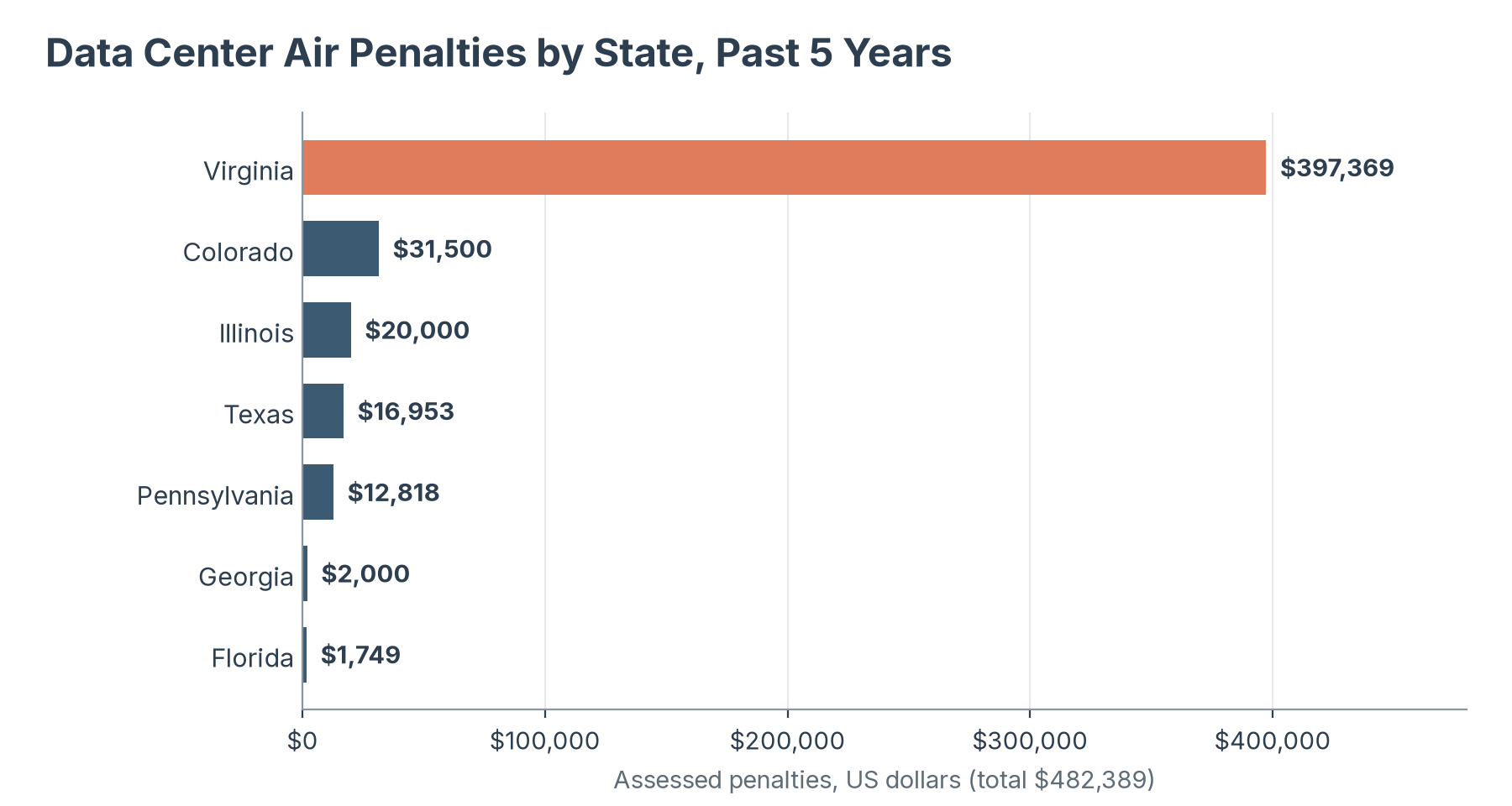
Source: AI Industry Reviews analysis of EPA ECHO air facility records for NAICS code 518210, October 2026 [1].
Key Findings
- Virginia accounts for $397,369, or 82%, of the $482,389 total, across 12 of the 21 penalized facilities. Four Virginia facilities account for $304,891, or 63% of the national total [1].
- Of 403 active facilities, 382 show no violation identified, and 21 carry a current violation status [1].
- Informal actions outnumber formal ones, 88 actions at 58 facilities against 30 actions at 23 facilities [1].
State Orders and Lawsuits Have Reached Data Center Power Plants Outside ECHO
This section collects the 2026 enforcement and legal actions that state regulators, courts, and advocacy groups have taken against data center power sources, which ECHO's facility records do not capture.
The table lists each action by date, with the state, the event, and the source.
State enforcement and legal actions on data center power, 2026
| Date | State | Event |
|---|---|---|
| April 2026 | MS | The NAACP sued xAI and MZX Tech over unpermitted gas turbines in Southaven [15] |
| July 2026 | GA | Georgia EPD issued a stop-work order for a data center in Newton County for illegal construction [9] |
| July 30, 2026 | MS | MDEQ and MZX Tech signed an agreed order setting retirement dates for 69 temporary turbines, the last by July 14, 2027 [12] |
| September 21, 2026 | TX | Governor Abbott directed TCEQ to pause data center permitting; TCEQ mailed notices on three major-source air permits the next day [16] |
| October 19, 2026 | TX | TCEQ told the governor it had paused issuance of all permits for infrastructure directly supporting data centers; Public Citizen counted 16 data center permit actions advanced or issued in the prior week [17][16] |
Source: Courthouse News (October 20, 2026) [15]; Georgia Public Broadcasting [9]; Mississippi Today (July 31, 2026) [12]; Public Citizen (October 19, 2026) [16]; TCEQ letter to Governor Abbott (October 19, 2026) [17].
Key Findings
- Mississippi's state regulator treated the 69 Southaven turbines as mobile, temporary sources exempt from air permits for 12 months or less, and the July order lets 13 of them run past that period [12].
- Texas actions overlapped. Public Citizen reported permits moving forward within a day of the governor's pause, including three major-source air permits with potential emissions of 38 million tons of air pollution per year [16], while TCEQ's October letter says it has paused all permits that directly support data centers [17].
- Sustainable Newton's president said public comments delayed a Covington data center, and activists there credit public participation for July's stop-work order [9].
Federal Rule Changes Touch Turbines, Public Notice, and Engine Run Hours
This section lists the federal actions in 2025 and 2026 that change how data center engines and turbines are regulated, using agency releases, the Federal Register, and press coverage.
Federal actions affecting data center air permits
| Date | Action | What it does |
|---|---|---|
| May 2025 | EPA interpretation of the engine air toxics rule | Certain engines may run up to 50 hours per year in non-emergency conditions to supply the grid under a financial arrangement [14] |
| January 15, 2026 | Final turbine standards review (subpart KKKKa) | Adds a subcategory for small and medium turbines up to 850 MMBtu/h in temporary applications, with a 25 ppm NOx standard on natural gas, 74 ppm on other fuels, and use at one location for up to 24 months [18] |
| July 1, 2026 | EPA proposal on minor source permits | Would remove public notice and comment for state-level air permits; EPA held a hearing on July 22 [9] |
| October 2026 | Nonroad Combustion Turbines Rule | Sent to the White House for final review; the Environmental Defense Fund expects it to treat trailer-mounted turbines as mobile sources [15] |
Source: US EPA [14]; Federal Register, January 15, 2026 [18]; Georgia Public Broadcasting [9]; Courthouse News [15].
Key Findings
- The final turbine standard lets temporary turbines stay at one location for up to 24 months, while Mississippi conditioned its exemption for xAI's mobile turbines on 12 months or less [18][12].
- The public notice proposal would reach the permit types that cover most data centers: 333 of the 403 active facilities in ECHO are minor, synthetic minor, or 80% synthetic minor [1][9].
- If the nonroad rule is finalized as the Environmental Defense Fund expects, trailer-mounted turbines would not need Title V or New Source Review permits, and the group says the one-year location limit would be hard to enforce [15].
What These Numbers Mean for Data Center Neighbors and Operators
A data center air permit is often the first public document that shows how many engines will run next to a neighborhood and how much they may emit. The permit counts above show how large those numbers have become, from 125 active facilities in Virginia to single campuses with 231 generators [1][7].
The record also shows where the paper trail is thin. ECHO lists 12 active Texas facilities, while Floodlight found at least 38 Texas data centers with minor permits since 2024, and Mississippi's 69 temporary turbines ran under a mobile-source exemption with no air permit [1][6][12]. Federal proposals on public notice and nonroad turbines would change how much of that record the public sees [9][15].
So if you want to know what a planned data center will emit, look up its state air permit application early, since the permit is a common form of public notice for a new data center and the notice period is when comments can still change the outcome [9].
Data Collection and Methodology
We compiled figures at three levels: federal facility records, state permit lists, and individual permit and enforcement cases. Facility counts, permit classes, federal rule flags, violation status, enforcement actions, and penalties come from our October 2026 download of ECHO's air facility records for NAICS code 518210. We counted a facility as active when ECHO lists it as operating or temporarily closed, which gives 403 of 479 records. Violation figures cover the past three years and enforcement and penalty figures cover the past five years, as ECHO defines them [8]. ECHO treats violation findings that have not been adjudicated as alleged.
Virginia permit figures come from DEQ's public list of issued air permits for data centers, which we copied in full in October 2026. Each row is one permit record, so a facility with several permits appears more than once. We took the year from the permit issuance date, and we counted Amazon and Microsoft by matching those names in the site name.
Generator, emissions, and permit figures for Virginia, Georgia, Texas, Tennessee, and Mississippi come from the state agency reports and news investigations cited in each section. Georgia and Texas counts are tallies of the permits that the Sierra Club and Floodlight reviewed, not statewide totals. NOx rates are the figures DEQ publishes per megawatt, and the chart shows the upper end of each range.
Terms. Nitrogen oxides (NOx) are smog-forming gases released when fuel burns in engines and turbines. A major source is a facility above the Clean Air Act thresholds for a pollutant, and a synthetic minor facility accepts permit limits that keep it below those thresholds. Tier 2 and Tier 4 are EPA emission standards for diesel engines, and Tier 4 requires far lower NOx and particulate emissions. Selective catalytic reduction (SCR) is a control that reduces NOx in exhaust. PSD is Prevention of Significant Deterioration, the permit for new major sources.
We calculated shares, sums, and ratios from the published values and rounded each result once from the unrounded figures. The Virginia generator totals of 13,767 sets and 33,132 MW are the sums of the SCC's two tier figures, and the 21,791 MW of contracted demand is the sum of the five utility figures the SCC lists. The study was conducted in October 2026 [1], and all sources were accessed in October 2026.
Sources
- AI Industry Reviews, Data Center Air Permit Study: analysis of EPA ECHO air facility records for NAICS code 518210 and Virginia DEQ's list of air permits issued to data centers, conducted October 2026.
- Virginia Department of Environmental Quality, Issued Air Permits for Data Centers (list dated October 26, 2026, and guidance APG-576 effective April 9, 2026): https://www.deq.virginia.gov/news-info/shortcuts/permits/air/issued-air-permits-for-data-centers
- Virginia State Corporation Commission staff, report to the General Assembly on data center electric service, water use, and generators (RD637, 2026): https://rga.lis.virginia.gov/Published/2026/RD637/PDF
- Virginia Department of Environmental Quality, Data Center Presentation to the Joint Subcommittee on Tax Policy (August 19, 2026): https://sfac.virginia.gov/pdf/Tax%20Policy/2026/08192026_No4_DEQ_Data%20Center%20Presentation.pdf
- Virginia Department of Environmental Quality, The Data Center Central: The Virginia Experience, presentation to NACAA (October 8, 2025): https://www.4cleanair.org/wp-content/uploads/The-Data-Center-NACAA.pdf
- Texas Tribune and Floodlight, Planned Texas data centers could emit significant pollution (July 9, 2026): https://www.texastribune.org/2026/07/09/texas-data-centers-ai-power-plants-pollution-state-permits/
- Georgia Environmental Protection Division, Regulatory Aspects of Data Center Growth in Georgia, AAPCA 2026 Spring Meeting (April 8, 2026): https://cleanairact.org/wp-content/uploads/2026/04/1_Dorrough_GA-EPD-Data-Centers-AAPCA-Spring-Meeting-Presentation.pdf
- US EPA, ECHO Air Facility Search Results Help: https://echo.epa.gov/help/facility-search/air-search-results-help
- Georgia Public Broadcasting, Georgia data center activists are alarmed. EPA wants to change Clean Air Act (August 5, 2026): https://www.gpb.org/news/2026/08/05/georgia-data-center-activists-are-alarmed-epa-wants-change-clean-air-act
- TechCrunch, xAI gets permits for 15 natural gas generators at Memphis data center (July 3, 2025): https://techcrunch.com/2025/07/03/xai-gets-permits-for-15-natural-gas-generators-at-memphis-data-center/
- Mississippi Today, State board approves xAI permit, Southaven community left with 'dread' (March 10, 2026): https://mississippitoday.org/2026/03/10/xai-permit-approved-southaven/
- Mississippi Today, State sets dates to retire temporary xAI turbines (July 31, 2026): https://mississippitoday.org/2026/07/31/southaven-xai-turbines-deadline/
- Electronic Code of Federal Regulations, 40 CFR 60.4211: https://www.ecfr.gov/current/title-40/part-60/section-60.4211
- US EPA, EPA Issues Clarification to Help Power Data Centers, Ensure U.S. Is the AI Capital of the World (May 2025): https://www.epa.gov/newsreleases/epa-issues-clarification-help-power-data-centers-ensure-us-ai-capital-world
- Courthouse News Service, EPA plans weaker pollution limits for data center turbines (October 20, 2026): https://www.courthousenews.com/epa-plans-weaker-pollution-limits-for-data-center-turbines/
- Public Citizen, 'Business as Usual': Despite Governor's Directive, TCEQ Continues Processing and Issuing Data Center Permits (October 19, 2026): https://www.citizen.org/news/business-as-usual-despite-governors-directive-tceq-continues-processing-and-issuing-data-center-permits/
- Texas Commission on Environmental Quality, letter to Governor Greg Abbott (October 19, 2026): https://www.tceq.texas.gov/downloads/response/tceq-response-gov-abbott-dc-directive.pdf
- Federal Register, New Source Performance Standards Review for Stationary Combustion Turbines and Stationary Gas Turbines (January 15, 2026): https://www.federalregister.gov/documents/2026/01/15/2026-00677/new-source-performance-standards-review-for-stationary-combustion-turbines-and-stationary-gas
Sources
- AI Industry Reviews, AI Data Center Power Study: analysis of NVIDIA AI server specifications, Uptime Institute operator surveys, LBNL, EPRI, EIA, and IEA electricity estimates, utility and grid operator load forecasts, and interconnection queue data, conducted October 2026.
- Lawrence Berkeley National Laboratory, 2024 United States Data Center Energy Usage Report (December 2024): https://escholarship.org/uc/item/32d6m0d1
- US Department of Energy, DOE Releases New Report Evaluating Increase in Electricity Demand from Data Centers (December 20, 2024): https://www.energy.gov/articles/doe-releases-new-report-evaluating-increase-electricity-demand-data-centers
- Electric Power Research Institute, Powering Intelligence 2026, Executive Summary (last updated February 25, 2026): https://powering-intelligence.epri.com/executive-summary.html
- Electric Power Research Institute, Powering Intelligence: Analyzing Artificial Intelligence and Data Center Energy Consumption (2024): https://restservice.epri.com/publicdownload/000000003002028905/0/Product
- International Energy Agency, Energy and AI, Executive Summary (April 2025): https://www.iea.org/reports/energy-and-ai/executive-summary
- International Energy Agency, Key Questions on Energy and AI, Executive Summary (2026): https://www.iea.org/reports/key-questions-on-energy-and-ai/executive-summary
- Uptime Institute, Global Data Center Survey 2026: https://datacenter.uptimeinstitute.com/rs/711-RIA-145/images/UptimeInstitute.GlobalDataCenterSurvey.2026.pdf
- Uptime Institute, Global Data Center Survey 2025: https://datacenter.uptimeinstitute.com/rs/711-RIA-145/images/2025.Annual.Survey.Report.pdf
- Grid Strategies, Power Demand Forecasts Revised Up for Third Year Running, Led by Data Centers (November 2025): https://gridstrategiesllc.com/wp-content/uploads/Grid-Strategies-National-Load-Growth-Report-2025.pdf
- Lawrence Berkeley National Laboratory, Queued Up: 2025 Edition (December 2025): https://emp.lbl.gov/publications/queued-2025-edition-characteristics
- PJM Interconnection, 2026 Long-Term Load Forecast Report (January 2026): https://www.pjm.com/-/media/DotCom/library/reports-notices/load-forecast/2026-load-report.pdf
- Dominion Energy, Second Quarter 2026 Earnings Conference Call presentation, slide 5 (July 31, 2026): https://s2.q4cdn.com/510812146/files/doc_financials/2026/q2/2026-07-31-DE-IR-2Q-2026-earnings-call-slides-vTCII.pdf
- US Energy Information Administration, Short-Term Energy Outlook, October 2026, Table 7a: https://www.eia.gov/outlooks/steo/tables/pdf/7atab.pdf
- NVIDIA, DGX A100 User Guide: https://docs.nvidia.com/dgx/dgxa100-user-guide/introduction-to-dgxa100.html
- NVIDIA, DGX H100/H200 User Guide: https://docs.nvidia.com/dgx/dgxh100-user-guide/introduction-to-dgxh100.html
- NVIDIA, DGX B200 User Guide: https://docs.nvidia.com/dgx/dgxb200-user-guide/introduction-to-dgxb200.html
- NVIDIA, A100 Tensor Core GPU: https://www.nvidia.com/en-us/data-center/a100/
- NVIDIA, H100 Tensor Core GPU: https://www.nvidia.com/en-us/data-center/h100/
- NVIDIA, DGX SuperPOD GB200 Reference Architecture, Components: https://docs.nvidia.com/dgx-superpod/reference-architecture-scalable-infrastructure-gb200/latest/dgx-superpod-components.html
- Schneider Electric, AI data center design and deployment are moving at an incredible pace (Steven Carlini, July 23, 2025): https://blog.se.com/datacenter/2025/07/23/ai-data-center-design-and-deployment-are-moving-at-an-incredible-pace-3-ways-to-approach-a-changing-landscape/
- Schneider Electric, How Schneider Electric and NVIDIA are redefining AI data center design (December 19, 2025): https://www.se.com/ww/en/insights/ai-and-technology/artificial-intelligence/how-schneider-electric-and-nvidia-are-redefining-ai-data-center-design/
- Steven Ridge, Executive Vice President and Chief Financial Officer, Dominion Energy, prepared remarks on the Second Quarter 2026 Earnings Conference Call (July 31, 2026), transcript: https://stockanalysis.com/stocks/d/transcripts/659241-q2-2026/