
Home / Research / AI Washing Enforcement Statistics
AI Washing Enforcement Statistics: 2026 Report
 By Darin ten Bruggencate, Founder, AI Industry Reviews · November 10, 2026
Our analysts built an enforcement action dataset of 31 federal actions announced from 2022 through October 23, 2026, and recorded each action's agency, year, forum, monetary outcome and status. We also tracked AI-related securities class action filings, along with the AI language in three years of SEC examination priorities.
Key Findings
- Federal regulators brought 31 AI washing actions from 2022 to October 23, 2026, 13 by the SEC, 13 by the FTC and 5 by the DOJ, and 23 of them centered on false AI claims.
- 2024 was the peak year, with 15 actions, including the SEC's first AI washing settlements and the FTC's five-case Operation AI Comply sweep.
- Final SEC civil penalties total $710,000 and fixed FTC payments total $2,173,000, while the six largest FTC judgments add up to $111.2 million on paper because most of each is suspended.
- One criminal restitution order, $4,224,850 against hedge fund founder Mina Tadrus, exceeds all fixed civil amounts ordered in AI washing cases combined.
- Private plaintiffs filed 15 AI-related securities class actions in the first half of 2026, nearly matching the 16 filed in all of 2025, and those cases carry 73% of Disclosure Dollar Loss.
"AI washing" is the practice of overstating what artificial intelligence a product or company uses, much as "greenwashing" overstates environmental credentials. Federal regulators have pursued it under existing fraud and advertising laws. The Securities and Exchange Commission polices claims made to investors, the Federal Trade Commission polices claims made to consumers and small businesses, and the Department of Justice brings criminal charges when founders lie to raise money. In its March 2024 release, the SEC quoted then-Chair Gary Gensler: "Such AI washing hurts investors." Six months later, the FTC quoted then-Chair Lina Khan: "there is no AI exemption from the laws on the books."
In the following sections, we count actions by agency and year, set out SEC penalties and FTC judgments case by case, separate fines from consumer redress, list the DOJ criminal cases, and track private securities litigation and the SEC's exam focus.
How Many AI Washing Actions Have Regulators Brought?
We count each company or scheme as one action per agency. The year is the year the action was first announced. Actions are "core" when the agency release alleges false or misleading claims about AI itself, and "adjacent" when AI was the lure but the alleged misstatements concerned customers, revenue or returns.
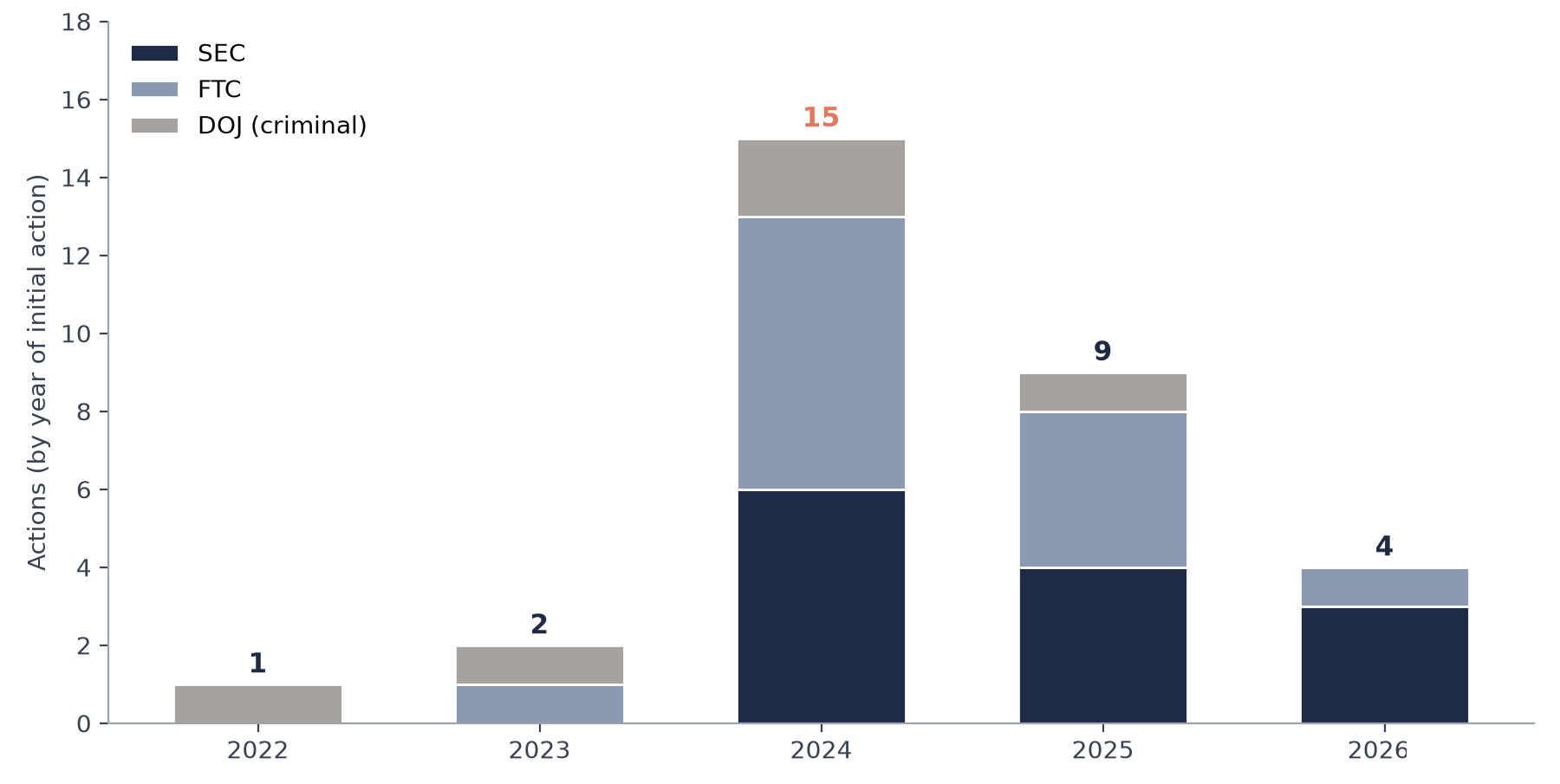
Federal AI washing enforcement actions by agency and year of initial action, 2022 to 2026
| Year | SEC | FTC | DOJ (criminal) | Total | Of which core |
|---|---|---|---|---|---|
| 2022 | 0 | 0 | 1 | 1 | 1 |
| 2023 | 0 | 1 | 1 | 2 | 2 |
| 2024 | 6 | 7 | 2 | 15 | 11 |
| 2025 | 4 | 4 | 1 | 9 | 7 |
| 2026 (to Oct 23) | 3 | 1 | 0 | 4 | 2 |
| Total | 13 | 13 | 5 | 31 | 23 |
AI Washing Enforcement Actions by Agency and Year, 2022 to October 23, 2026
Key Findings
- Activity peaked in 2024, when 15 of the 31 actions (48%) began. That year brought the SEC's first AI washing settlements in March and the FTC's five-case Operation AI Comply sweep in September.
- The agencies differ in focus. Twelve of the FTC's 13 actions are core cases about AI claims, while only seven of the SEC's 13 are; the other six SEC cases are investment or startup frauds that used AI as a selling point.
- For compliance teams, the implication is that a rise in total counts does not show a rise in pure AI claim cases. Our dataset records no SEC action of either kind between January and July 2026, and only one of the three SEC actions filed since then is a core case.
SEC Actions and Penalties
The SEC's AI washing docket mixes small administrative settlements with large fraud suits filed in federal court. Most of the court cases are still being litigated, so few monetary outcomes are final.
SEC AI washing actions, amounts alleged and monetary outcomes
| Date | Matter | Type | Amount alleged | Monetary outcome |
|---|---|---|---|---|
| Mar 18, 2024 | Delphia (USA) | Core | Not stated | $225,000 civil penalty |
| Mar 18, 2024 | Global Predictions | Core | Not stated | $175,000 civil penalty |
| Jun 11, 2024 | Joonko / Ilit Raz | Adjacent | At least $21 million defrauded | Litigation |
| Sep 16, 2024 | Kubient / Roberts, Weiss, Coen | Adjacent | $1.3 million improper revenue | Litigation |
| Oct 10, 2024 | Rimar Capital / Liptz, Boro | Core | Nearly $4 million from 45 investors | $310,000 civil penalties; $213,611 disgorgement and interest |
| Oct 15, 2024 | Destiny Robotics / Kavtaradze | Core | About $141,000 raised | $50,000 penalty offered, subject to court approval |
| Jan 14, 2025 | Presto Automation | Core | Not stated | No civil penalty |
| Apr 9, 2025 | Nate / Albert Saniger | Core | Over $42 million raised | Litigation |
| Apr 22, 2025 | PGI Global / Palafox | Adjacent | About $198 million raised | Litigation |
| Dec 22, 2025 | Morocoin / AI Wealth | Adjacent | At least $14 million | Litigation |
| Aug 26, 2026 | GenesisAI / Cheishvili | Adjacent | More than $5.3 million | $50,000 penalty offered, subject to court approval |
| Sep 29, 2026 | Cryptoaiml | Adjacent | More than $12.5 million | Litigation |
| Sep 29, 2026 | TSAI | Core | $2.8 million | Litigation |
Key Findings
- Final SEC civil penalties across the Delphia, Global Predictions and Rimar matters total $710,000. Presto Automation, a restaurant-technology company that was publicly traded on the Nasdaq until September 2024, settled with no penalty; the SEC cited its cooperation and remediation.
- The amounts alleged in the adjacent cases are far larger than the penalties in the core cases. PGI Global alone allegedly raised about $198 million on what the SEC called a "supposed AI-powered auto-trading platform."
- The implication is that the SEC's AI washing exposure comes in two kinds: modest fines for overstated marketing by advisers, and fraud litigation when AI claims help raise investor money. Then-Enforcement Director Gurbir Grewal described Joonko as "old school fraud using new school buzzwords like 'artificial intelligence'."
FTC Actions, Judgments and Redress
The FTC's cases fall into two groups: technology products whose AI claims allegedly could not be backed up, and money-making schemes that promised AI-powered income. The schemes produced the large judgments, but most of those judgments are suspended.
FTC AI-related actions and monetary terms
| Initial action | Case | Alleged AI claim | Monetary terms | Status |
|---|---|---|---|---|
| Aug 2023 | Automators AI | AI-powered online stores | $21,765,902.65 judgment, partially suspended; asset turnover | Settled Feb 2024 |
| Jun 2024 | FBA Machine / Passive Scaling | AI-powered storefront software | $15.7 million judgment, partially suspended | Settled Jul 2025 |
| Sep 25, 2024 | DoNotPay | "World's first robot lawyer" | $193,000 monetary relief | Final Feb 2025 |
| Sep 25, 2024 | Ascend Ecom | "Cutting edge" AI-powered tools | $25 million judgment, partially suspended | Settled Jun 2025 |
| Sep 25, 2024 | Ecommerce Empire Builders | "AI-powered Ecommerce Empire" | $9,786,124 judgment, partially suspended | Order May 2025 |
| Sep 25, 2024 | Rytr | AI tool generating fake reviews (adjacent) | None | Order set aside Dec 22, 2025 |
| Nov 26, 2024 | Evolv Technologies | AI weapons detection | None; school contract cancellation option | Settled |
| Dec 3, 2024 | IntelliVision | Bias-free facial recognition | None | Final Jan 2025 |
| Jan 3, 2025 | accessiBe | AI widget makes sites compliant | $1 million | Final Apr 2025 |
| Mar 2025 | Click Profit | AI-powered passive income | $13.6 million and $7.3 million judgments, partially suspended | Settled Aug 2025 |
| Apr 28, 2025 | Workado | "98 percent" accurate AI detector | None | Final Aug 2025 |
| Aug 25, 2025 | Air AI | "Conversational AI" business tools | $18 million judgment, largely suspended; $50,000 payable | Settled Mar 2026 |
| May 21, 2026 | Cox Media Group, MindSift, 1010 Digital Works | AI-powered "Active Listening" ad targeting | $930,000 for redress | Final Aug 27, 2026 |
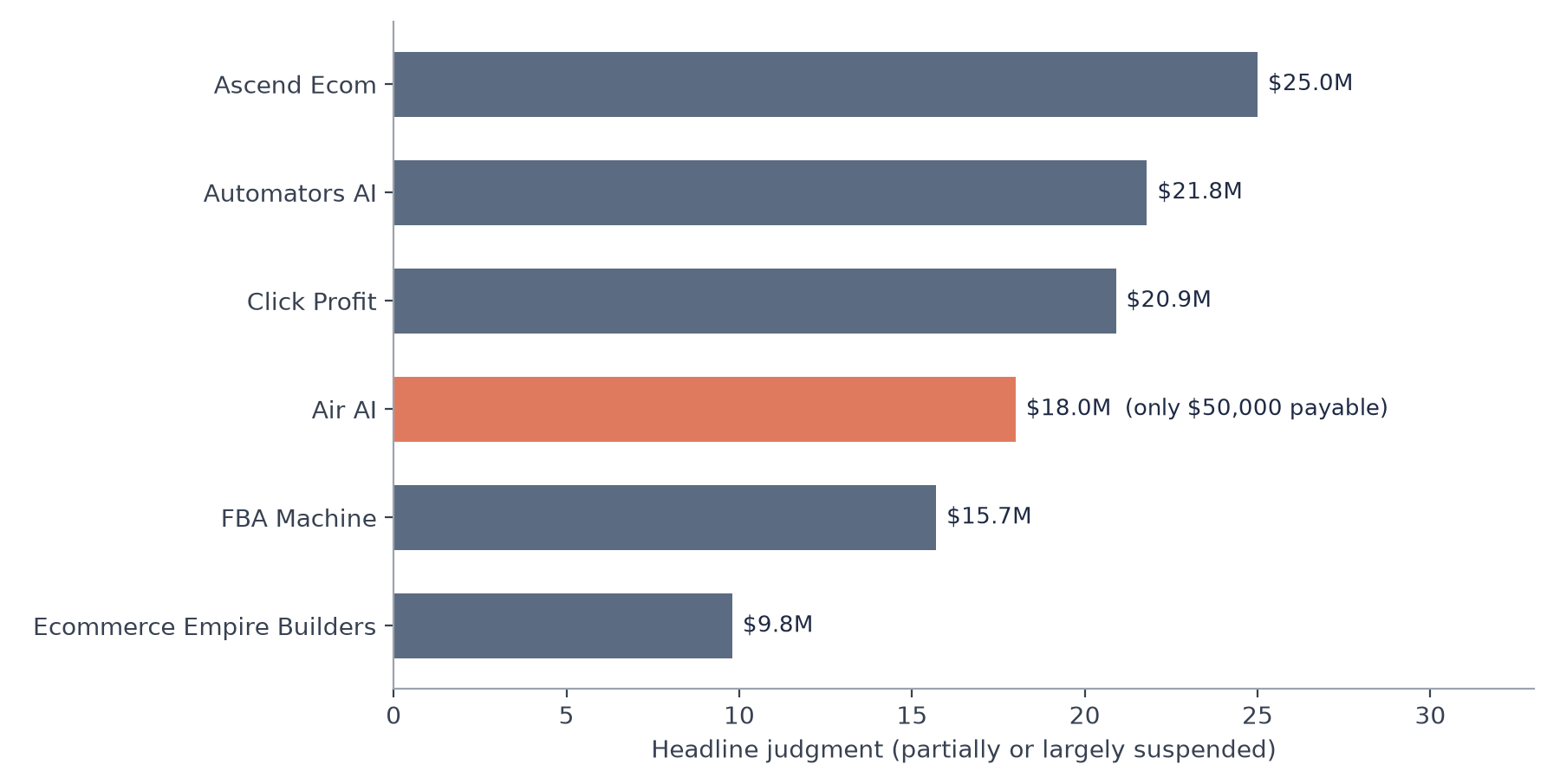
FTC Judgments in AI Money-Making Schemes, in Millions
Key Findings
- The six business opportunity judgments add up to $111.2 million on paper, and each is suspended in part based on the defendants' inability to pay. Air AI shows the gap most clearly: an $18 million judgment, with $50,000 to be paid to the Commission for consumer relief.
- Four of the 13 FTC actions ended with no money at all: Evolv, IntelliVision, Workado and the set-aside Rytr order. In those cases, relief takes the form of a requirement to substantiate future claims, plus, for Evolv, an option for some K-12 customers to cancel contracts.
- The implication for product companies is that an FTC AI claim case usually costs more in conduct restrictions than in cash. Workado's order bars effectiveness claims unless they are backed by "competent and reliable evidence," after independent testing found 53 percent accuracy on general-purpose content against a claimed 98 percent.
Fines Versus Consumer Redress
The agencies' money goes to different places. SEC civil penalties are fines, DOJ sentences can add fines or restitution, and FTC monetary relief is used for refunds to consumers. The table below counts only fixed amounts ordered, not suspended judgments or amounts still awaiting court approval.
Fixed money ordered in AI washing cases by type
| Type | Cases | Total ordered | Note |
|---|---|---|---|
| SEC civil penalties (final) | Delphia, Global Predictions, Rimar | $710,000 | Presto paid no penalty |
| SEC penalties offered, pending court approval | Destiny Robotics, GenesisAI | $100,000 | $50,000 each |
| FTC fixed payments for redress or refunds | DoNotPay, accessiBe, Cox Media Group et al., Air AI | $2,173,000 | Excludes suspended judgments and asset turnovers |
| DOJ criminal fine | Shamim (YouPlus) | $50,000 | Plus 30 months in prison |
| DOJ restitution | Tadrus (Tadrus Capital) | $4,224,850 | Plus 30 months in prison |
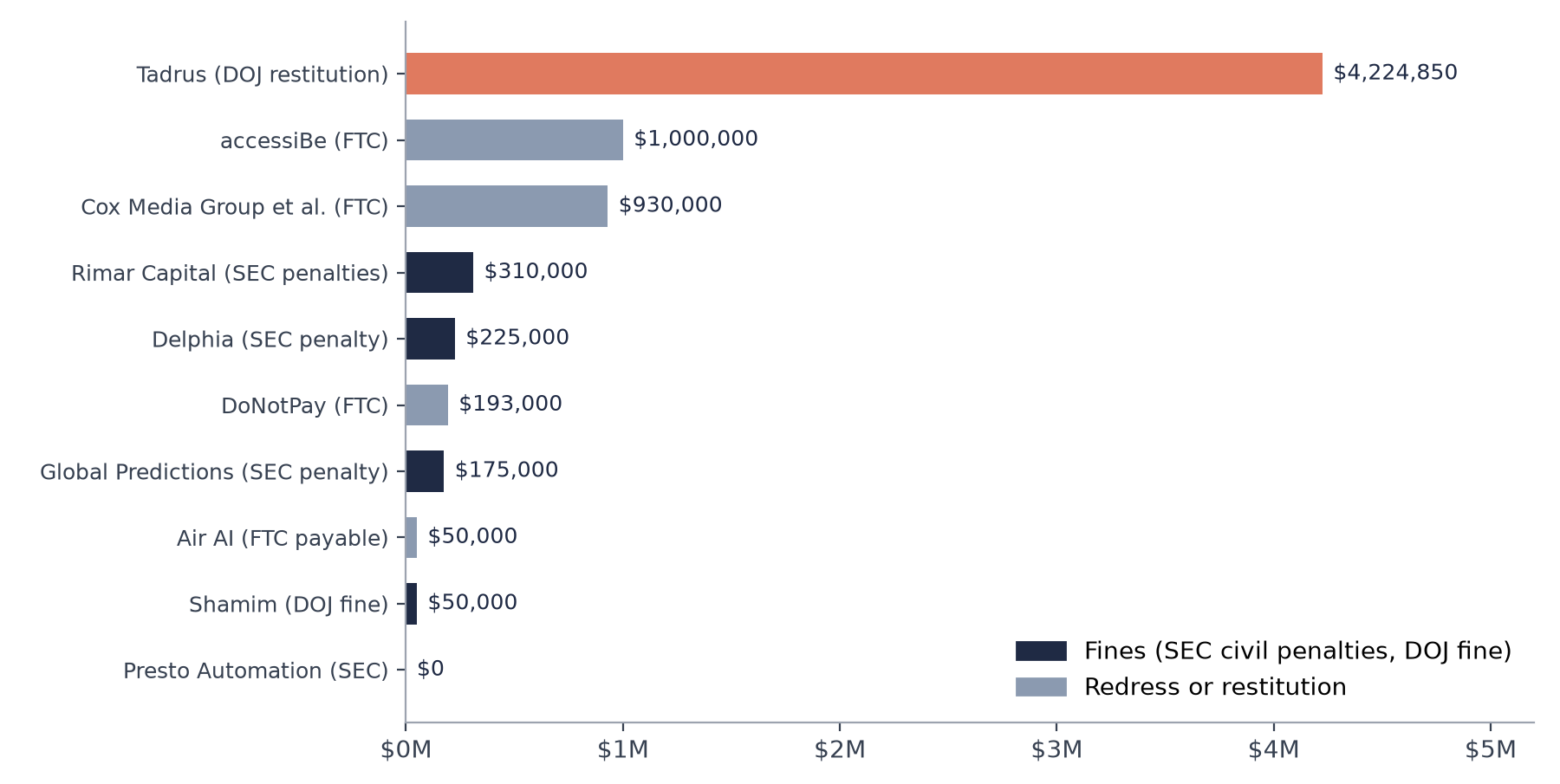
Fixed Money Ordered in AI Washing Cases, by Case
Key Findings
- Fixed FTC redress payments of $2,173,000 are about three times final SEC penalties of $710,000. The sum also leaves out the asset turnovers in Automators AI, FBA Machine and Click Profit, which the FTC says will fund refunds but does not value in dollars in those releases.
- A single criminal restitution order, the $4,224,850 imposed on Mina Tadrus, exceeds all of the fixed civil amounts in Table 4 combined, which total $2,983,000. Tadrus claimed his fund used AI-based algorithmic trading; the EDNY release says it used none.
- The implication is that headline dollar totals overstate what victims recover. Readers comparing cases should separate fines payable to the government, fixed redress, and suspended judgments that become payable only if defendants misreport their finances.
DOJ Criminal Cases
Criminal AI washing cases target founders who used AI claims to raise venture or investor money. Each case in our dataset had a parallel or related SEC matter, as noted in the DOJ or SEC releases.
DOJ criminal cases involving AI claims
| Defendant (company) | District | First charged | Amount alleged | Outcome as of Oct 23, 2026 |
|---|---|---|---|---|
| Shaukat Shamim (YouPlus) | N.D. Cal. | Jun 14, 2022 indictment | About $6.4 million obtained via false statements | 30 months, $50,000 fine (Apr 7, 2025) |
| Mina Tadrus (Tadrus Capital) | E.D.N.Y. | 2023 (docket 23-CR-393) | More than $5.7 million from at least 31 investors | 30 months, $4,224,850 restitution (Aug 18, 2025) |
| Ilit Raz (Joonko) | S.D.N.Y. | Jun 2024 | About $27 million in funding rounds | Pleaded guilty Sep 11, 2026; sentencing pending |
| Paul Roberts (Kubient) | S.D.N.Y. | Sep 16, 2024 | More than $1.3 million fraudulent revenue | 1 year and 1 day (Mar 20, 2025) |
| Albert Saniger (Nate) | S.D.N.Y. | Apr 9, 2025 indictment | More than $40 million raised | Charged; presumed innocent |
Key Findings
- Three of the five cases have reached sentencing, with prison terms from one year and one day to 30 months. Shamim admitted that YouPlus had employees in India manually review videos while he told investors a neural network search engine did the work.
- Saniger's indictment follows the same pattern: the DOJ alleges that Nate's automation rate was "effectively zero percent" and that hundreds of contractors in the Philippines completed purchases by hand. Both counts against him carry maximum sentences of 20 years.
- The implication for founders is that the government treats false statements made to investors while raising money as securities fraud evidence. Raz's plea centered on false customer and revenue claims and forged bank statements, which is why we classify her case as adjacent.
Securities Class Actions Alleging AI Misstatements
Private plaintiffs have filed more AI cases each year than any single agency has brought. Cornerstone Research and the Stanford Law School Securities Class Action Clearinghouse began tracking an AI category in 2024. It covers filings against companies that develop, supply or use AI where the allegations relate to AI or to undisclosed AI risks.
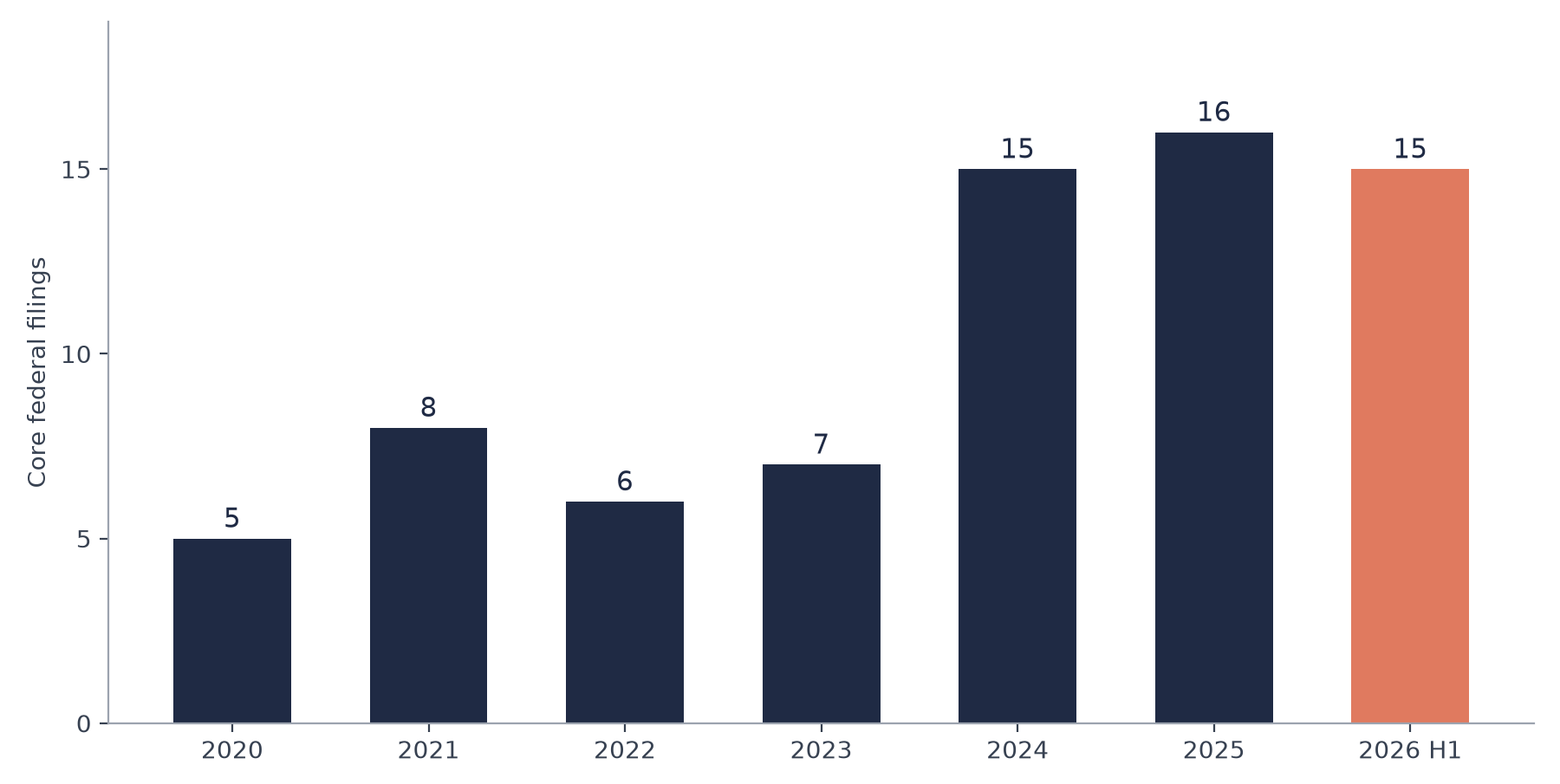
AI-related securities class action filings, core federal filings
| Year | AI-related filings | All class action filings | Note |
|---|---|---|---|
| 2020 | 5 | Not used | From 2026 Midyear Figure 2 |
| 2021 | 8 | Not used | |
| 2022 | 6 | Not used | |
| 2023 | 7 | Not used | |
| 2024 | 15 | 226 | AI tied with COVID-19 as a top trend |
| 2025 | 16 | 207 | 12 in H1, 4 in H2 |
| 2026 H1 | 15 | 121 | 73% of Disclosure Dollar Loss |
AI-Related Securities Class Action Filings by Year, 2020 to 2026 H1
Key Findings
- AI-related filings more than doubled from 7 in 2023 to 15 in 2024. Fifteen more were filed in the first six months of 2026, which Cornerstone says puts the category on pace to nearly double the 2025 total.
- The losses at stake are concentrated. AI cases made up 13% of core filings in 2026 H1 but $385 billion of Disclosure Dollar Loss and $1,349 billion of Maximum Dollar Loss, or 73% of each index.
- The implication for publicly traded companies is that private litigation, not agency enforcement, now carries most of the dollar exposure tied to AI statements. The 2026 H1 cases also changed character: seven involved AI development and five involved data centers, and none concerned autonomous vehicles.
SEC Examination Priorities and AI
The SEC Division of Examinations publishes annual priorities that tell registered advisers and broker-dealers what examiners will check. AI representations have appeared in each of the last three editions, though the wording has shifted.
AI language in SEC Division of Examinations priorities
| Fiscal year | AI language | Term uses |
|---|---|---|
| FY2025 | Will "review registrant representations regarding their AI capabilities or AI use for accuracy" and assess policies to supervise AI use | "AI" 7, "artificial intelligence" 2 |
| FY2026 | Will "focus on recent advancements in AI" and review for accuracy "registrant representations regarding their AI capabilities" | "AI" 7, "artificial intelligence" 1 |
| FY2027 (released Oct 23, 2026) | Uses "super intelligence (SI)"; reviews of emerging technology assess whether "representations are fair and accurate," plus SI-related cyberattack, phishing and deepfake risks | "AI" 0, "SI" 11 |
Key Findings
- The accuracy of AI claims has been an explicit exam item in FY2025 and FY2026. That gives advisers notice that marketing language like Delphia's and Global Predictions' will be tested against what firms do.
- The FY2027 report, released October 23, 2026, replaces "AI" with "super intelligence" throughout and adds threat scenarios such as deepfake voice and video used for social engineering. Its press release lists emerging technologies among eight key areas of focus.
- The implication for compliance officers is that the vocabulary has changed but the substantiation test has not. Firms should map every public AI or SI claim to documentation an examiner can review.
What the 2025 and 2026 Cases Show
The FTC set aside its Rytr order on December 22, 2025, citing the administration's AI Action Plan, while its later AI cases, Air AI and Cox Media Group, still ended in payments. The SEC's three 2026 filings are fraud suits over money raised, not cases against advisers over marketing language.
Private litigation has grown as agency penalties have stayed small. Investors filed 15 AI-related class actions in the first half of 2026, the same number of AI washing actions that federal agencies opened in all of 2024 in our dataset, and those filings carry $385 billion of Disclosure Dollar Loss.
So if you make public claims about AI capabilities, treat each one as a statement that may be checked by an SEC examiner, an FTC substantiation demand or a plaintiff's complaint, and keep the evidence behind it on file.
Data Collection and Methodology
Scope. Federal actions by the SEC, FTC and DOJ announced from January 2022 through October 23, 2026 in which the agency release describes false or misleading AI claims, or AI marketing used as the lure for a fraud. State actions, such as the Texas Attorney General's settlement with Pieces Technologies, are excluded.
Counting rules. One action is one company or scheme per agency. The two SEC complaints in litigation release 26654 (Cryptoaiml and TSAI) count as two actions because they concern separate schemes. Delphia and Global Predictions count as two. A case brought by more than one agency counts once for each agency. The year is the year of the agency's first public action; for FBA Machine, that is the June 2024 complaint, and for Tadrus it is the 2023 docket year.
Classification. "Core" means the agency release alleges that AI claims themselves were false, misleading or unsubstantiated. "Adjacent" means AI branding was part of the pitch, but the release centers on other misstatements. Rytr is adjacent because the FTC alleged its AI tool enabled fake reviews, not that its AI claims were false.
Exclusions. The DOJ release on PGI Global's Ramil Palafox (Feb 12, 2026, 20-year sentence) does not mention AI, so we count PGI only under the SEC, whose release describes the AI trading claims. The SEC's Tadrus releases describe "algorithmic trading" without AI, so we count Tadrus only under DOJ. The SEC civil case against Shamim, noted as pending in the DOJ release, is not counted separately.
Money. Civil penalties, criminal fines, restitution and FTC payments are taken as stated in releases. Suspended FTC judgments are reported separately and are never added to amounts ordered. Totals and percentages are our calculations from the cited figures. Asset turnovers without a stated dollar value are not included.
Exam priority term counts come from the text of the SEC PDFs.
Sources
- AI Industry Reviews, AI washing enforcement action dataset (31 federal actions, 2022 to Oct 23, 2026), compiled from the releases below. File: ai-washing-enforcement-actions-2026.csv.
- SEC, press release 2024-36, Delphia and Global Predictions (Mar 18, 2024). https://www.sec.gov/newsroom/press-releases/2024-36
- SEC, press release 2024-70, Joonko and Ilit Raz (Jun 11, 2024). https://www.sec.gov/newsroom/press-releases/2024-70
- SEC, press release 2024-131, Kubient (Sep 16, 2024). https://www.sec.gov/newsroom/press-releases/2024-131
- SEC, press release 2024-167, Rimar Capital (Oct 10, 2024). https://www.sec.gov/newsroom/press-releases/2024-167
- SEC, litigation release 26157, Destiny Robotics (Oct 15, 2024). https://www.sec.gov/enforcement-litigation/litigation-releases/lr-26157
- SEC, administrative proceeding 33-11352, Presto Automation (Jan 14, 2025). https://www.sec.gov/enforcement-litigation/administrative-proceedings/33-11352-s
- SEC, litigation release 26282, Saniger (Apr 2025). https://www.sec.gov/enforcement-litigation/litigation-releases/lr-26282
- SEC, press release 2025-69, PGI Global (Apr 22, 2025). https://www.sec.gov/newsroom/press-releases/2025-69
- SEC, litigation release 26453, Morocoin (Dec 22, 2025). https://www.sec.gov/enforcement-litigation/litigation-releases/lr-26453
- SEC, litigation release 26619, GenesisAI (Aug 26, 2026). https://www.sec.gov/enforcement-litigation/litigation-releases/lr-26619
- SEC, litigation release 26654, Cryptoaiml and TSAI (Sep 29, 2026). https://www.sec.gov/enforcement-litigation/litigation-releases/lr-26654
- FTC, "FTC Announces Crackdown on Deceptive AI Claims and Schemes" (Sep 25, 2024). https://www.ftc.gov/news-events/news/press-releases/2024/09/ftc-announces-crackdown-deceptive-ai-claims-schemes
- FTC, Automators AI complaint (Aug 2023) and settlement (Feb 2024). https://www.ftc.gov/news-events/news/press-releases/2023/08/ftc-action-stops-business-opportunity-scheme-promised-its-ai-boosted-tools-would-power-high-earnings and https://www.ftc.gov/news-events/news/press-releases/2024/02/ftc-action-leads-ban-owners-automators-ai-e-commerce-money-making-scheme
- FTC, DoNotPay final order (Feb 2025). https://www.ftc.gov/news-events/news/press-releases/2025/02/ftc-finalizes-order-donotpay-prohibits-deceptive-ai-lawyer-claims-imposes-monetary-relief-requires
- FTC, Ascend Ecom order (Jun 2025). https://www.ftc.gov/news-events/news/press-releases/2025/06/ftc-case-leads-order-banning-ascend-ecom-its-owners-business-opportunity-marketing
- FTC, Ecommerce Empire Builders order (May 2025). https://www.ftc.gov/news-events/news/press-releases/2025/05/ftc-action-ends-ecommerce-empire-builders-online-business-opportunity-scam
- FTC, FBA Machine settlement (Jul 2025). https://www.ftc.gov/news-events/news/press-releases/2025/07/ftc-obtains-permanent-ban-e-commerce-business-opportunity-scheme-operator
- FTC, Rytr order set aside (Dec 2025). https://www.ftc.gov/news-events/news/press-releases/2025/12/ftc-reopens-sets-aside-rytr-final-order-response-trump-administrations-ai-action-plan
- FTC, Evolv Technologies (Nov 2024). https://www.ftc.gov/news-events/news/press-releases/2024/11/ftc-takes-action-against-evolv-technologies-deceiving-users-about-its-ai-powered-security-screening
- FTC, IntelliVision complaint (Dec 2024) and final order (Jan 2025). https://www.ftc.gov/news-events/news/press-releases/2024/12/ftc-takes-action-against-intellivision-technologies-deceptive-claims-about-its-facial-recognition and https://www.ftc.gov/news-events/news/press-releases/2025/01/ftc-finalizes-order-prohibiting-intellivision-making-deceptive-claims-about-its-facial-recognition
- FTC, accessiBe proposed (Jan 2025) and final (Apr 2025) orders. https://www.ftc.gov/news-events/news/press-releases/2025/01/ftc-order-requires-online-marketer-pay-1-million-deceptive-claims-its-ai-product-could-make-websites and https://www.ftc.gov/news-events/news/press-releases/2025/04/ftc-approves-final-order-requiring-accessibe-pay-1-million
- FTC, Click Profit complaint (Mar 2025) and orders (Aug 2025). https://www.ftc.gov/news-events/news/press-releases/2025/03/ftc-acts-stop-click-profit-online-business-opportunity-has-cost-consumers-least-14-million and https://www.ftc.gov/news-events/news/press-releases/2025/08/ftc-case-against-e-commerce-business-opportunity-scheme-its-operators-results-permanent-ban-industry
- FTC, Workado proposed (Apr 28, 2025) and final (Aug 2025) orders. https://www.ftc.gov/news-events/news/press-releases/2025/04/ftc-order-requires-workado-back-artificial-intelligence-detection-claims and https://www.ftc.gov/news-events/news/press-releases/2025/08/ftc-approves-final-order-against-workado-llc-which-misrepresented-accuracy-its-artificial
- FTC, Air AI complaint (Aug 2025) and settlement (Mar 2026). https://www.ftc.gov/news-events/news/press-releases/2025/08/ftc-sues-stop-air-ai-using-deceptive-claims-about-business-growth-earnings-potential-refund and https://www.ftc.gov/news-events/news/press-releases/2026/03/air-ai-its-owners-will-be-banned-marketing-business-opportunities-settle-ftc-charges-company-misled
- FTC, Cox Media Group proposed (May 2026) and final (Aug 2026) orders. https://www.ftc.gov/news-events/news/press-releases/2026/05/ftc-require-cox-media-group-two-other-firms-pay-nearly-1-million-settle-charges-they-deceived and https://www.ftc.gov/news-events/news/press-releases/2026/08/ftc-finalizes-orders-cox-media-group-two-other-firms-settling-charges-they-deceived-customers-about
- DOJ, N.D. Cal., Shamim sentencing (Apr 8, 2025). https://www.justice.gov/usao-ndca/pr/silicon-valley-start-founder-sentenced-25-years-prison-securities-fraud
- DOJ, E.D.N.Y., Tadrus sentencing (Aug 18, 2025). https://www.justice.gov/usao-edny/pr/founder-purported-artificial-intelligence-powered-hedge-fund-sentenced-30-months
- DOJ, S.D.N.Y., Roberts sentencing (Mar 20, 2025). https://www.justice.gov/usao-sdny/pr/former-ceo-kubient-inc-sentenced-prison-connection-accounting-fraud-scheme
- DOJ, S.D.N.Y., Saniger indictment (Apr 9, 2025). https://www.justice.gov/usao-sdny/pr/tech-ceo-charged-artificial-intelligence-investment-fraud-scheme
- DOJ, S.D.N.Y., Raz guilty plea (Sep 11, 2026). https://www.justice.gov/usao-sdny/pr/founder-and-former-ceo-artificial-intelligence-company-pleads-guilty-securities-fraud
- Cornerstone Research and Stanford SCAC, Securities Class Action Filings 2026 Midyear Assessment (Jul 29, 2026). https://www.cornerstone.com/insights/reports/securities-class-action-filings-2026-midyear-assessment/
- Cornerstone Research and Stanford SCAC, Securities Class Action Filings 2025 Year in Review. https://www.cornerstone.com/insights/reports/securities-class-action-filings-2025-year-in-review/
- Cornerstone Research and Stanford SCAC, Securities Class Action Filings 2024 Year in Review. https://www.cornerstone.com/insights/reports/securities-class-action-filings-2024-year-in-review/
- SEC Division of Examinations, FY2025 Examination Priorities. https://www.sec.gov/files/2025-exam-priorities.pdf
- SEC Division of Examinations, FY2026 Examination Priorities. https://www.sec.gov/files/2026-exam-priorities.pdf
- SEC Division of Examinations, FY2027 Examination Priorities, and press release 2026-109 (Oct 23, 2026). https://www.sec.gov/files/2027-exam-priorities.pdf and https://www.sec.gov/newsroom/press-releases/2026-109-sec-announces-fiscal-year-2027-examination-priorities