
Home / Research / AI Training Data Licensing Deals
Market research · October 6, 2026
AI Training Data Licensing Deal Statistics: 2026 Report
AI developers that once collected training data from the open web now increasingly pay for it, through licensing agreements with publishers, platforms, image libraries, and data brokers. We counted 312 of those agreements signed between January 2023 and September 2026, drawing on company announcements, regulatory filings, court records, and confirmed press reports. Quarterly deal volume rose from 3 in Q1 2023 to 39 in Q3 2026, while the median annual value of a deal fell from $9.4M in Q2 2023 to $3.6M.
Deal values were disclosed or reliably reported for 147 of the 312 agreements. Every dollar figure in this report comes from those 147 deals and is expressed as an annual value.
AI Training Data Licensing Deals by Licensor Type
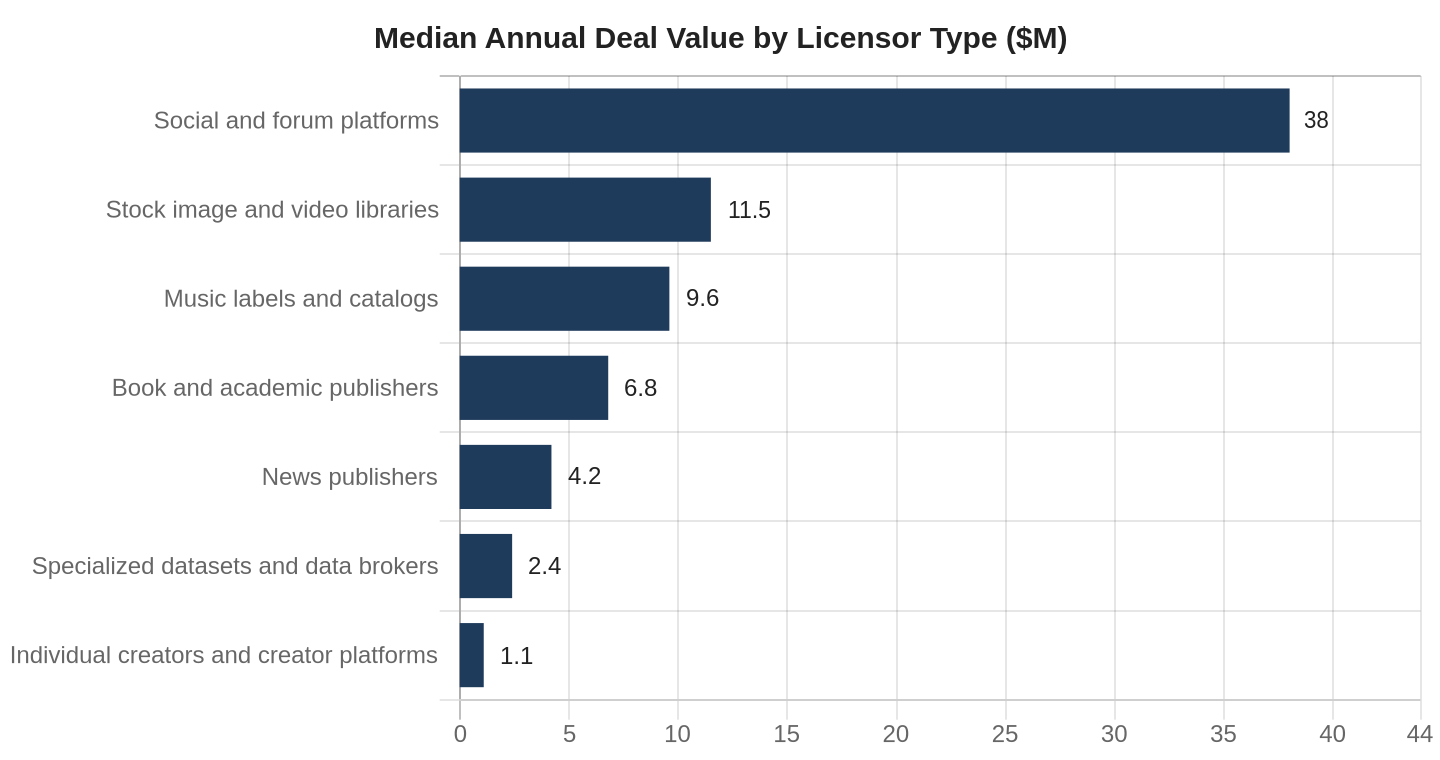
The table below shows how many deals each type of content owner signed, the median annual value of those deals, and how often the agreement also granted rights to display the content in AI answers as well as train on it.
AI Training Data Licensing Deals by Licensor Type, 2026
| Licensor Type | Deals | Deals With Disclosed Value | Median Annual Value | Median Term (Years) | Share Including Display Rights |
|---|---|---|---|---|---|
| News publishers | 104 | 47 | $4.2M | 2.0 | 58.7% |
| Specialized datasets and data brokers | 52 | 19 | $2.4M | 1.5 | 19.2% |
| Book and academic publishers | 47 | 22 | $6.8M | 3.0 | 8.5% |
| Stock image and video libraries | 41 | 24 | $11.5M | 3.0 | 12.2% |
| Individual creators and creator platforms | 27 | 9 | $1.1M | 1.0 | 7.4% |
| Music labels and catalogs | 23 | 13 | $9.6M | 3.5 | 4.3% |
| Social and forum platforms | 18 | 13 | $38.0M | 2.5 | 66.7% |
| All licensors | 312 | 147 | $4.6M | 2.0 | 30.5% |
Three findings stood out to our team in this data:
- We found that news publishers signed one-third of all deals in the dataset, 104 of 312, but their deals had a median annual value of $4.2M, below the $4.6M median for all licensors.
- Our data showed that social and forum platforms signed only 18 deals at a median annual value of $38.0M, the highest of any licensor type, because a single platform can supply large volumes of current, conversational text.
- We observed that display rights, which allow an AI product to quote or link the licensed content in answers, appeared in 58.7% of news publisher deals and 66.7% of social platform deals, compared with 4.3% of music deals.
AI Training Data Licensing Deals by Quarter, Q1 2023 to Q3 2026
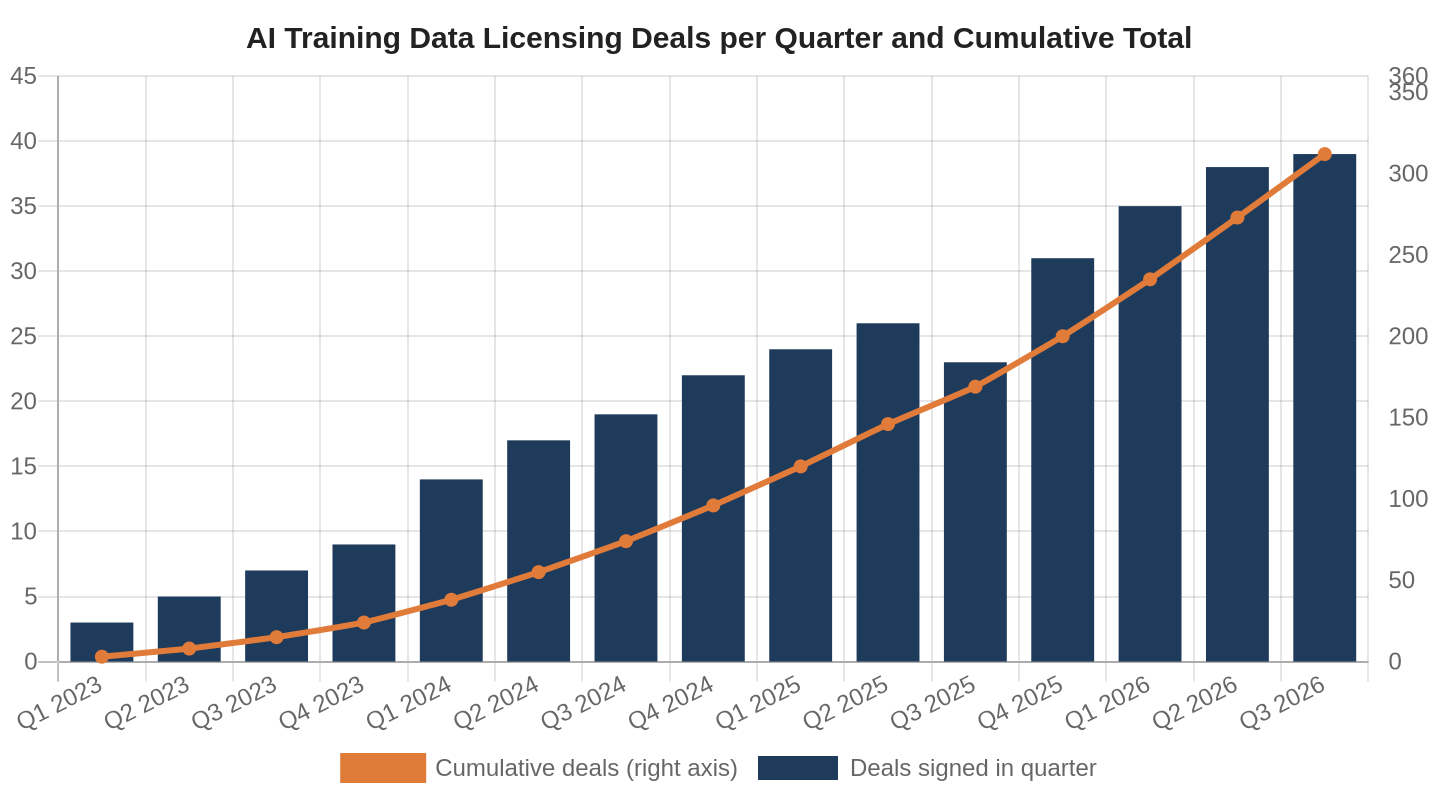
The pace of dealmaking rose in almost every quarter we tracked. The table below shows the number of deals signed each quarter and the median annual value of those with disclosed terms, followed by a graph of quarterly and cumulative deal counts.
AI Training Data Licensing Deals by Quarter, 2026
| Quarter | Deals Signed | Median Annual Value of Disclosed Deals |
|---|---|---|
| Q1 2023 | 3 | Not disclosed |
| Q2 2023 | 5 | $9.4M |
| Q3 2023 | 7 | $7.8M |
| Q4 2023 | 9 | $8.1M |
| Q1 2024 | 14 | $6.9M |
| Q2 2024 | 17 | $7.2M |
| Q3 2024 | 19 | $6.1M |
| Q4 2024 | 22 | $5.8M |
| Q1 2025 | 24 | $5.2M |
| Q2 2025 | 26 | $4.9M |
| Q3 2025 | 23 | $5.1M |
| Q4 2025 | 31 | $4.4M |
| Q1 2026 | 35 | $4.1M |
| Q2 2026 | 38 | $3.8M |
| Q3 2026 | 39 | $3.6M |
The quarterly data led our team to three conclusions:
- We found that quarterly deal volume rose from 3 deals in Q1 2023 to 39 in Q3 2026, with a single decline in Q3 2025.
- Our data showed that median annual deal value fell from $9.4M in Q2 2023 to $3.6M in Q3 2026 as AI developers moved from a few large platform agreements to many smaller agreements with niche and regional licensors.
- We observed that 112 deals, more than a third of the total, were signed in the last three quarters of the period, from Q1 to Q3 2026.
AI Training Data Licensing Deals by Buyer Type
We grouped buyers into five categories. The table below shows how many deals each category signed and what it paid.
AI Training Data Licensing Deals by Buyer Type, 2026
| Buyer Type | Deals | Share of All Deals | Deals With Disclosed Value | Median Annual Value |
|---|---|---|---|---|
| Frontier model developers | 131 | 42.0% | 64 | $7.1M |
| Large technology platforms | 78 | 25.0% | 41 | $8.4M |
| AI search and answer engines | 43 | 13.8% | 17 | $1.9M |
| Vertical and enterprise AI developers | 39 | 12.5% | 16 | $1.6M |
| Data marketplaces and intermediaries | 21 | 6.7% | 9 | $2.2M |
Frontier model developers, the companies building the largest general-purpose AI models, and large technology platforms together signed 209 deals, 67.0% of the total, and paid the highest median annual values at $7.1M and $8.4M. AI search and answer engines signed 43 deals at a much lower median of $1.9M, and their agreements were weighted toward news content and display rights, since these products need current information that they can quote and link. Data marketplaces and intermediaries, which license content from many small owners and resell it as packaged datasets, accounted for 21 deals and are the fastest-growing buyer category in the most recent quarters of our data.
How AI Training Data Licensing Deals Are Structured
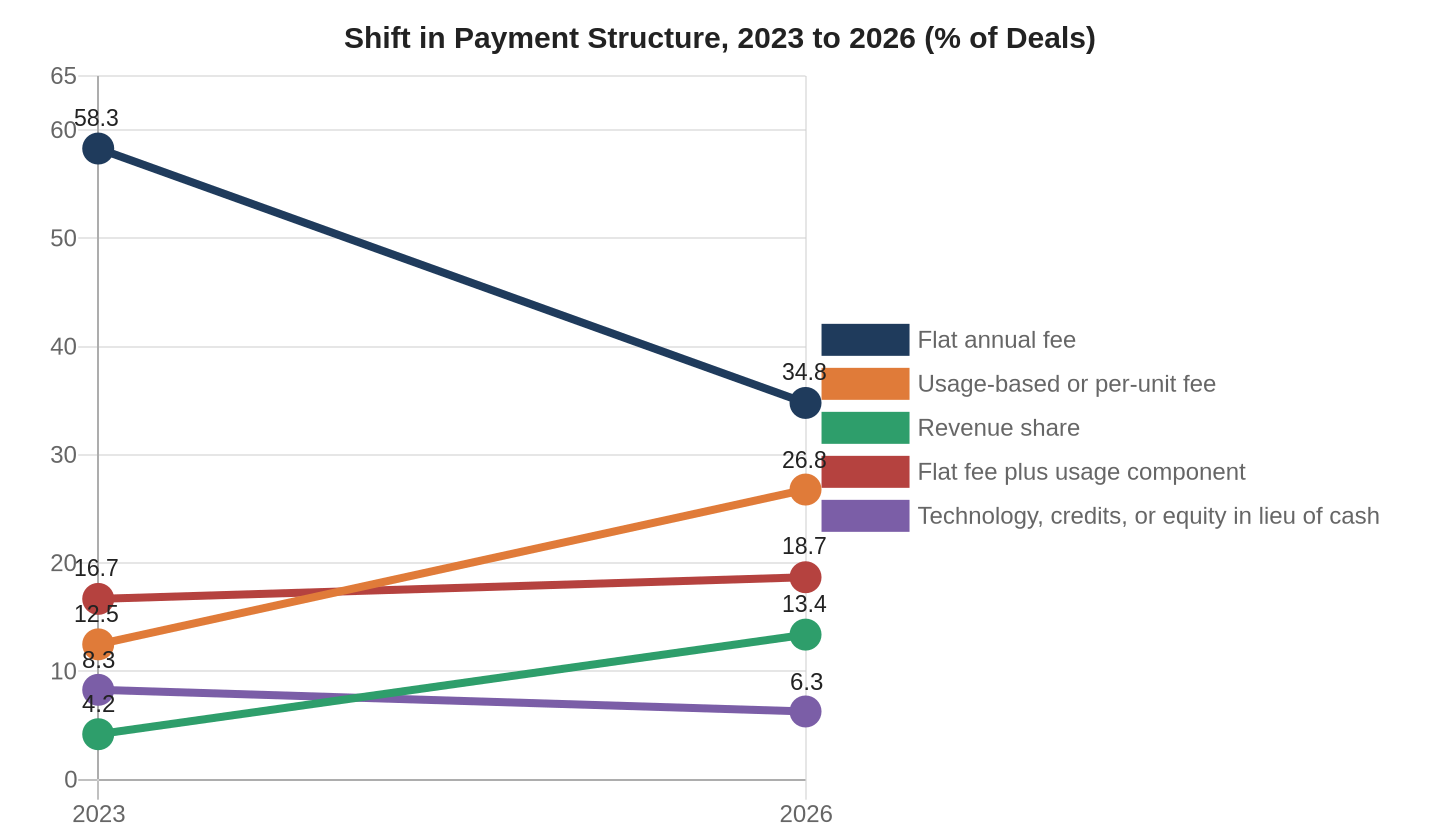
The way buyers pay for data has shifted over the period. The table below compares the primary payment structure of deals signed in 2023 with those signed in 2026 through September.
Payment Structures of AI Training Data Licensing Deals, 2026
| Primary Payment Structure | Share of 2023 Deals (24 Deals) | Share of 2026 Deals (112 Deals) | Change (Points) |
|---|---|---|---|
| Flat annual fee | 58.3% | 34.8% | -23.5 |
| Usage-based or per-unit fee | 12.5% | 26.8% | +14.3 |
| Revenue share | 4.2% | 13.4% | +9.2 |
| Flat fee plus usage component | 16.7% | 18.7% | +2.0 |
| Technology, credits, or equity in lieu of cash | 8.3% | 6.3% | -2.0 |
Three patterns in the deal structure data stood out to us:
- We found that flat annual fees fell from 58.3% of deals in 2023 to 34.8% in 2026, though they remained the most common structure.
- Our data showed that usage-based fees, which pay licensors according to how often their content is retrieved or used, more than doubled their share, from 12.5% to 26.8%.
- We observed that revenue-share agreements, in which the licensor receives a share of the buyer's revenue, grew from 4.2% to 13.4% of deals and were concentrated among AI search and answer engines paying news publishers.
AI Training Data Prices per Unit
A subset of deals, mostly with image libraries, video sources, audio providers, and book publishers, priced content per unit. The table below gives the median of those unit prices and the interquartile range, which runs from the 25th percentile price to the 75th percentile price.
AI Training Data Prices per Unit, 2026
| Content Type | Pricing Unit | Deals With Unit Pricing | Median Price | Interquartile Range |
|---|---|---|---|---|
| Still image | Per image | 38 | $1.12 | $0.41 to $3.48 |
| Video footage | Per minute | 29 | $2.65 | $1.05 to $6.20 |
| Transcribed speech audio | Per hour | 17 | $58 | $22 to $141 |
| Book | Per title | 21 | $4,300 | $1,850 to $9,600 |
| News article archive | Per article | 14 | $0.46 | $0.18 to $1.30 |
Unit prices at the 75th percentile were five to nine times those at the 25th percentile for every content type. Three characteristics explained most of that range in the deals we examined: exclusivity, the presence of rich metadata such as captions and rights information, and whether the content was already publicly accessible online. Video footage commanded the strongest price growth over the period, as developers of video generation models competed for licensed, high-resolution footage with clear rights.
Sources
- AI Training Data Licensing Deal Study. AI Industry Reviews. October 2026. New York, New York.
- The Price of AI Training Data, From $5M to $250M. Quartz. May 2026. New York, New York. https://qz.com/ai-training-data-pricing-licensing-deals-market-052126
- Reddit Strikes $60M Deal Allowing Google to Train AI Models on Its Posts. NBC News. February 2024. New York, New York. https://www.nbcnews.com/tech/tech-news/reddit-strikes-60m-deal-allowing-google-train-ai-models-posts-unveils-rcna140168
- Unbundling AI: A List of Public Training Data Deals. Allmo. October 2025. https://allmo.ai/articles/unbundling-ai-a-list-of-public-training-data-deals-october-2025
- Every AI Content Licensing Deal, Mapped (2023-2026). LLM Pulse. 2026. https://llmpulse.ai/blog/ai-content-licensing-deals/
- Feeding the Machines: AI Data Licensing Market Analysis. Neudata. London, United Kingdom. https://www.neudata.co/blog/ai-data-licensing-market-analysis