
Home / Research / AI Risk Factor Disclosure Statistics
Market research · October 15, 2026
AI Risk Factor Disclosure Statistics: 2026 Report
 By Darin ten Bruggencate, Founder, AI Industry Reviews
Every year, US public companies list the biggest risks to their business in their annual 10-K filings. After ChatGPT's release in November 2022, AI began appearing in those lists far more often, first at technology and finance companies and then in nearly every sector. We wanted to know how quickly AI became a listed risk and which AI risks companies cite.
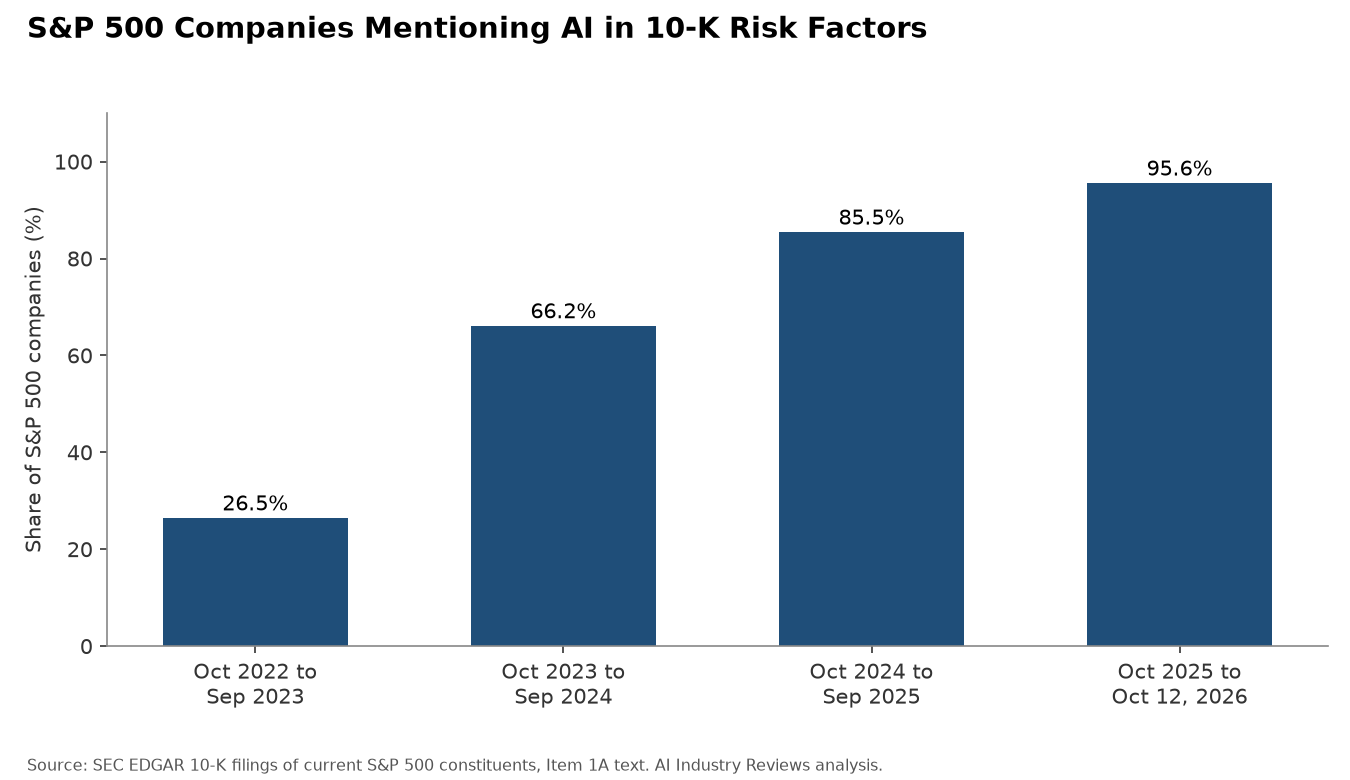
Our analysts studied the risk factors in the 10-K reports of S&P 500 companies filed from October 2022 through the latest 12 months. In the latest 12 months, 95.6% of S&P 500 companies mentioned AI in their risk factors, up from 26.5% in filings made from October 2022 to September 2023.
In the following sections, we track AI mentions over time and by sector, list the specific AI risks companies cite, and rank the companies that mention AI most.
Share of S&P 500 Companies Mentioning AI in Risk Factors
Each filing window covers one year of 10-K filings, so every company appears once per window. The windows run from October to September to match the spread of fiscal year ends.
S&P 500 Companies Mentioning AI in 10-K Risk Factors, by Filing Window
| Filing Window | Companies Analyzed | Companies Mentioning AI | Share Mentioning AI | Median AI Mentions per Filing | Share With 10 or More Mentions |
|---|---|---|---|---|---|
| Oct 2022 to Sep 2023 | 464 | 123 | 26.5% | 0 | 6.5% |
| Oct 2023 to Sep 2024 | 470 | 311 | 66.2% | 2 | 23.2% |
| Oct 2024 to Sep 2025 | 476 | 407 | 85.5% | 6 | 42.0% |
| Oct 2025 to Oct 12, 2026 | 480 | 459 | 95.6% | 13 | 59.2% |
- The share of companies mentioning AI in their risk factors rose 2.5 times in one year, from 26.5% to 66.2% in the year after ChatGPT's release in November 2022.
- The median filing now mentions AI 13 times in its risk factors, against 0 three years earlier. The average rose from 1.6 to 18.3 mentions.
- Of the 459 companies that mention AI in their latest risk factors, 123 already did so in the first window, 194 added it in the second, 94 in the third and 48 in the latest.
- For investors, an AI risk factor is now standard rather than a signal about one company. Only 21 of 480 companies left AI out of Item 1A. What a company says about AI now matters more than whether it mentions it.
AI Risk Factor Mentions by Sector
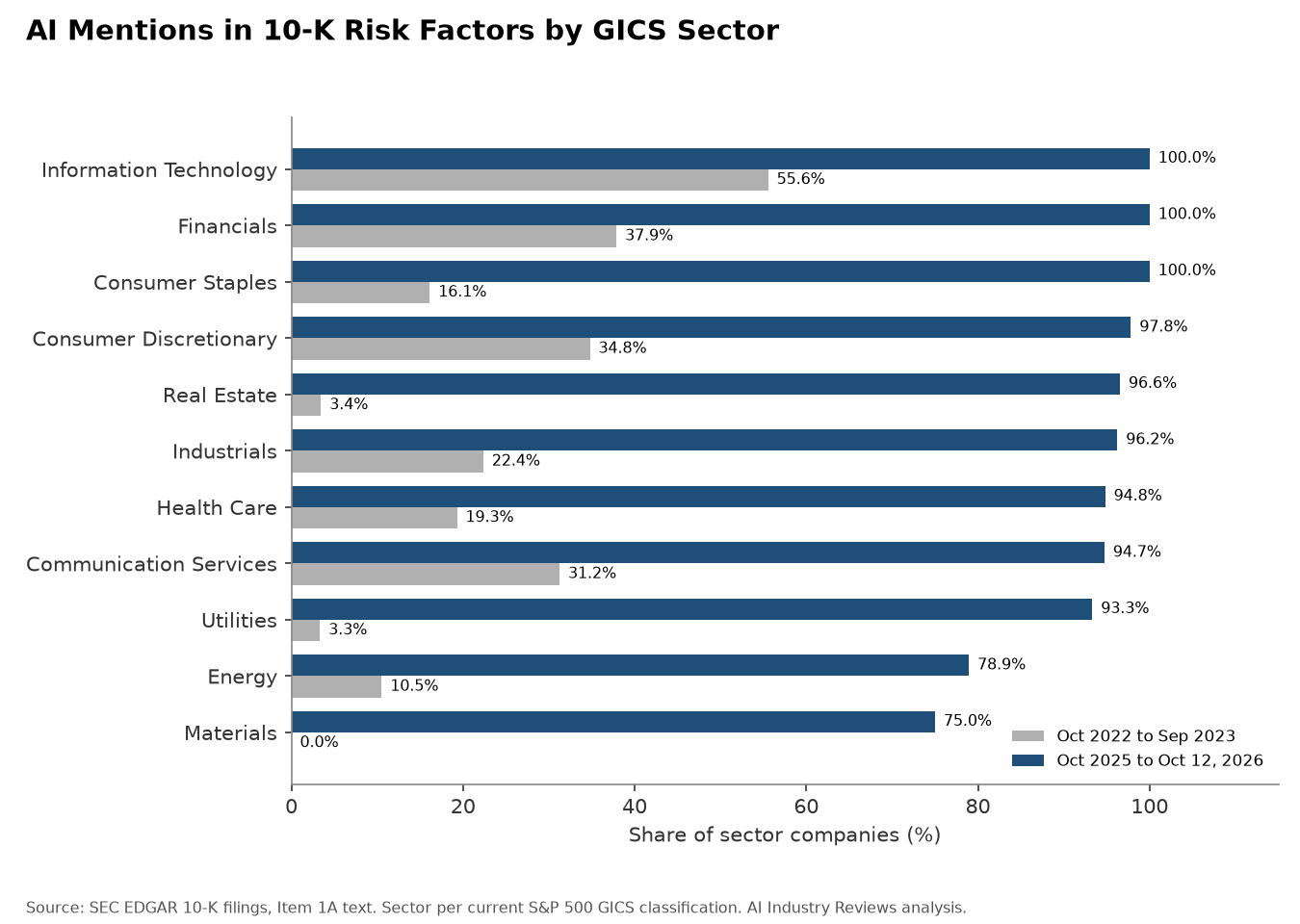
AI disclosure started in technology and finance and has spread to nearly every sector. Sector assignments follow the current S&P 500 GICS classification.
Share of Companies Mentioning AI in 10-K Risk Factors, by GICS Sector
| GICS Sector | Companies, Latest Window | Oct 2022 to Sep 2023 | Oct 2023 to Sep 2024 | Oct 2024 to Sep 2025 | Oct 2025 to Oct 12, 2026 | Median AI Mentions, Latest Window |
|---|---|---|---|---|---|---|
| Information Technology | 74 | 55.6% | 88.7% | 98.6% | 100.0% | 37 |
| Financials | 68 | 37.9% | 80.6% | 94.0% | 100.0% | 22.5 |
| Consumer Staples | 33 | 16.1% | 66.7% | 84.8% | 100.0% | 10 |
| Consumer Discretionary | 46 | 34.8% | 71.7% | 91.3% | 97.8% | 9.5 |
| Real Estate | 29 | 3.4% | 55.2% | 75.9% | 96.6% | 9 |
| Industrials | 80 | 22.4% | 53.8% | 77.2% | 96.2% | 9 |
| Health Care | 58 | 19.3% | 63.2% | 87.9% | 94.8% | 14.5 |
| Communication Services | 19 | 31.2% | 94.1% | 94.4% | 94.7% | 11 |
| Utilities | 30 | 3.3% | 50.0% | 76.7% | 93.3% | 5 |
| Energy | 19 | 10.5% | 31.6% | 68.4% | 78.9% | 3 |
| Materials | 24 | 0.0% | 34.8% | 62.5% | 75.0% | 3 |
- Every Information Technology, Financials and Consumer Staples company analyzed mentioned AI in its latest risk factors.
- Real Estate rose from 3.4% to 96.6% and Utilities from 3.3% to 93.3%, the largest gains of any sector.
- Materials and Energy trail the rest of the index, with 75.0% and 78.9%. No Materials company mentioned AI in the first window.
- Every sector now treats AI as a risk to explain to shareholders. The two trailing sectors are likely to close most of the gap next cycle.
Specific AI Risks Cited in Risk Factors
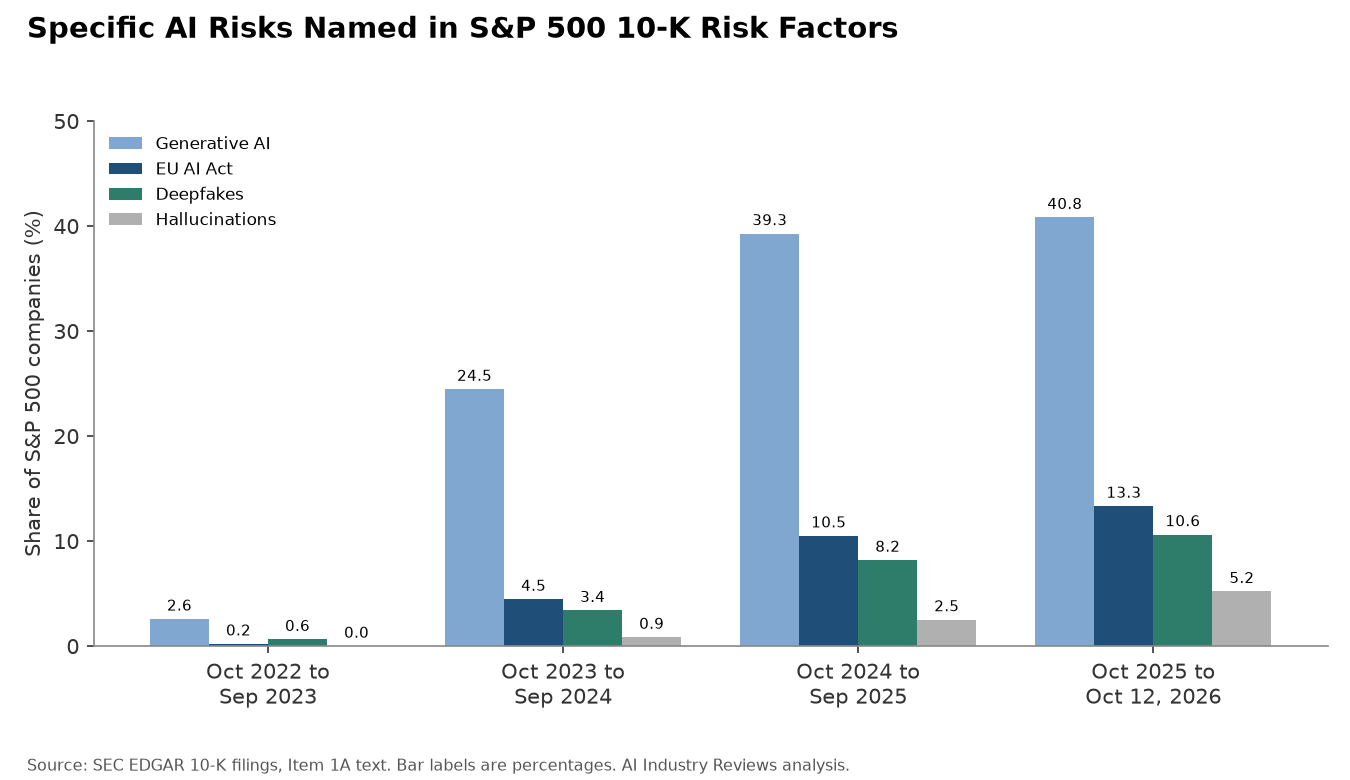
Beyond general mentions of AI, a growing number of companies mention specific technologies, rules and failure modes. The shares below count companies with at least one mention of each term in Item 1A.
Share of S&P 500 Companies Citing Specific AI Risks in 10-K Risk Factors
| Filing Window | Generative AI | EU AI Act | Deepfakes | Hallucinations |
|---|---|---|---|---|
| Oct 2022 to Sep 2023 | 2.6% | 0.2% | 0.6% | 0.0% |
| Oct 2023 to Sep 2024 | 24.5% | 4.5% | 3.4% | 0.9% |
| Oct 2024 to Sep 2025 | 39.3% | 10.5% | 8.2% | 2.5% |
| Oct 2025 to Oct 12, 2026 | 40.8% | 13.3% | 10.6% | 5.2% |
- 196 companies, 40.8% of those analyzed, mentioned generative AI in their latest risk factors, against 12 in the first window.
- 13.3% of companies now cite the EU AI Act, which entered into force in August 2024.
- Disclosures are moving from general mentions to specific risks. Deepfakes are now cited by 10.6% of companies, up from 0.6%. As more AI rules take effect, the share citing specific laws is likely to keep rising.
- Hallucinations, where an AI model produces false output, are mentioned by 5.2% of companies, up from none in the first window.
Companies With the Most AI Mentions in Risk Factors
The companies that mention AI most often in their risk factors are chipmakers, software and internet companies that sell AI products, along with some outside technology.
S&P 500 Companies With the Most AI Mentions in 10-K Risk Factors, Latest Filing
| Company | GICS Sector | AI Mentions in Item 1A | Generative AI Mentions |
|---|---|---|---|
| Advanced Micro Devices | Information Technology | 152 | 8 |
| Gen Digital | Information Technology | 117 | 4 |
| Alphabet | Communication Services | 101 | 2 |
| Cognizant | Information Technology | 99 | 0 |
| Meta Platforms | Communication Services | 86 | 4 |
| Microsoft | Information Technology | 85 | 0 |
| Qualcomm | Information Technology | 85 | 9 |
| Cisco | Information Technology | 80 | 2 |
| Arch Capital Group | Financials | 79 | 1 |
| News Corp | Communication Services | 77 | 0 |
- Advanced Micro Devices mentions AI 152 times in its latest risk factors, the most of any S&P 500 company.
- The most detailed AI risk sections come from companies whose revenue depends on AI. Only an insurer and a publisher made the top 10 from outside tech. Other financial and media companies are likely to follow their lead.
What AI Risk Factor Disclosure Trends Mean for 2027 and Beyond
AI risk language in annual filings has moved from a niche technology topic to a near-routine part of how large public companies describe their business.
As more AI rules take effect, companies will have to say more about how AI could hurt their business. These sections are likely to read less like boilerplate and more like a record of each company's legal and operational exposure that investors can compare from one company to the next.
That makes AI risk factor text a lasting tool for investors comparing companies, not a one-off novelty from the ChatGPT cycle. When you read the next round of 10-Ks, compare the specific AI risks each company lists with those of its peers.
Data Collection and Methodology
The AI Industry Reviews research team built the dataset from 10-K filings on SEC EDGAR for companies in the S&P 500 as of October 2026.
We downloaded each company's 10-K filings from October 1, 2022 to October 12, 2026, and grouped them into four filing windows running October to September. The latest window ends October 12, 2026, so for companies with fiscal years ending in the late summer or fall, the latest window holds the 10-K they filed in late 2025. We extracted the text of Item 1A, Risk Factors, from the start of its heading in the body of the filing to the next item heading. A mention is any occurrence of "AI" as a capitalized standalone word, "artificial intelligence", "machine learning" or "large language model". Generative AI counts "generative AI" and "generative artificial intelligence". The EU AI Act, deepfake and hallucination counts use the same Item 1A text. A mention shows that a company discusses AI in its risk factors and does not measure how serious it considers the risk.
17 or 18 companies per window were excluded because their 10-K places risk factors in an exhibit or annual report insert, or uses a layout we could not split reliably. They include Wells Fargo, Citigroup, Morgan Stanley, U.S. Bancorp, BNY Mellon, Charles Schwab, Intel, McDonald's, GE Aerospace and Honeywell. Companies with two share classes are counted once. The analysis covers current index members, so companies added to the S&P 500 since 2022 are included for earlier windows and companies that have left are not. Sector medians and counts for every filing are in data.csv.
Sources
- AI Industry Reviews, AI Risk Factor Disclosure Study: analysis of Item 1A risk factor text in 1,890 10-K filings from current S&P 500 companies, filed October 2022 to October 12, 2026, conducted October 2026.
- SEC EDGAR, company submissions and filing archives
- SEC, Form 10-K general instructions (Item 1A, Risk Factors, Regulation S-K Item 105)
- eCFR, 17 CFR 229.105, Risk factors
- Wikipedia, List of S&P 500 companies (constituents, CIK and GICS sector)
- European Commission, AI Act enters into force, Aug. 1, 2024