
Home / Research / AI Patent Litigation Statistics
Market research · October 22, 2026
AI Patent Litigation Statistics: 2026 Report
 By Darin ten Bruggencate, Founder, AI Industry Reviews
Patents on artificial intelligence, from speech recognition to neural network training, have been asserted in US courts for well over a decade. In July 2026 the University of Tennessee Research Foundation sued Anthropic over Claude Code, one of several recent suits against AI developers. Yet no court-data vendor publishes a free yearly count of AI patent suits, so we built one.
Our analysts matched every granted patent in the USPTO Artificial Intelligence Patent Dataset (AIPD) to the patents listed in the USPTO's district-court litigation files. We found 16,883 cases filed through 2020 that asserted at least one AI patent. The open files end in 2020, so for 2021 through October 2026 we added published counts from Lex Machina, Unified Patents, RPX, the USPTO, LexisNexis Intellectual Property Solutions, Exponent and Docket Navigator, plus court records for major AI cases. In every year from 2015 to 2020, AI patent cases made up between 24.6% and 27.0% of all US patent cases.
In the following sections, we compare AI patent suits by year, published AI-specific counts since 2021, major AI cases and rulings, overall patent filings, plaintiff types, venues, defendants, PTAB challenges and AI patent grants.
AI Patent Suits by Year, 2010 to 2026
Our series through 2020 counts unique district-court cases that asserted at least one granted patent the AIPD labels as AI. No open docket file lists patents in suit after 2020, so later rows carry Lex Machina's all-patent totals and the one published annual AI count.
US District-Court Patent Cases and AI Patent Cases by Year Filed, 2010 to 2026
| Year Filed | AI Patent Cases | All Patent Cases | AI Share | Source |
|---|---|---|---|---|
| 2010 | 597 | - | - | Our AIPD join |
| 2011 | 1,135 | - | - | Our AIPD join |
| 2012 | 2,106 | - | - | Our AIPD join |
| 2013 | 2,065 | - | - | Our AIPD join |
| 2014 | 1,489 | - | - | Our AIPD join |
| 2015 | 1,561 | 5,967 | 26.2% | Our AIPD join |
| 2016 | 1,264 | 4,681 | 27.0% | Our AIPD join |
| 2017 | 980 | 3,990 | 24.6% | Our AIPD join |
| 2018 | 927 | 3,571 | 26.0% | Our AIPD join |
| 2019 | 878 | 3,529 | 24.9% | Our AIPD join |
| 2020 | 1,074 | 4,001 | 26.8% | Our AIPD join |
| 2021 | - | 3,990 | - | Lex Machina |
| 2022 | - | 3,830 | - | Lex Machina |
| 2023 | - | 3,111 | - | Lex Machina |
| 2024 | - | 3,803 | - | Lex Machina |
| 2025 | 53 (G06N patents only) | 4,547 | - | Docket Navigator via Bloomberg Law; Lex Machina |
| 2026 (January to June) | - | About 1,900 | - | Lex Machina |
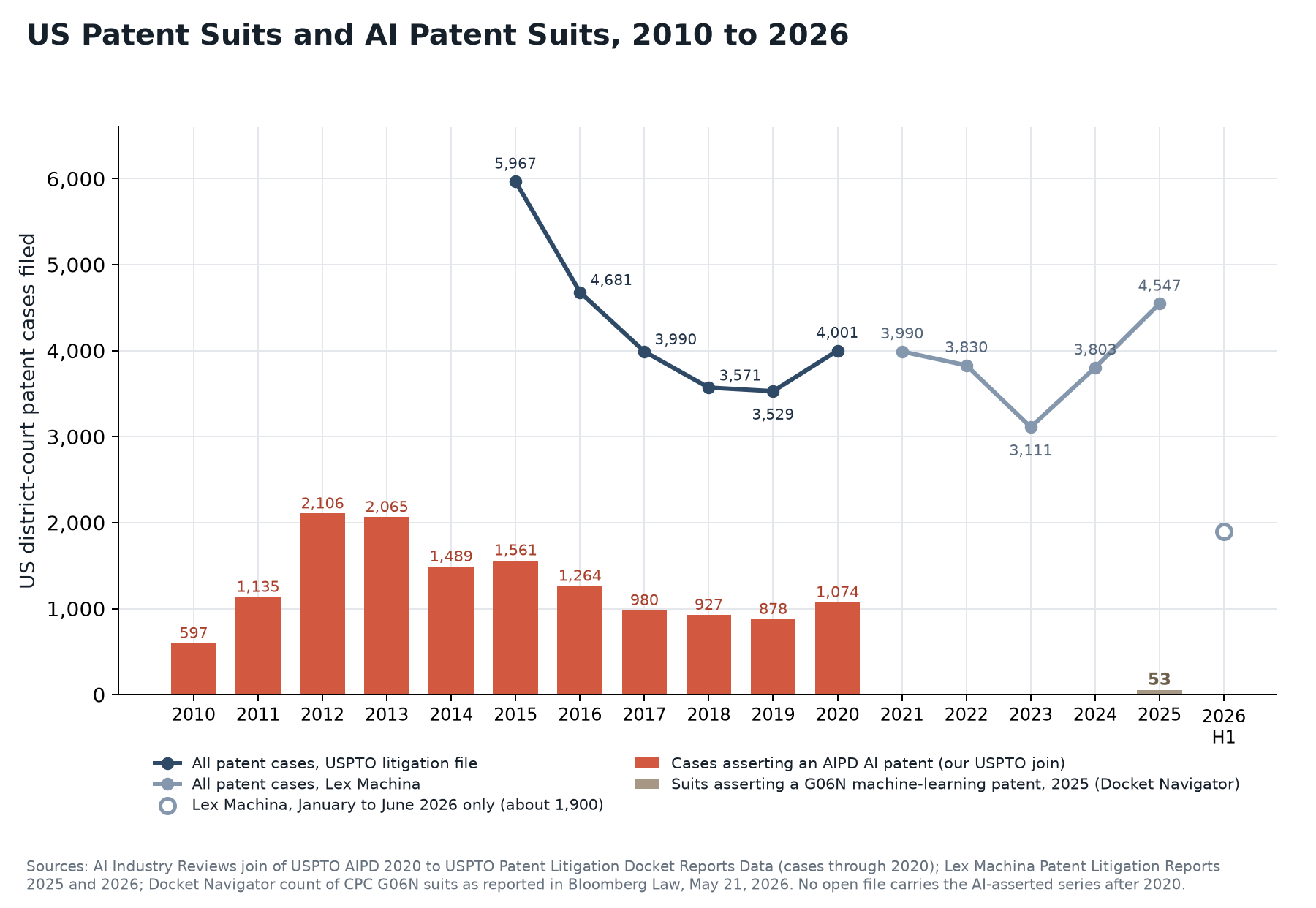
- AI patent cases peaked at 2,106 filings in 2012 and fell to 878 by 2019. They rose 22.3% in 2020, to 1,074.
- Overall filings dropped to 3,111 in 2023, then climbed 19.6% in 2025, per Lex Machina. The first half of 2026 ran at about 1,900 cases.
- Docket Navigator's 2025 count covers only CPC class G06N, a narrow machine-learning class, while our AIPD series uses the USPTO's broader AI label. Anyone sizing AI patent exposure should keep the two measures separate.
AI Patent Suits Since 2021: What Published Counts Show
No court-data vendor publishes a free annual series of AI patent suits for 2021 to 2026. The published counts below each use a different definition, so we list them side by side.
Published AI Patent Litigation Counts, 2020 to 2026
| Measure | Figure | Period | Source |
|---|---|---|---|
| US district-court suits asserting a G06N patent | 53 | 2025 | Docket Navigator, via Bloomberg Law |
| AI-related patent lawsuits filed worldwide | More than 1,000, nearly two-thirds in the US | 2020 to Oct. 2025 | Exponent |
| Growth in US generative AI patent litigation | 500% | Since 2021 | Exponent |
| Litigation events, natural language processing patents | 880 | Cumulative to 2026 | LexisNexis IP |
| Litigation events, computer vision patents | 593 | Cumulative to 2026 | LexisNexis IP |
| Litigation events, machine learning patents | 158 | Cumulative to 2026 | LexisNexis IP |
| Litigation events, generative AI patents | 14 | Cumulative to 2026 | LexisNexis IP |
| Change in machine learning litigation events | More than 2.5 times | 2024 to 2025 | LexisNexis IP |
| AI patent families held by patent assertion entities | 393 | 2026 | LexisNexis IP |
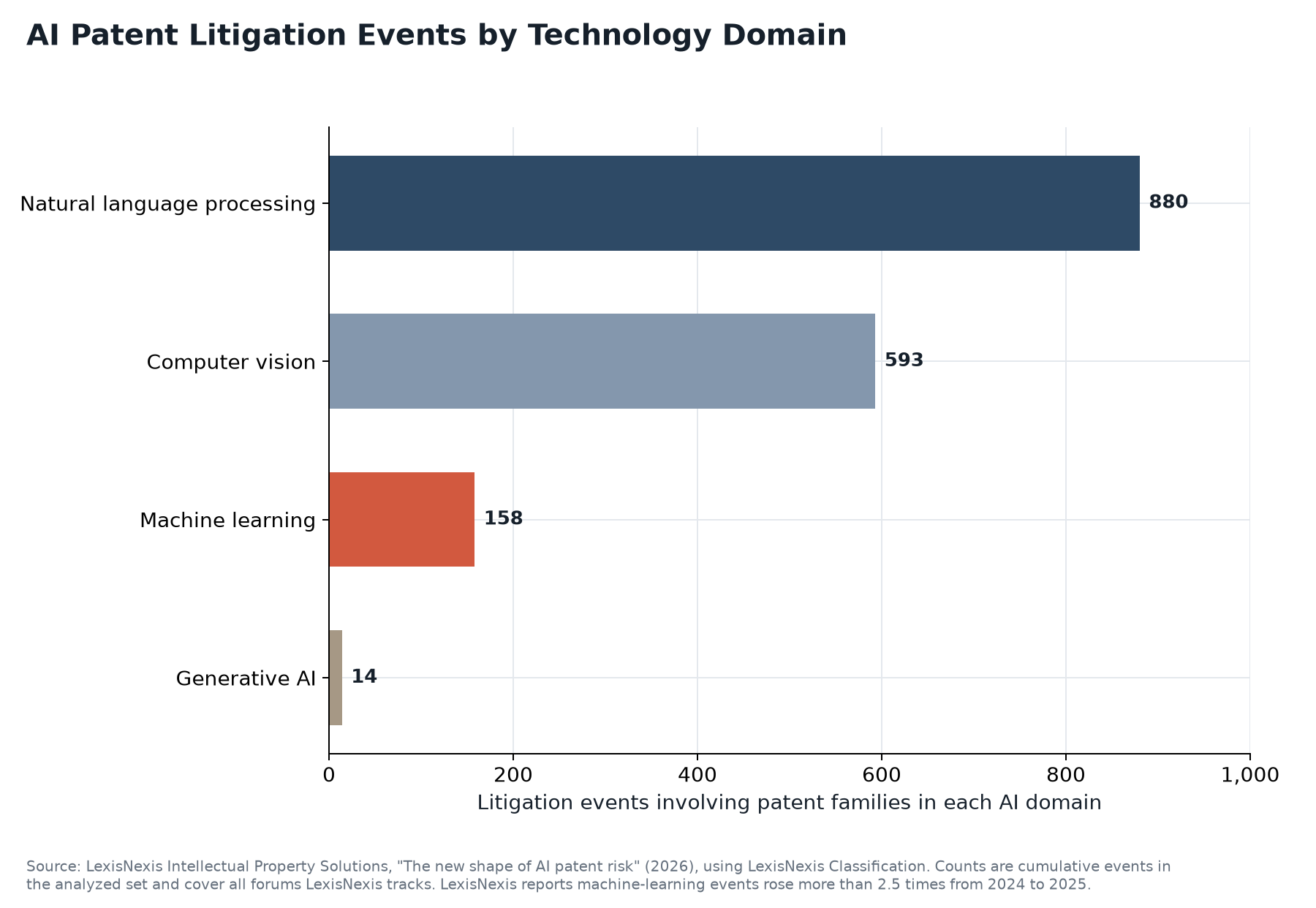
- Language and vision patents account for most AI litigation events in the LexisNexis set. Generative AI patent families have drawn few suits so far.
- LexisNexis found the top 15 assertion entities hold about 80% of the AI patent families owned by such entities, and the top five about 68%. A small group of licensing firms controls most of the AI patents held for assertion.
- Machine learning events rose more than 2.5 times from 2024 to 2025, which LexisNexis describes as the strongest recent increase of the four domains. For companies that train or deploy models, that is the category to watch in the next vendor update.
Major AI Patent Suits and Rulings, 2021 to 2026
These cases and decisions shaped how AI patents are asserted and defended in the US. We drew them from court opinions, USPTO decisions, dockets and news coverage.
Selected AI Patent Cases and Decisions, 2021 to 2026
| Year | Case or Decision | Forum | What Happened |
|---|---|---|---|
| 2021 | IPA Technologies v. Amazon | D. Del. | Judge Andrews granted Amazon summary judgment of noninfringement on Alexa voice-assistant patents in October 2021. |
| 2022 | Thaler v. Vidal | Fed. Cir. | Held on Aug. 5, 2022 that an AI system cannot be an inventor under the Patent Act. |
| 2023 | VB Assets v. Amazon | D. Del. | A jury awarded $46.7 million over Alexa patents in November 2023. Final judgment of $40,007,600 entered May 16, 2025, with ongoing royalties of $0.45 per new Alexa user. |
| 2024 | Singular Computing v. Google | D. Mass. | Settled Jan. 24, 2024 during trial. Singular had sought $1.67 billion over Google's TPU AI chips. |
| 2024 | ParTec v. Microsoft | E.D. Tex. | Filed June 10, 2024 over supercomputing technology used for Azure AI. Settled May 8, 2026. |
| 2024 | Xockets v. Nvidia, Microsoft and RPX | W.D. Tex. | Filed Sept. 5, 2024, asserting seven data processing unit patents alongside antitrust claims. |
| 2025 | Recentive Analytics v. Fox Corp. | Fed. Cir. | Held on Apr. 18, 2025 that claims applying generic machine learning to a new data environment are patent-ineligible. |
| 2025 | Sanas.AI v. Krisp Technologies | N.D. Cal. | Filed July 7, 2025 on six AI voice patents. The court denied Krisp's eligibility challenge in February 2026. |
| 2025 | Ex parte Desjardins | USPTO Appeals Review Panel | Vacated an eligibility rejection of machine learning training claims on Sept. 26, 2025. Designated precedential Nov. 4, 2025. |
| 2026 | www.ai.law v. Butler Labs (Eve Legal) | N.D. Cal. | Filed June 17, 2026, asserting U.S. Patent 12,461,932 against a legal AI platform. |
| 2026 | Univ. of Tennessee Research Foundation v. Anthropic | D. Del. | Filed July 20, 2026, asserting U.S. Patents 10,019,470 and 10,095,718 on neural networks against Claude Code. |
- Voice assistants drew the first large AI patent fights, with Alexa facing two separate plaintiffs. AI chips and cloud infrastructure followed in 2024 with suits against Google, Microsoft and Nvidia.
- RPX tracked new AI campaigns in late 2025, including Arlington Technologies on AI avatar and speech systems and Tesseract Systems on neural network training frameworks. The 2026 suits against Anthropic and Eve Legal reach AI application developers.
- Recentive and Desjardins pull eligibility in two directions, with the Federal Circuit rejecting generic machine learning claims and the USPTO accepting claims tied to training improvements. Patent owners and defendants should test AI claims against both decisions before filing or answering.
Overall US Patent Litigation, 2021 to 2026
AI suits are part of the wider patent docket, which three trackers count in different ways. Lex Machina and Unified Patents publish curated case counts, while CourtListener counts dockets marked with the patent nature-of-suit code.
US District-Court Patent Cases Filed, by Tracker, 2021 to 2026
| Year | Lex Machina | Unified Patents | CourtListener Dockets | NPE Share (Unified) |
|---|---|---|---|---|
| 2021 | 3,990 | - | 3,355 | - |
| 2022 | 3,830 | - | 2,745 | Nearly 60% |
| 2023 | 3,111 | - | 2,684 | 58% |
| 2024 | 3,803 | 4,053 | 3,045 | 51.8% |
| 2025 | 4,547 | 4,531 | 3,395 | 55.4% |
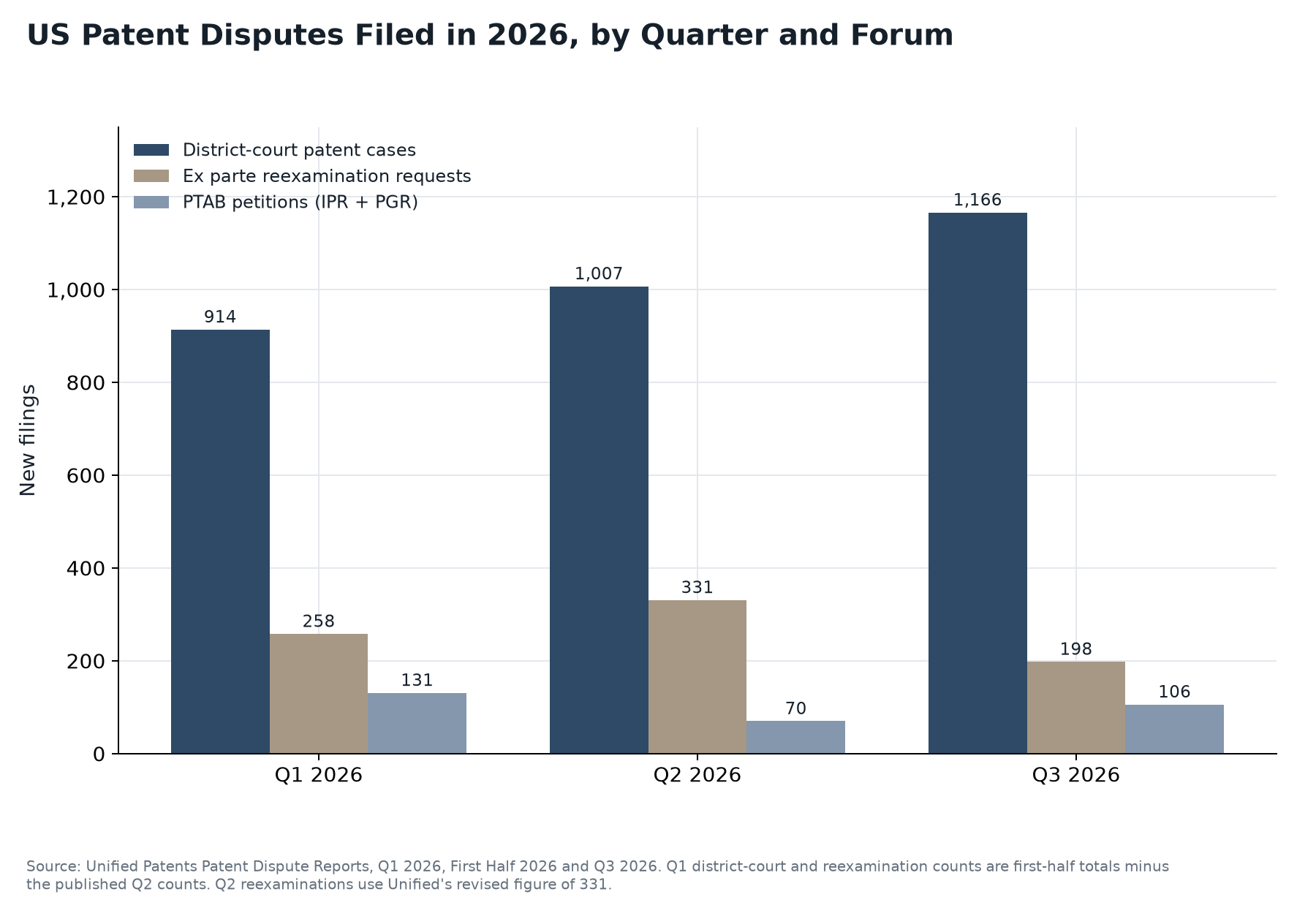
| 2026 | About 1,900 (January to June) | 1,921 (January to June); 1,166 (Q3) | 2,564 (through Oct. 18) | 50.5% (January to June); 55.7% (Q3) |
- Lex Machina's 2025 total was the highest of the 2016 to 2025 decade. Unified Patents' count for the same year lands within 16 cases of it.
- Unified Patents counted 18.4% fewer district-court cases in the first half of 2026 than a year earlier. Q3 2026 filings rose to the highest quarterly level of the year.
- Courts awarded $2.353 billion in patent damages across 63 cases in 2025, per Lex Machina, down from $3.48 billion in 2024. Lex Machina counted $8.156 billion in reasonable royalties from 2023 through 2025, against $582 million in lost profits, so royalty-rate evidence drives most damages exposure.
Who Files AI Patent Suits
Patent assertion entities (PAEs) are firms whose main business is licensing and suing on patents. Unified Patents and RPX use the broader term non-practicing entities (NPEs). We labeled each AI patent case's first-listed plaintiff with a name screen: an LLC or Ltd whose name also contains tokens such as IP, Patent, Licensing, Holdings or Technologies. The screen misses assertion entities with ordinary corporate names, so it gives a lower bound.
AI Patent Cases by Plaintiff Name Screen, 2015 to 2020
| Year Filed | PAE-Like Name | Other Plaintiffs | PAE-Like Share |
|---|---|---|---|
| 2015 | 347 | 1,197 | 22.5% |
| 2016 | 207 | 1,042 | 16.6% |
| 2017 | 170 | 810 | 17.3% |
| 2018 | 168 | 757 | 18.2% |
| 2019 | 140 | 738 | 15.9% |
| 2020 | 224 | 850 | 20.9% |
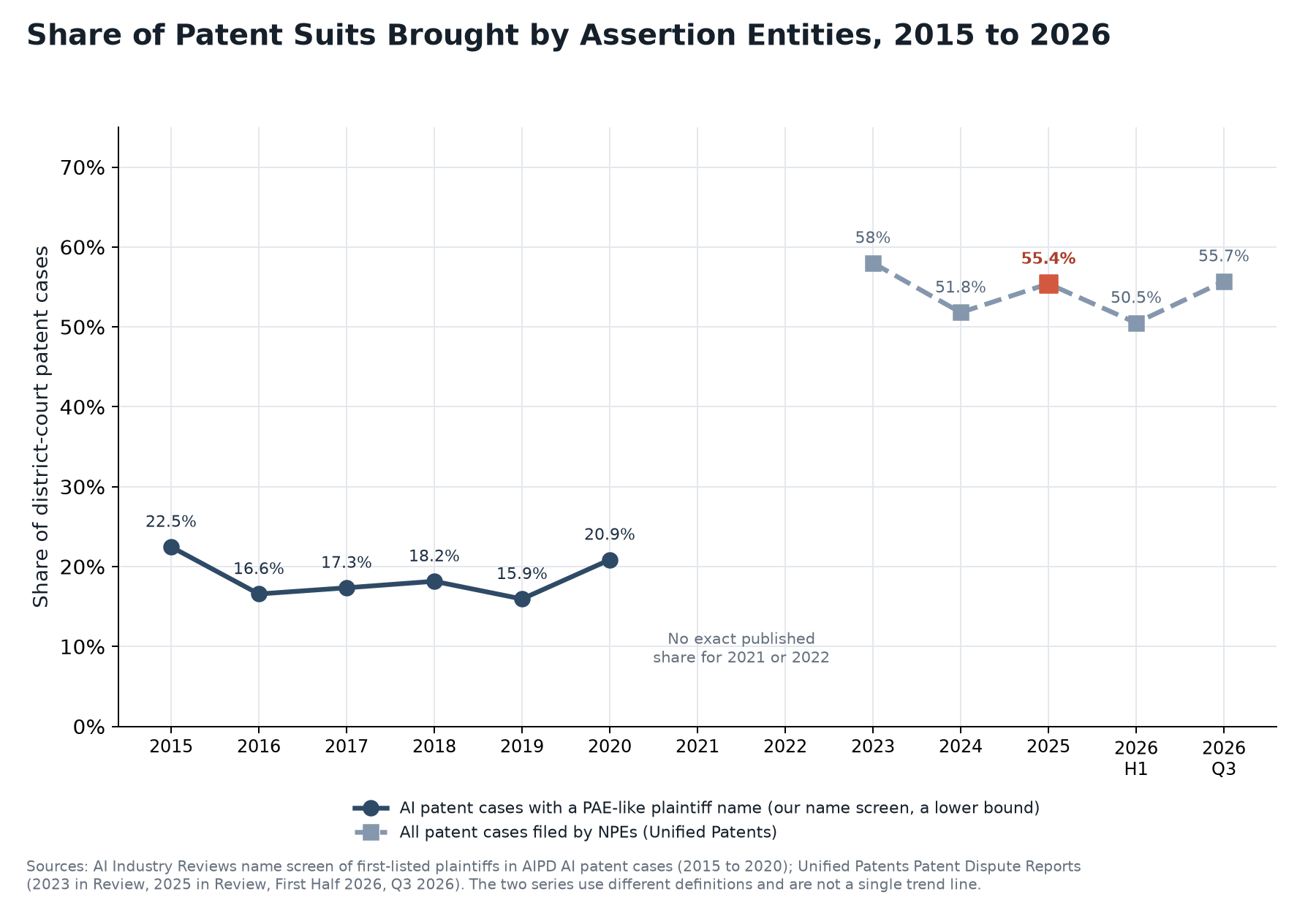
- Under our name screen, PAE-like plaintiffs filed 15.9% to 22.5% of AI patent cases each year from 2015 through 2020.
- Unified Patents, which classifies plaintiffs by business model, puts NPEs at 55.4% of all patent suits in 2025. NPEs filed 87.7% of high-tech patent suits in Q3 2026.
- For software and device makers, that makes licensing entities the most common source of patent suits.
Defendants Added to US Patent Suits by Plaintiff Type, 2021 to 2025 (RPX)
| Year | NPE Suits | Operating-Company Suits | Total |
|---|---|---|---|
| 2021 | 2,338 | 1,179 | 3,517 |
| 2022 | About the same as 2021 | 12% fewer than 2021 | - |
| 2023 | 1,553 | 1,005 | 2,558 |
| 2024 | 1,884 | 1,075 | 2,959 |
| 2025 | 2,236 | 1,190 | 3,426 |
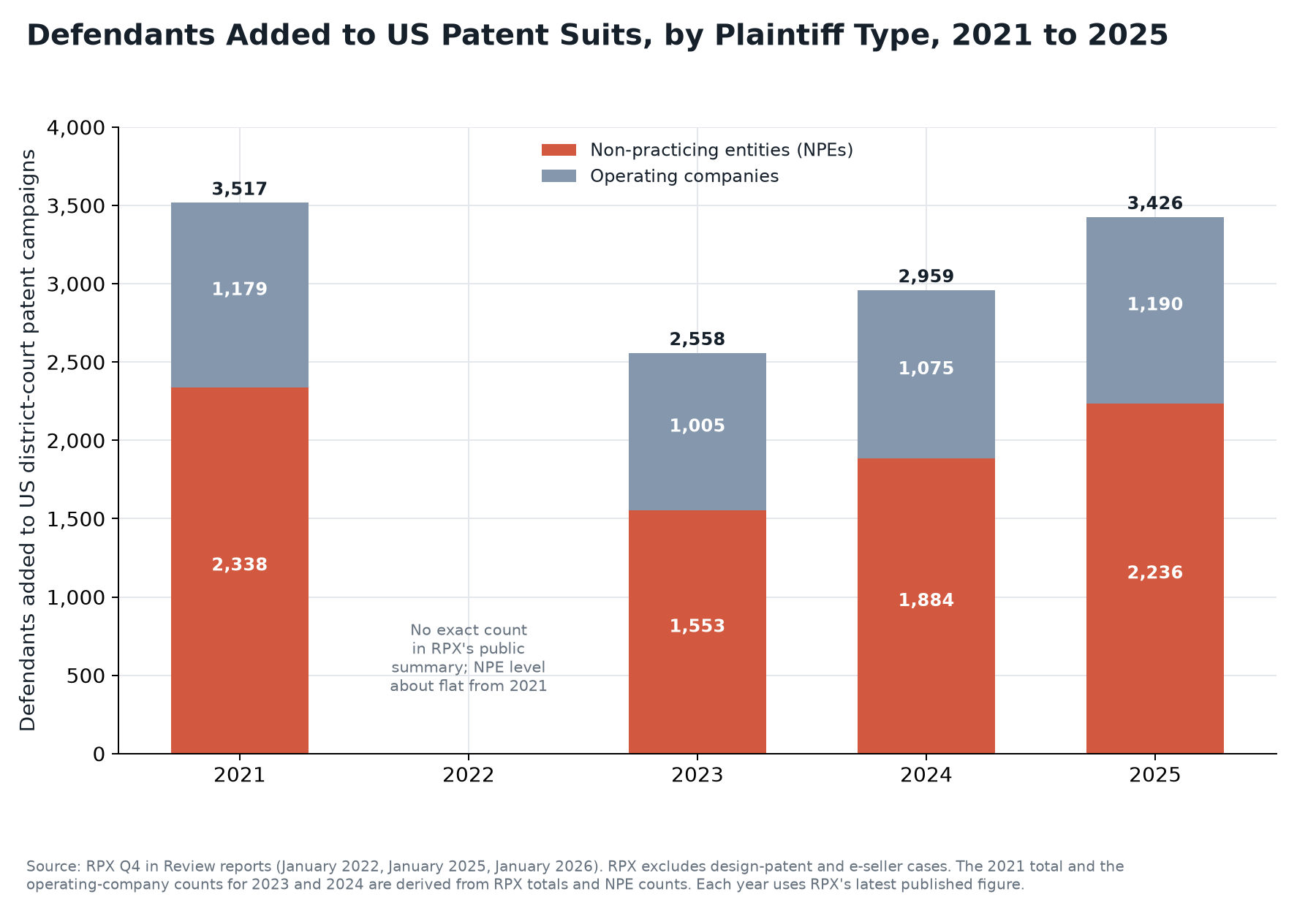
- RPX counted 2,236 defendants added in NPE suits in 2025, up 44% from 2023. Operating-company litigation grew more slowly over the same period.
- NPE defendant counts in 2025 were just below the 2021 level. Companies facing repeat campaigns can use these counts to benchmark how often they are pulled into suits.
Where AI Patent Cases Are Filed
Counting patent-in-suit rows by district shows where AI patents were asserted most often through 2020. Lex Machina's district counts cover all patent cases from 2022 onward.
Top Districts by AI Patent Assertions (Patent-in-Suit Rows), Cases Through 2020
| District | AI Patent-in-Suit Rows |
|---|---|
| E.D. Tex. | 9,872 |
| D. Del. | 5,182 |
| N.D. Cal. | 3,243 |
| C.D. Cal. | 2,343 |
| N.D. Ill. | 1,757 |
| W.D. Tex. | 1,342 |
| S.D. Fla. | 1,292 |
| S.D.N.Y. | 962 |
| E.D. Va. | 656 |
| D.N.J. | 632 |
- The Eastern District of Texas leads with 9,872 AI patent-in-suit rows, almost twice Delaware's total.
- Five of the top six districts are in Texas, Delaware or California. AI patent risk concentrates in a few courts whose judges and local rules shape defense costs.
All Patent Cases Filed in Leading Districts, 2022 to 2025 (Lex Machina)
| District | 2022 | 2023 | 2024 | 2025 |
|---|---|---|---|---|
| E.D. Tex. | 470 | 627 | 1,069 | 1,245 |
| W.D. Tex. | 878 | 519 | 375 | 531 |
| D. Del. | 668 | 428 | 395 | 530 |
| N.D. Ill. | 216 | 235 | 426 | - |
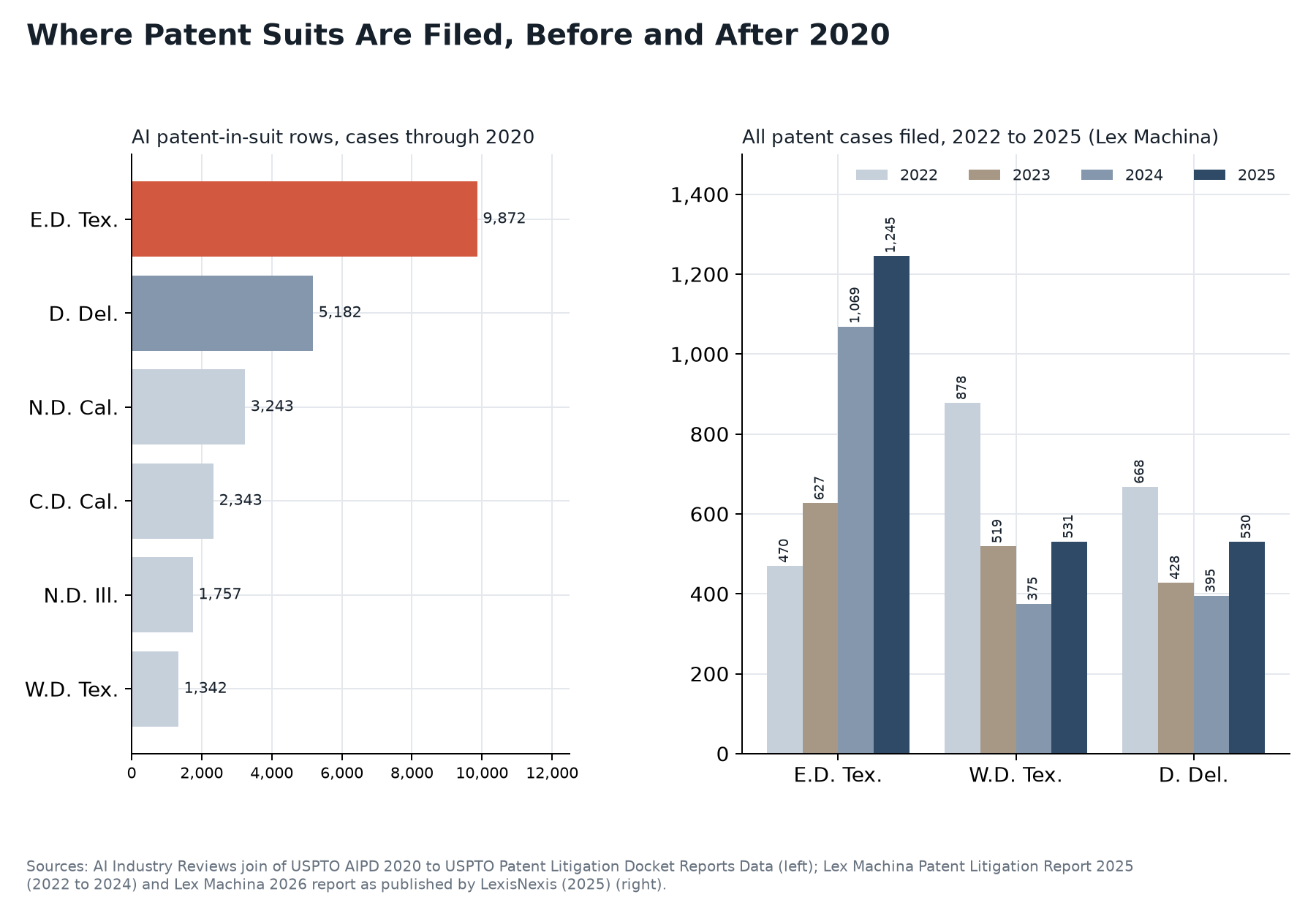
- W.D. Tex. led in 2022, then fell behind as E.D. Tex. more than doubled its caseload by 2024.
- Lex Machina counted 2,941 E.D. Tex. cases from 2023 through 2025, or 25.7% of all filings, with 2,276 assigned to Judge Rodney Gilstrap. Unified Patents put the district at 34.3% of Q3 2026 filings.
- E.D. Tex. drew more patent cases than any other district in 2025 in both Lex Machina and RPX counts. For an AI company, a new patent suit is more likely to be filed there than in any other court, so defense budgets should assume that court's procedures.
Who Gets Sued on AI Patents
For cases filed from 2015 through 2020 that asserted an AIPD AI patent, we counted defendant rows in the USPTO litigation names file. The 2025 and 2026 lists cover all patent cases.
Most Frequent Defendants in AI Patent Cases, 2015 to 2020
| Defendant (as filed) | Defendant Rows |
|---|---|
| Microsoft Corporation | 99 |
| Apple Inc. | 92 |
| Samsung Electronics Co., Ltd. | 77 |
| Samsung Electronics America, Inc. | 77 |
| Hewlett Packard Enterprise Co. | 73 |
| Amazon Web Services, Inc. | 67 |
| Google LLC | 61 |
| Amazon.com, Inc. | 54 |
| LG Electronics, Inc. | 54 |
| ZTE (USA) Inc. | 51 |
- Microsoft and Apple top the 2015 to 2020 list, with two Samsung entities tied for third.
- Amazon appears under both Amazon Web Services and Amazon.com, so family totals run higher than any single row. Cloud, device and computer companies make up the whole top ten.
Most Frequent US Patent Defendants, 2025 and First Half of 2026
| Rank | 2025 Defendant | 2025 Cases | H1 2026 Defendant | H1 2026 Cases |
|---|---|---|---|---|
| 1 | Apple | 49 | Samsung | 34 |
| 2 | Samsung Electronics America | 48 | Apple | 25 |
| 3 | Samsung Electronics | 47 | 22 | |
| 4 | 32 | Amazon | 19 | |
| 5 | Amazon | 27 | Zydus | 18 |
- The 2025 column comes from Lex Machina and the 2026 column from Unified Patents, which groups corporate families. Meta and Microsoft each faced 11 suits in the first half of 2026.
- Apple, Samsung and Google led again in Q3 2026. The device and cloud companies at the top of the AI patent defendant list through 2020 still top the overall patent defendant lists in 2025 and 2026.
PTAB Challenges to Patents, FY 2021 to FY 2026
Defendants often answer a suit by asking the Patent Trial and Appeal Board to cancel the asserted claims through inter partes review (IPR) or post-grant review (PGR), the two trial types created by the America Invents Act (AIA). USPTO statistics do not break out AI patents, so we show the electrical and computer category, where software patents are grouped.
PTAB AIA Trial Petitions and Institution Rates by Fiscal Year
| Fiscal Year | Petitions | IPR | PGR | Electrical/Computer | Institution Rate |
|---|---|---|---|---|---|
| FY 2021 | 1,401 | 1,308 | 93 | 904 | 58% |
| FY 2022 | 1,367 | 1,320 | 47 | 892 | 66% |
| FY 2023 | 1,239 | 1,209 | 30 | 861 | 67% |
| FY 2024 | 1,288 | 1,250 | 38 | 887 | 68% |
| FY 2025 | 1,433 | 1,361 | 72 | 967 | 50% |
| FY 2026 | 500 | 452 | 48 | 331 | 41% |
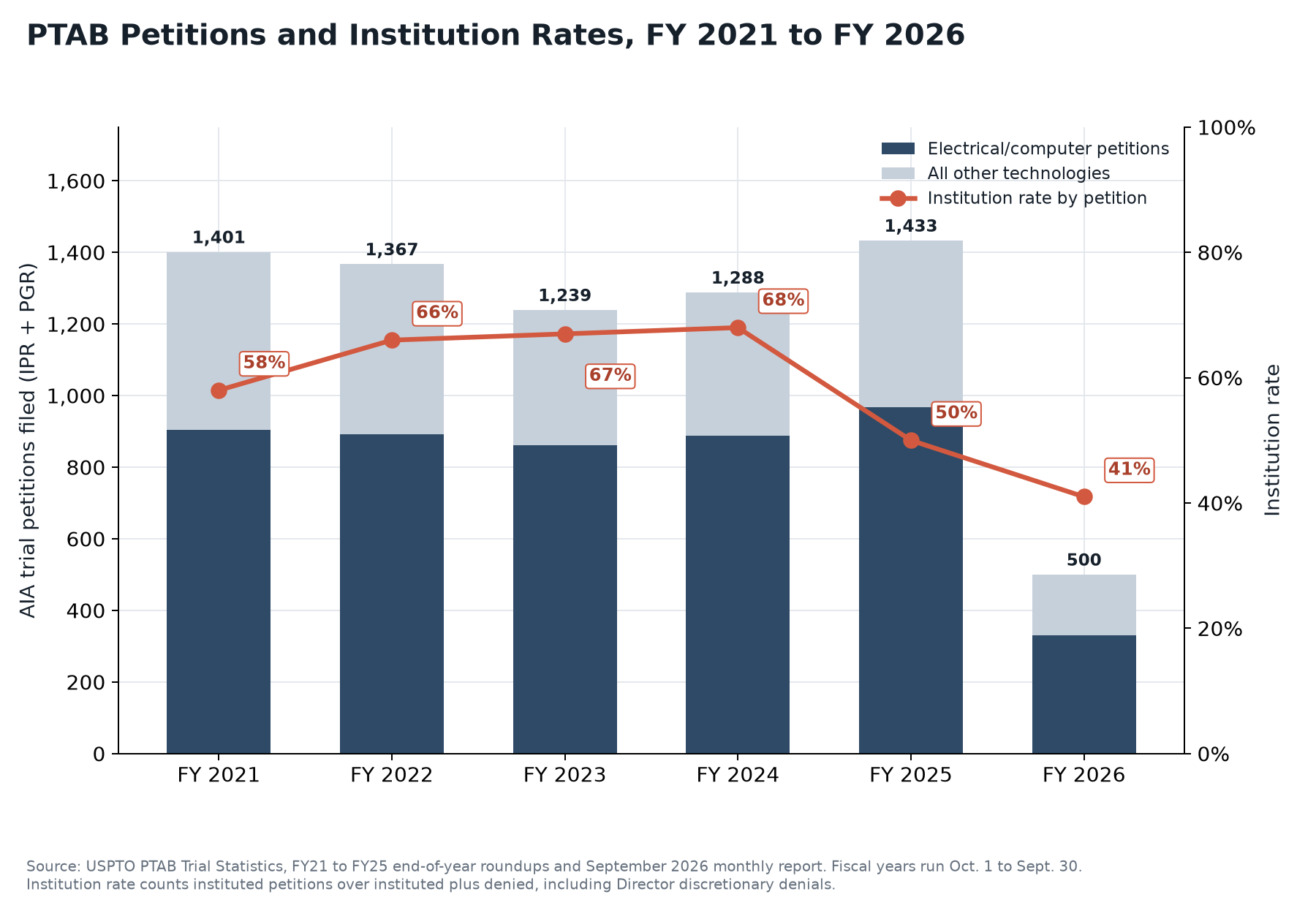
- Petitions fell from 1,433 in FY 2025 to 500 in FY 2026. Electrical and computer patents drew 66.2% of FY 2026 petitions.
- The USPTO denied 438 FY 2026 petitions on discretionary grounds and 114 on the merits. Unified Patents tracked the IPR institution rate falling from 81.8% in January 2025 to 19.4% in August 2025, then reaching 57.3% in Q3 2026.
- Ex parte reexamination requests rose from 437 in 2024 to 726 in 2025, per Unified Patents. AI defendants should budget for reexamination and district-court invalidity defenses when an IPR may not be instituted.
For machine learning patents specifically, Sidley's Alexis Cohen reported in Bloomberg Law that patent owners at least partly prevailed in most PTAB challenges to G06N patents. Most G06N district-court cases ended in settlement, dismissal or invalidity rulings, according to the same analysis.
AI Patent Grants Behind the Litigation
AIPD classifies granted US patents through 2020. The stock of AI patents grew steadily in the decade before our litigation join ends.
Granted US Patents Labeled AI by AIPD, 2010 to 2020
| Grant Year | AI Patents Granted | With Machine Learning Component | With Vision Component |
|---|---|---|---|
| 2010 | 28,465 | 3,318 | 6,873 |
| 2012 | 35,940 | 4,017 | 9,723 |
| 2014 | 44,132 | 4,683 | 11,243 |
| 2016 | 43,186 | 4,422 | 11,812 |
| 2018 | 44,927 | 4,995 | 12,084 |
| 2019 | 58,806 | 8,260 | 17,152 |
| 2020 | 61,796 | 9,989 | 19,320 |
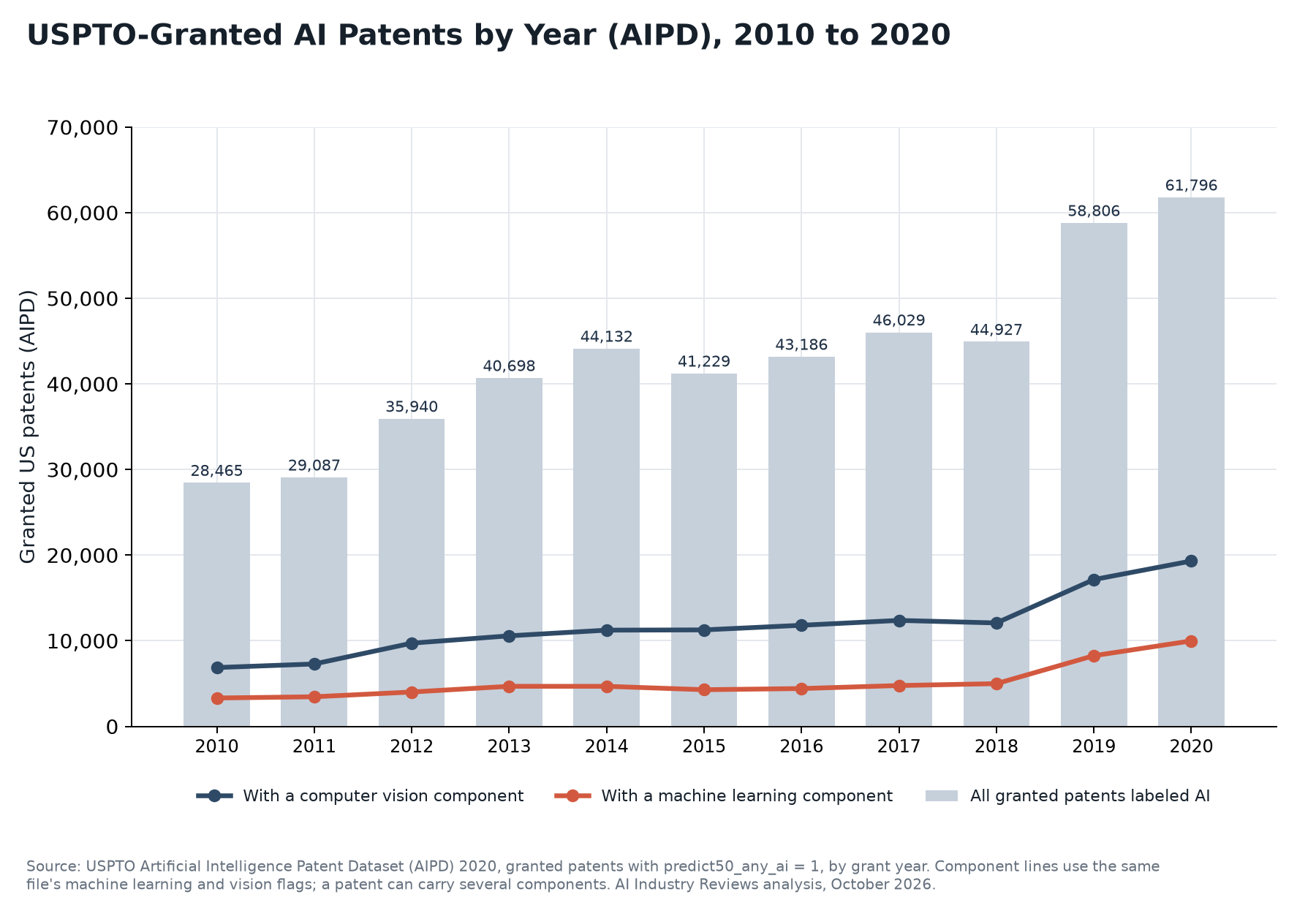
- AIPD counts 668,808 granted AI patents in its 2020 release. Annual grants more than doubled from 2010 to 2020.
- Among 2015 to 2020 AI patent cases, patents with AIPD planning components appear in 5,089 cases and machine learning components in 652.
- Derwent counted more than 32,000 G06N grants in 2025, up from 426 in 2008. Sidley's Alexis Cohen argues in Bloomberg Law that this growing stock of patents points to more AI patent suits in the next several years.
What These Numbers Mean for AI Companies
For companies that build or sell AI products, patent suits so far have come mostly from licensing firms holding older speech, language and vision patents, and they have fallen mostly on large device and cloud companies. The 2026 suits against Anthropic and Eve Legal show the same kind of claim now reaching companies that build AI models and AI applications.
The ways to answer a suit are changing too. Since 2025 the PTAB has instituted far fewer challenges, so defendants have turned to ex parte reexamination and to eligibility motions under Recentive, while patent owners with specific training or model improvements can point to Desjardins when drafting claims.
So if you build or license AI systems, check language, vision and model-training features for patent exposure before launch, and plan for an invalidity defense in district court that does not depend on the PTAB taking the case.
Data Collection and Methodology
AI patents through 2020: We used the USPTO Artificial Intelligence Patent Dataset (AIPD) 2020 from the USPTO Office of the Chief Economist archive on Zenodo (record 17268251). We kept granted patents (flag_patent = 1) with predict50_any_ai = 1, yielding 668,808 patents. Component flags come from the same file.
Litigation through 2020: We used the USPTO Patent Litigation Docket Reports Data from the same archive (patents.csv, cases.csv, names.csv). A case counts as an AI patent case if patents.csv lists at least one patent that matches an AIPD AI granted patent. We count unique cases by filing year; all-patent totals come from cases.csv. Patent-in-suit rows are individual patents.csv rows.
Plaintiff screen and defendants: For each AI patent case we took the first plaintiff in names.csv and labeled it PAE-like if it is an LLC or Ltd-style entity whose name contains tokens such as IP, Patent, Licensing, Holdings, Technologies, Innovations, Partners, Capital, Ventures, Assert, Monetiz or Intellectual. Defendant counts are names.csv rows with a defendant party type on cases filed 2015 to 2020; corporate families are not merged. We left out Blitzsafe Texas, LLC (56 rows) and Genaville LLC (53 rows), patent-asserting plaintiffs that also carry defendant-type rows in the file. ZTE (TX) Inc. ties ZTE (USA) Inc. at 51 rows.
Published figures for 2021 to 2026: We compiled counts from the public summaries, press releases and reports listed in Sources, retrieved October 2026, and copied them at the precision each source published. Vendors revise earlier years in later editions. Lex Machina's 2025 report gives 3,990 cases for 2021 and 3,830 for 2022; its 2026 report gives 3,111 for 2023, 3,803 for 2024 and 4,547 for 2025 (its 2025 report had 3,115 and 3,806). We use the latest edition for each year. Lex Machina's 2025 report put 2024 damages at more than $4.3 billion; its 2026 report, as reported by Global Legal Post, gives $3.48 billion, which we use. RPX revised 2024 NPE defendants from 1,889 to 1,884, and we use 1,884. Unified Patents revised Q2 2026 NPE cases from 489 to 507 and Q2 reexamination requests from 336 to 331. The 2021 RPX total, RPX operating-company counts for 2023 and 2024, and Q1 2026 district-court (914) and reexamination (258) counts are our subtraction from published totals. Percentages we computed are rounded once to one decimal.
Years without AI-specific counts: We found no published annual count of US district-court suits asserting AI patents for 2021, 2022, 2023, 2024 or 2026. The only annual AI-specific suit count we found is Docket Navigator's 53 G06N suits in 2025, reported by Bloomberg Law. Exponent and LexisNexis IP publish multi-year or cumulative AI figures, which we report as published. RPX did not publish exact 2022 defendant counts in its public summary, and we found no exact Unified Patents NPE share for 2021. We excluded counts that combine patent suits with copyright and other AI litigation, and a widely repeated 2023 figure we could not trace to a primary source.
Attempted open extension: The USPTO litigation docket file (updated March 2024) still ends with 2020 filings. AIPD 2023 is listed on the USPTO Open Data Portal, but its bulk file was not downloadable during this build, so the grants table and chart stay at 2020. A CourtListener RECAP pilot that matched complaint patent numbers to AIPD and to 84,749 PatentsView CPC G06N patents stopped at 20 dockets because of API rate limits; 3 of those 2025 dockets asserted an AIPD AI patent, too few to publish as a series. CourtListener docket counts in the litigation table cover all patent suits.
Definitions: Lex Machina, Unified Patents, RPX and CourtListener each define a case differently; RPX counts defendants added to campaigns and excludes design-patent and e-seller cases. NPE share uses Unified Patents' classification. USPTO PTAB counts use fiscal years ending Sept. 30, and the institution rate counts instituted petitions over instituted plus denied petitions, including discretionary denials. Unified Patents PTAB and reexamination counts use calendar periods. CPC G06N covers computing systems based on specific computational models, a narrower group than AIPD's any-AI label. All money figures are in US dollars as published.
Sources
- AI Industry Reviews, AI Patent Litigation Study: AIPD 2020 joined to USPTO Patent Litigation Docket Reports Data, conducted October 2026.
- USPTO Office of the Chief Economist, Artificial Intelligence Patent Dataset (AIPD) 2020, and USPTO Patent Litigation Docket Reports Data, via Zenodo 10.5281/zenodo.17268251.
- Lex Machina, 2026 Patent Litigation Report press release, Aug. 5, 2026.
- Lex Machina, Patent Litigation Trends, 2026.
- Lex Machina, 2025 Patent Litigation Report press release, 2025.
- Lex Machina, 2024 Patent Litigation Report press release, 2024.
- Global Legal Post, US district court patent filings hit 10-year high in 2025, 2026.
- Unified Patents, Patent Dispute Report: Q3 2026, Oct. 16, 2026.
- Unified Patents, Patent Dispute Report: First Half 2026, July 9, 2026, and Q1 2026 report via Unified Patents Reports.
- Unified Patents, Patent Dispute Report: 2025 in Review, Jan. 13, 2026.
- Unified Patents, Patent Dispute Report: 2023 in Review, Jan. 8, 2024.
- Unified Patents, 2022 Patent Dispute Report, Jan. 4, 2023.
- RPX, Q4 in Review: USPTO Pushes Further IPR Limits, January 2026.
- RPX, Q4 in Review, January 2025.
- RPX, Q4 in Review: NPEs Cap Off a Busy 2021, January 2022.
- RPX via Legal 500, Q4 in Review: NPE Litigation Holds Steady in 2022, 2023.
- USPTO PTAB, FY21, FY22, FY23 and FY24 end-of-year trial statistics roundups.
- USPTO PTAB, Trial Statistics FY25 Q4 and Trial Statistics September 2026.
- Bloomberg Law, Alexis Cohen (Sidley), The AI Patent Litigation War Hasn't Started, But It's Coming Fast, May 21, 2026 (Docket Navigator and Derwent figures).
- LexisNexis Intellectual Property Solutions, AI litigation and licensing, 2026.
- Exponent, Preparing for Exponential Growth in AI Patent Litigation, Oct. 10, 2025.
- US Court of Appeals for the Federal Circuit, Thaler v. Vidal, No. 21-2347, Aug. 5, 2022.
- US Court of Appeals for the Federal Circuit, Recentive Analytics v. Fox Corp., No. 23-2437, Apr. 18, 2025.
- USPTO Appeals Review Panel, Ex parte Desjardins, Appeal 2024-000567, Sept. 26, 2025.
- Reuters, Amazon must pay $46.7 mln in voice-assistant patent case, Nov. 8, 2023, and PTAB record IPR2025-01167 for the final judgment.
- Reuters, Google settles AI-related chip patent lawsuit that sought $1.67 bln, Jan. 24, 2024.
- Bloomberg Law, Microsoft, ParTec Settle AI Supercomputer Tech Patent Dispute, 2026, and CourtListener docket 2:24-cv-00433.
- Reuters, Nvidia, Microsoft hit with patent lawsuit over AI computing technology, Sept. 5, 2024.
- US District Court for the Northern District of California, Sanas.ai Inc. v. Krisp Technologies Inc., 3:25-cv-05666.
- PacerMonitor, www.ai.law Corp. v. Butler Labs, Inc., 3:26-cv-05930.
- Bloomberg Law, Anthropic Hit With Patent Suit Over Claude AI Neural Networks, July 2026.
- CourtListener / Free Law Project, RECAP docket search, nature of suit Patent counts by filing year, retrieved Oct. 19, 2026.
- PatentsView, g_cpc_current bulk file, CPC subclass G06N patent identifiers, retrieved Oct. 19, 2026.