
Home / Research / AI Foundation Model Training Cost Statistics
AI Foundation Model Training Cost Statistics: 2026 Report
 By Darin ten Bruggencate, Founder, AI Industry Reviews · November 18, 2026
This report covers frontier and notable model training runs with published or estimated hardware, cost, or power figures. It compares amortized hardware-and-energy costs for the final training run, cloud-rental and upfront cluster figures where they exist, electrical power and energy, and the share of development cost that goes to staff instead of chips, and it sets those final-run costs against total R&D compute spending. Cost figures in 2023 US dollars form one comparable series. Later dollar figures are in the dollars of the year they were estimated.
Key Findings
- Grok 4's final training run cost an estimated $387.8 million in 2023 dollars for amortized hardware and energy, and $490 million in a later September 2025 estimate.
- We estimate the final training run for OpenAI's GPT-6 Astra, released September 3, 2026, at about $921 million, with 232.7 MW of power draw and about 502.6 GWh of electricity over roughly 90 days.
- Amortized training-run costs for frontier models have grown 2.4 times per year since 2016.
- Hardware accounts for 47% to 67% of full development cost, R&D staff for 29% to 49%, and energy for 2% to 6%.
- Final training runs took 9.6% of OpenAI's $5 billion in 2024 R&D compute spending, or about $480 million.
Training a foundation model is the multi-week, or multi-month, computing job that produces the large model a company later offers as a chatbot, an API, or an open-weight download. The bill for that final run is not the same as the price of fine-tuning an existing model, and it is not the price of answering user queries after the model is released. Public cost figures are scarce, they are usually estimates, not invoices, and they often mix the cost of buying a cluster with the smaller amount that can be attributed to one training run. Each figure below is shown with the method behind it. The tables below use model-level estimates current to November 13, 2026, plus our own calculations where a share, a unit conversion, or a clearly labeled estimate can be derived from those figures.
In the following sections, we set out the estimated cost of recent training runs, compare hardware, staff, and energy shares, report power and electricity use, and show how much of lab compute spending goes to the run that produces a named model.
How Much Does a Final Training Run Cost?
The main cost series is the amortized cost of the chips, servers, interconnect, and electricity used during the final training run, expressed in 2023 dollars so older and newer models can be compared. That figure is smaller than the cost of buying the cluster, and smaller than the cost of renting the same chips in the cloud. The table uses the comparable 2023-dollar series as the headline cost, and shows the other two methods where estimates exist.
Estimated final-training-run costs for selected foundation models
| Model | Organization | Publication date | Amortized hardware and energy (2023 USD) | Cloud-rental estimate | Upfront hardware (cluster) | Hardware and quantity |
|---|---|---|---|---|---|---|
| GPT-4 (Mar 2023) | OpenAI | March 15, 2023 | $37.3 million | $81.4 million | $806.2 million | 25,000 NVIDIA A100 40 GB |
| Gemini 1.0 Ultra | Google DeepMind | December 6, 2023 | $30.7 million | $206.1 million | $619.5 million | 57,000 Google TPU v4 |
| Claude 3.5 Sonnet | Anthropic | June 20, 2024 | $25.9 million | Not published | Not published | Not published |
| Llama 3.1-405B | Meta AI | July 23, 2024 | $52.9 million | $176.0 million | $928.4 million | 16,384 NVIDIA H100 80 GB |
| Grok-2 | xAI | August 13, 2024 | $31.6 million | Not published | Not published | NVIDIA H100 80 GB |
| Grok 3 | xAI | February 17, 2025 | $217.8 million | $849.7 million | $4.45 billion | 80,000 NVIDIA H100 80 GB |
| GPT-4.5 | OpenAI | February 27, 2025 | $366.0 million | Not published | Not published | 187 million H100-hours, estimate |
| Llama 4 Behemoth (preview) | Meta AI | April 5, 2025 | $44.6 million | Not published | $1.78 billion | 32,000 NVIDIA H100 80 GB |
| Grok 4 | xAI | July 9, 2025 | $387.8 million | $490 million, later estimate | $10.72 billion | 200,000 accelerators |
| GPT-6 Astra | OpenAI | September 3, 2026 | $921 million, our estimate | Not published | Not published | At least 100,000 NVIDIA GB200 |
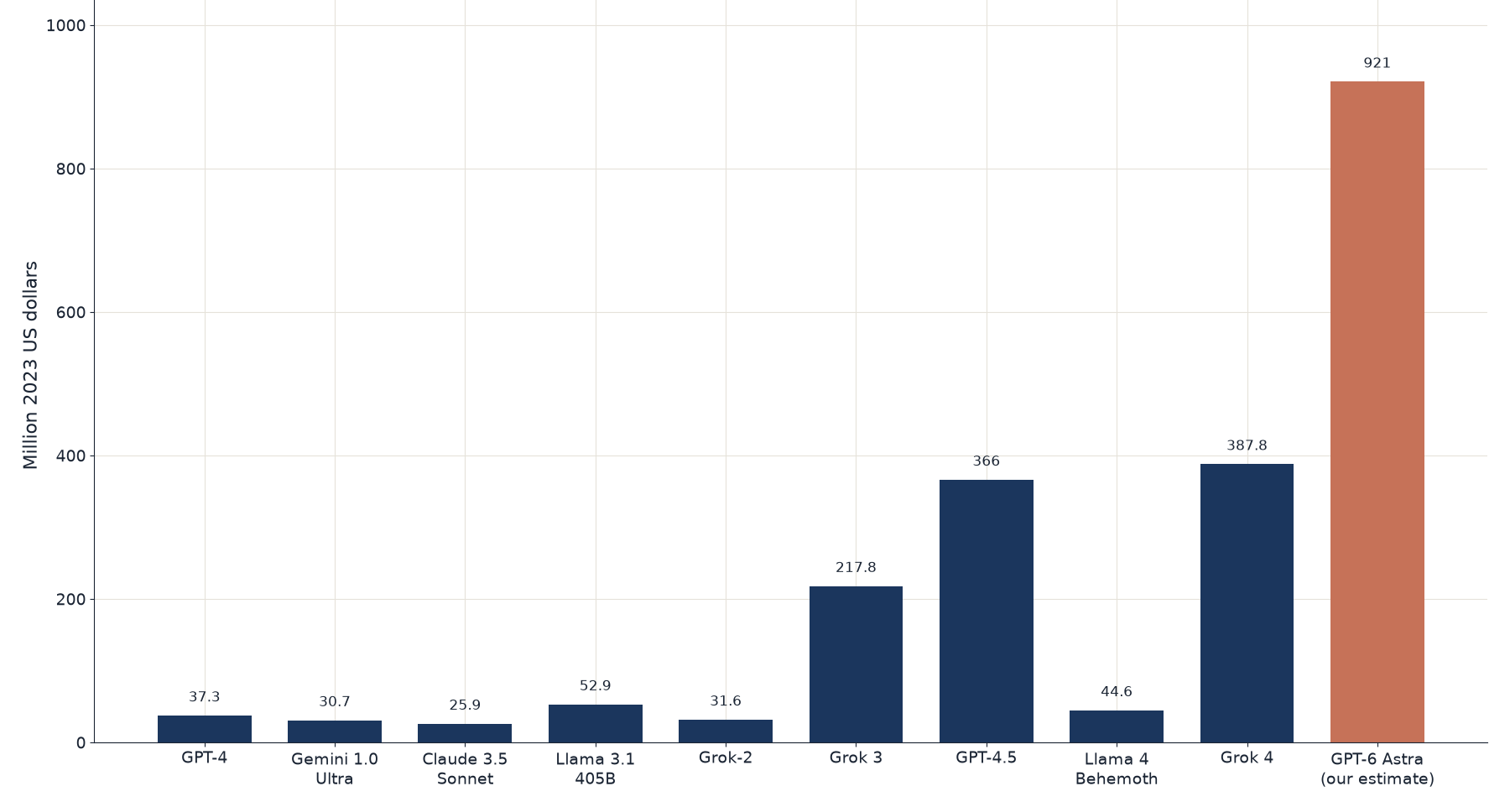
Estimated Amortized Final-Training-Run Cost by Model
Key Findings
- The comparable 2023-dollar series rises sharply from GPT-4 and Gemini Ultra, which are in the $30 million to $40 million range, to GPT-4.5 and Grok 4, which are in the mid-to-high hundreds of millions. Llama 4 Behemoth is an exception in that series, at $44.6 million, closer to Llama 3.1-405B than to the 2025 frontier-lab runs.
- Upfront cluster figures are much larger than the training-run costs and should not be quoted as the cost of training the model. Grok 4's $10.72 billion upfront figure is the estimated cost of the hardware pool, not the amount that can be attributed to one run.
- Anyone citing a single training cost should give the method with the number. Grok 4 is $387.8 million in the 2023-dollar amortized series and $490 million in a later estimate that used 246 million H100-hours and a rental range of $1.90 to $2.20 per H100-hour.
How Fast Have Training Costs Grown, and What Share Goes to Staff?
Amortized hardware-and-energy costs for 45 frontier models grew 2.4 times per year from 2016 to 2024, with a 90% interval of 2.0 to 3.1 times after later revisions. A cloud-rental method produced a similar growth rate, 2.6 times per year, but costs about twice as high on average, because many labs train on hardware they own. For a smaller set of models, including GPT-4 and Gemini Ultra, there are also estimates of full development cost that add experimental compute and R&D staff pay, including equity.
Breakdown of full development cost for selected frontier models
| Component | Share of estimated development cost |
|---|---|
| Hardware (accelerator chips, servers, and interconnect) | 47% to 67% |
| R&D staff, including equity | 29% to 49% |
| Energy | 2% to 6% |
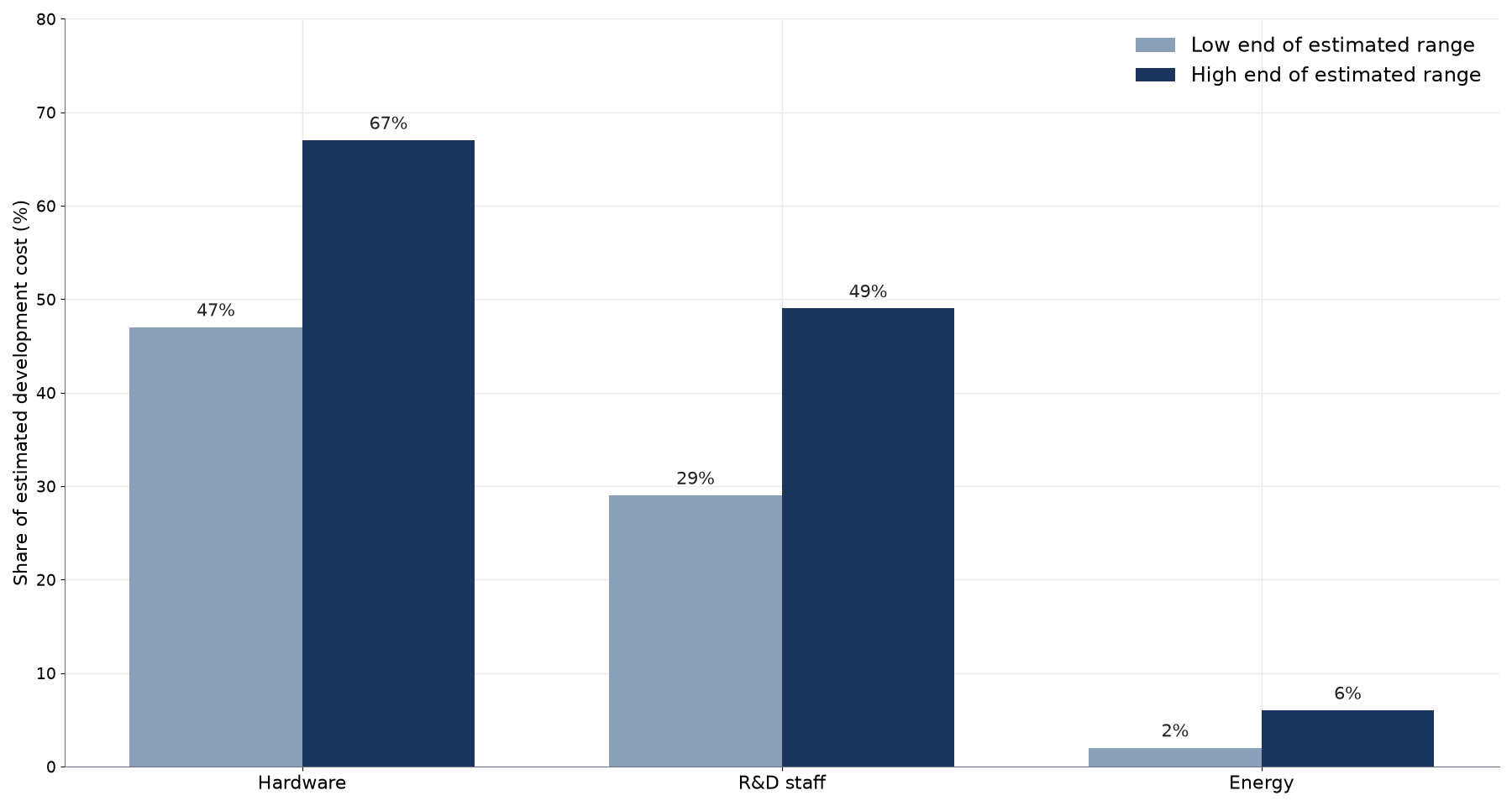
Hardware, Staff, and Energy Shares of Development Cost
Key Findings
- Staff costs are large even though they are not the largest slice. A training-run figure that covers only chips and electricity leaves out roughly one-third to one-half of full development cost for the models with detailed estimates.
- Energy is a small share of the dollar cost and a large physical requirement. Gemini Ultra needed an estimated 35 megawatts, and the later models in the table below draw far more.
- For a lab planning a frontier run, the published training-run cost is not a budget for the whole project. The R&D compute figures in the last section make the same point from the spending side: the named run is the last step in a much larger compute bill.
How Much Power and Electricity Do These Runs Use?
Power figures are shown in megawatts. Energy in gigawatt-hours is shown as a published total or as an estimate from power and duration.
Training power, duration, and electricity for selected models
| Model | Training power | Duration | Electricity | Notes |
|---|---|---|---|---|
| GPT-4 (Mar 2023) | 19.9 MW | 2,280 hours | 45.5 GWh, estimate | 25,000 A100s |
| Gemini 1.0 Ultra | 38.4 MW | 2,400 hours | 92.2 GWh, estimate | 57,000 TPU v4; an earlier estimate put power at 35 MW |
| Llama 3.1-405B | 22.6 MW | 2,142 hours | 48.5 GWh, estimate | 16,384 H100s |
| Grok 3 | 109.9 MW | 2,160 hours | 237.5 GWh, estimate | 80,000 H100s |
| Llama 4 Behemoth (preview) | 43.9 MW | Not published | Not published | 32,000 H100s |
| Grok 4 | Not published | Not published | 310 GWh | About 246 million H100-hours |
| GPT-6 Astra | 232.7 MW | About 90 days | 502.6 GWh, our estimate | At least 100,000 GB200s in Abilene, Texas; 90 days times 232.7 MW |
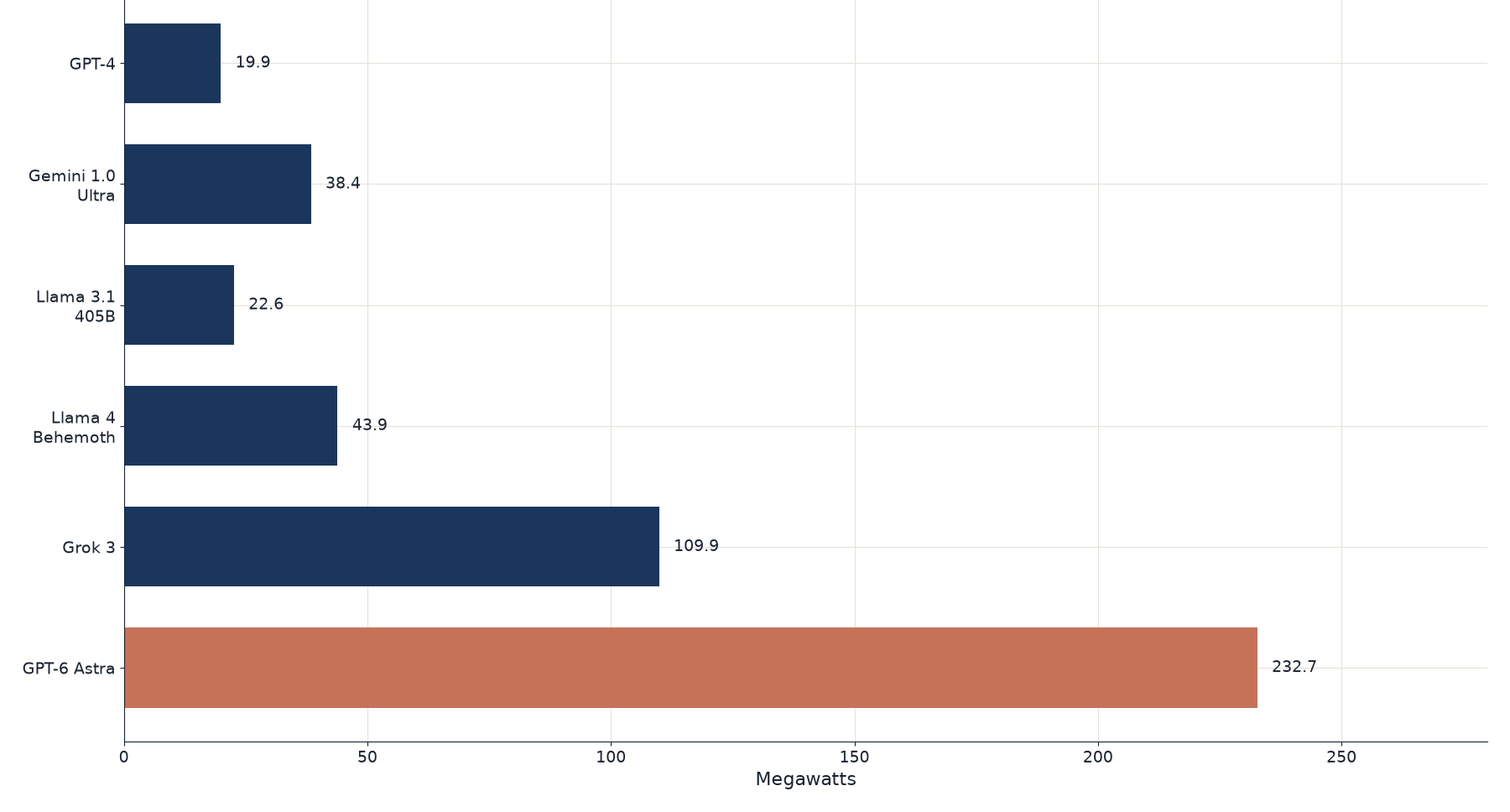
Training Power Draw for Selected Foundation Models
Key Findings
- Power draw has moved from tens of megawatts for GPT-4 and Gemini Ultra to more than 100 MW for Grok 3 and 232.7 MW for GPT-6 Astra. The largest training runs could draw 4 to 16 gigawatts by 2030 if recent trends hold.
- Electricity figures of 45.5 GWh for GPT-4, 92.2 GWh for Gemini 1.0 Ultra, 48.5 GWh for Llama 3.1-405B, and 237.5 GWh for Grok 3 are estimates from each model's power draw and duration. Grok 4's 310 GWh is a published energy total. The same run is estimated to have used 750 million liters of water and emitted about 140,000 to 154,000 tons of CO2, using a natural-gas emissions factor of 0.49 kilograms per kilowatt-hour.
- The 502.6 GWh figure for GPT-6 Astra is an estimate from its 232.7 MW power draw and 90-day duration. Electricity and cooling are the physical limits that show up first, even though energy is a small line in the cost breakdown.
How Much of R&D Compute Goes to the Final Run?
The figures above describe the run that produces a named model. Labs also spend compute on experiments, failed or unreleased training jobs, and synthetic data. The table below compares those final-run costs with disclosed R&D compute spending at OpenAI and, after their early-2026 Hong Kong listings, at MiniMax and Z.ai.
Final training runs as a share of R&D compute spending
| Organization | Period | R&D compute spending | Final-training-run share |
|---|---|---|---|
| OpenAI | 2024 | $5 billion | 9.6% |
| MiniMax | Fourth quarter of 2024 through third quarter of 2025 | $141 million | 22.6% |
| Z.ai | Second half of 2024 through first half of 2025 | $216 million | 12.3% |
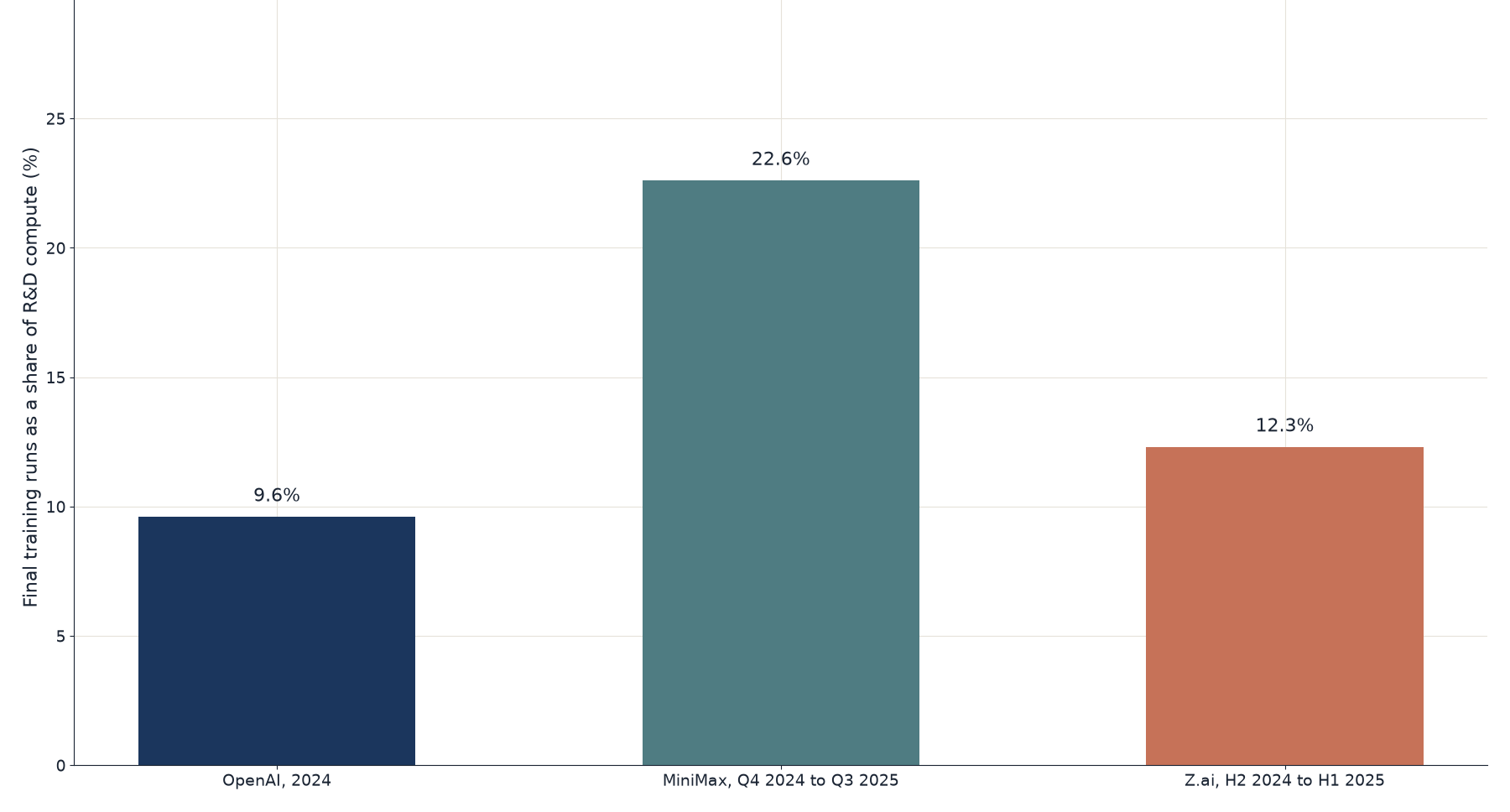
Final Training Runs as a Share of R&D Compute Spending
Key Findings
- At OpenAI, a 9.6% share means that about $480 million of the $5 billion 2024 R&D compute total went to final training runs for released models, with the rest going to other research compute. That $480 million is our calculation from the share and total.
- The two smaller Chinese firms also spent most of their disclosed R&D compute outside the final runs, even though their totals are much smaller than OpenAI's and their shares are higher.
- Anyone comparing the cost of GPT-4.5 with a company's compute budget should keep in mind that the named run can be large in isolation and still be a minority of what the lab spent that year to develop models.
What These Training Costs Mean for Frontier Model Development
The comparable estimates show a short list of US labs training models whose final runs now cost hundreds of millions of dollars, on clusters measured in tens of thousands of accelerators and in hundreds of megawatts. Those runs are still only one piece of the development bill. Staff, experimental compute, and the purchase of the cluster itself are larger items, and energy, while a small share of cost, is already a site-level power problem.
GPT-6 Astra's dollar figure is our estimate, scaled from the Grok 4 training-run cost by the two models' estimated training compute. Later 2026 GPT-6, Claude, and Gemini releases have no published dollar cost yet.
So if you are citing the cost of training a foundation model, say whether the figure is the amortized cost of the final run, a cloud-rental estimate, the price of the cluster, or a full development budget that includes staff, and name the year-dollar basis.
Methodology
Scope. This report covers estimated costs, hardware, power, and energy for the final training runs of notable foundation models, plus published shares for full development cost and R&D compute. It does not cover fine-tuning of already trained models or the cost of inference after release. All dollar figures are in US dollars.
Sources and dates. Epoch AI's frontier and notable model files were retrieved on November 13, 2026, together with Epoch's June 2024 training-cost paper, its September 12, 2025 Grok 4 note, its 2026 note on R&D compute, and its power-demand paper. Epoch's costs are estimates, not invoices.
Cost methods. The headline series is Epoch's amortized hardware-and-energy cost in 2023 dollars, rounded once to the nearest $0.1 million. Cloud-rental and upfront cluster figures are shown separately and are not added to the amortized series. Grok 4's $490 million figure is Epoch's later median estimate, not a 2023-dollar amortized value. GPT-6 Astra's $921 million figure is our estimate: Epoch's $490 million Grok 4 estimate times the ratio of the two models' estimated training compute (9.4e26 / 5.0e26 = 1.88; $490 million times 1.88 = $921.2 million, rounded once to $921 million).
Power and energy. Watts were divided by 1,000,000 and rounded once to one decimal megawatt. Electricity estimates of 45.5, 92.2, 48.5, and 237.5 GWh are unrounded watts times duration, divided by 1,000,000,000, rounded once to one decimal gigawatt-hour. Grok 4's 310 GWh is Epoch's published energy total. GPT-6 Astra's 502.6 GWh is our estimate: 232.66877857984325 MW times 90 days times 24 hours, rounded once to one decimal gigawatt-hour. The 90-day duration and the 100,000 GB200 lower bound come from Epoch's compute notes. GPT-4.5's 187 million H100-hours figure is Epoch's median hardware-time estimate.
R&D compute. OpenAI, MiniMax, and Z.ai shares and spending totals are Epoch's published figures. The $480 million OpenAI final-run amount is 9.6% of $5 billion, rounded once to the nearest $10 million. MiniMax and Z.ai periods follow their IPO disclosures and are not calendar years; Z.ai's disclosed figure is third-party compute fees. Epoch's September 12, 2025 Grok 4 page carries 140,000, 150,000, and 154,000 tons of CO2 in different places; all three are reported where that run is discussed.
Sources
- AI Industry Reviews, AI Foundation Model Training Cost Statistics: 2026 Report, analysis of Epoch AI model records and Epoch publications on training cost, Grok 4 resources, and R&D compute, conducted November 2026 (this study).
- Epoch AI, How much does it cost to train frontier AI models?, Ben Cottier, Robi Rahman, Loredana Fattorini, Nestor Maslej, and David Owen, June 3, 2024: https://epoch.ai/publications/how-much-does-it-cost-to-train-frontier-ai-models
- Epoch AI, frontier model data file, frontier_ai_models.csv, retrieved November 13, 2026: https://epoch.ai/data/frontier_ai_models.csv
- Epoch AI, notable AI models data file, notable_ai_models.csv, retrieved November 13, 2026: https://epoch.ai/data/notable_ai_models.csv
- Epoch AI, What did it take to train Grok 4?, James Sanders, Luke Emberson, and Yafah Edelman, September 12, 2025: https://epoch.ai/data-insights/grok-4-training-resources
- Epoch AI, Final training runs account for a minority of R&D compute spending, Jean-Stanislas Denain and Cheryl Wu, 2026: https://epoch.ai/gradient-updates/r-and-d-vs-training-compute
- Epoch AI, How much power will frontier AI training demand in 2030?: https://epoch.ai/publications/power-demands-of-frontier-ai-training
- GPT-6 Astra amortized cost of $921 million: our estimate, $490 million times 9.4e26 / 5.0e26, using Epoch's later Grok 4 training-run cost and the two models' estimated training compute in Epoch's files. GPT-6 Astra electricity of 502.6 GWh: our estimate, 232.66877857984325 MW from Epoch's file times 90 days from Epoch's compute notes.