
Home / Research / AI Copyright Registration Statistics
Market research · October 20, 2026
AI Copyright Registration Statistics: 2026 Report
 By Darin ten Bruggencate, Founder, AI Industry Reviews
When a writer, artist or software team uses a generative AI tool, the US Copyright Office will register the human-authored parts of the resulting work, but not the AI-generated parts. Applicants have to disclose and carve out that AI material on the registration form. Those disclosures now leave a public record of who is registering AI-assisted work, and what they claim.
The volume of those filings has grown fast.
Our analysts searched the US Copyright Office Public Catalog for registrations that exclude AI-generated material in the claim. As of October 19, 2026, 6,968 registrations used the Office's guidance phrase "generated by artificial intelligence." Expanding the search to other common disclaimer wordings raised the unique count to 11,827. Register of Copyrights Shira Perlmutter told the Senate in May 2026 that the Office had registered more than 7,000 such claims.
In the following sections, we track those registrations by year, work type and claimant type, summarize Review Board and court decisions on AI authorship, and look at what the trend points to.
AI-Disclaimer Registrations by Year
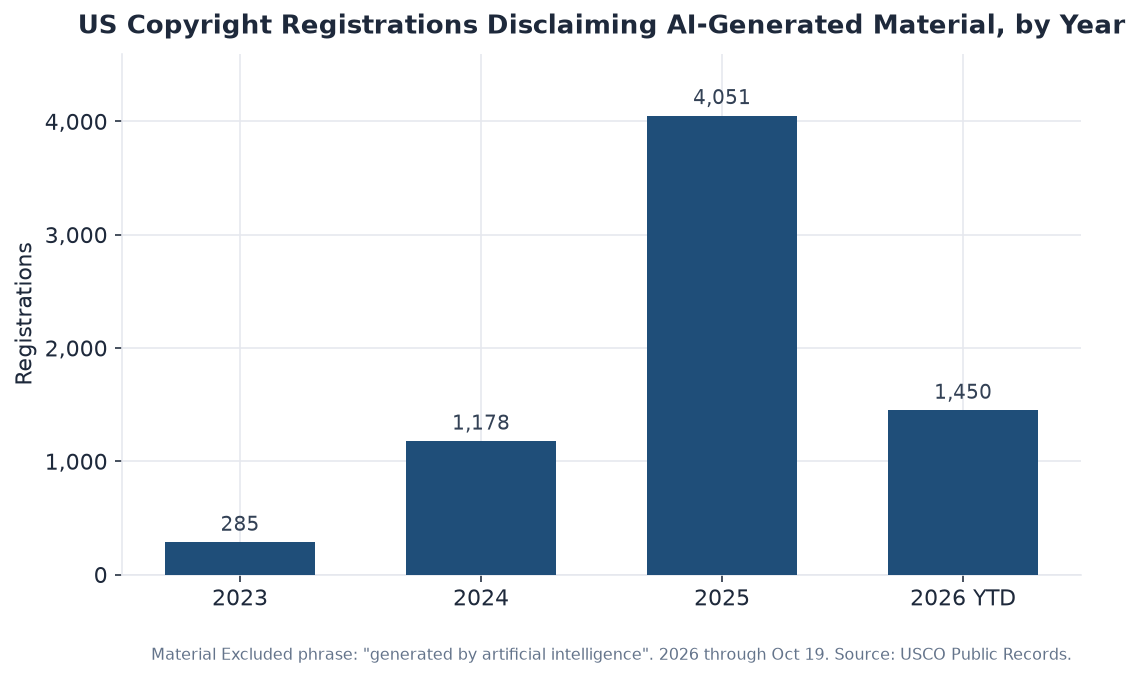
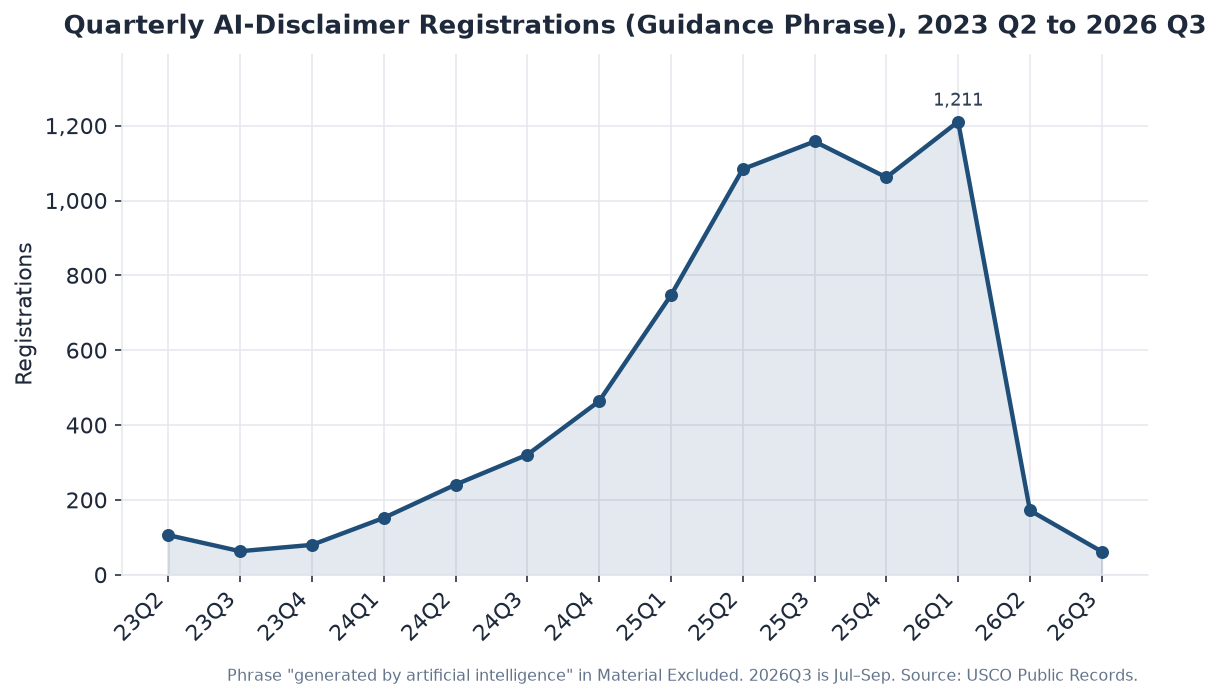
The Copyright Office's March 16, 2023 registration guidance told applicants to exclude more-than-de-minimis AI-generated material in the Limitation of the Claim section. The counts below are registrations whose Material Excluded field contains the guidance phrase "generated by artificial intelligence," dated by the Public Catalog's representative date.
US Copyright Registrations Using the Guidance AI-Disclaimer Phrase, by Year
| Year | Registrations | Published | Unpublished | Share Unpublished |
|---|---|---|---|---|
| 2023 | 285 | 184 | 101 | 35.4% |
| 2024 | 1,178 | 595 | 583 | 49.5% |
| 2025 | 4,051 | 1,616 | 2,435 | 60.1% |
| 2026 (through Oct 19) | 1,450 | 463 | 987 | 68.1% |
| Total in catalog (all years) | 6,968 | 2,859 | 4,109 | 59.0% |
- Guidance-phrase registrations rose from 285 in 2023 to 1,178 in 2024 and 4,051 in 2025, a 14-times increase over two years.
- Most of these claims are unpublished works (59.0% overall, 68.1% of the 2026 year-to-date count). That fits a pattern of authors registering drafts, manuscripts and internal software before release.
- Only 27 registrations with this phrase predate the March 16, 2023 guidance. Nearly all of the public trail starts after the Office told applicants how to disclose AI material.
- The Material Excluded field shows which parts of a work the claimant left out of the claim, and a registration that excludes AI-generated material still protects the human-authored remainder.
Disclaimer Wording Shift in 2026
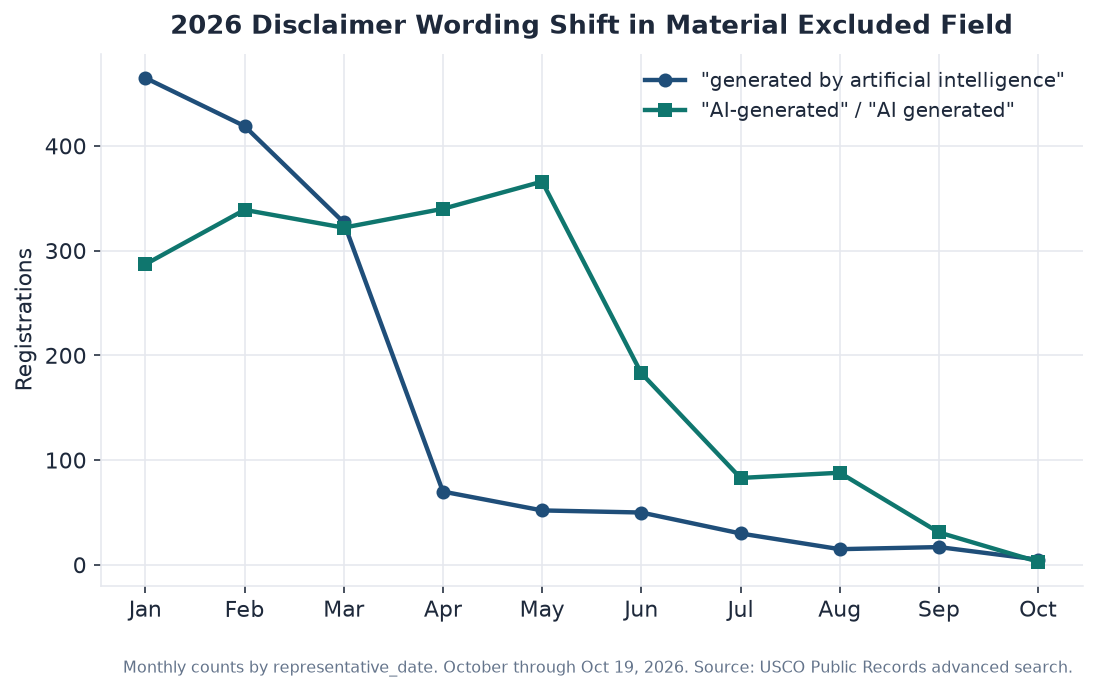
Applicants do not all use the same words. A second phrase search for "AI-generated" or "AI generated" in Material Excluded returns 4,416 registrations. After March 2026, that shorter wording overtook the longer guidance phrase in the monthly Public Catalog counts.
Monthly 2026 Registrations by Material Excluded Phrase
| Month (2026) | "generated by artificial intelligence" | "AI-generated" / "AI generated" |
|---|---|---|
| January | 465 | 287 |
| February | 419 | 339 |
| March | 327 | 322 |
| April | 70 | 340 |
| May | 52 | 366 |
| June | 50 | 183 |
| July | 30 | 83 |
| August | 15 | 88 |
| September | 17 | 31 |
| October (through 19) | 5 | 3 |
- Unioned across the guidance phrase, "AI-generated," "AI generated" and "generated by AI," the Public Catalog holds 11,827 unique registrations as of October 19, 2026.
- The sharp drop in the longer guidance phrase after March 2026 is mainly a wording change, not a disappearance of AI disclaimers. The shorter "AI-generated" series stayed above 300 per month from February through May.
- October 2026 counts are still thin in the catalog. Recent registrations can lag before they appear in Public Records, so the latest months should be read as incomplete.
- A search for the guidance phrase alone will undercount filings made after March 2026, so any rights check should cover several disclaimer wordings.
AI-Disclaimer Registrations by Work Type
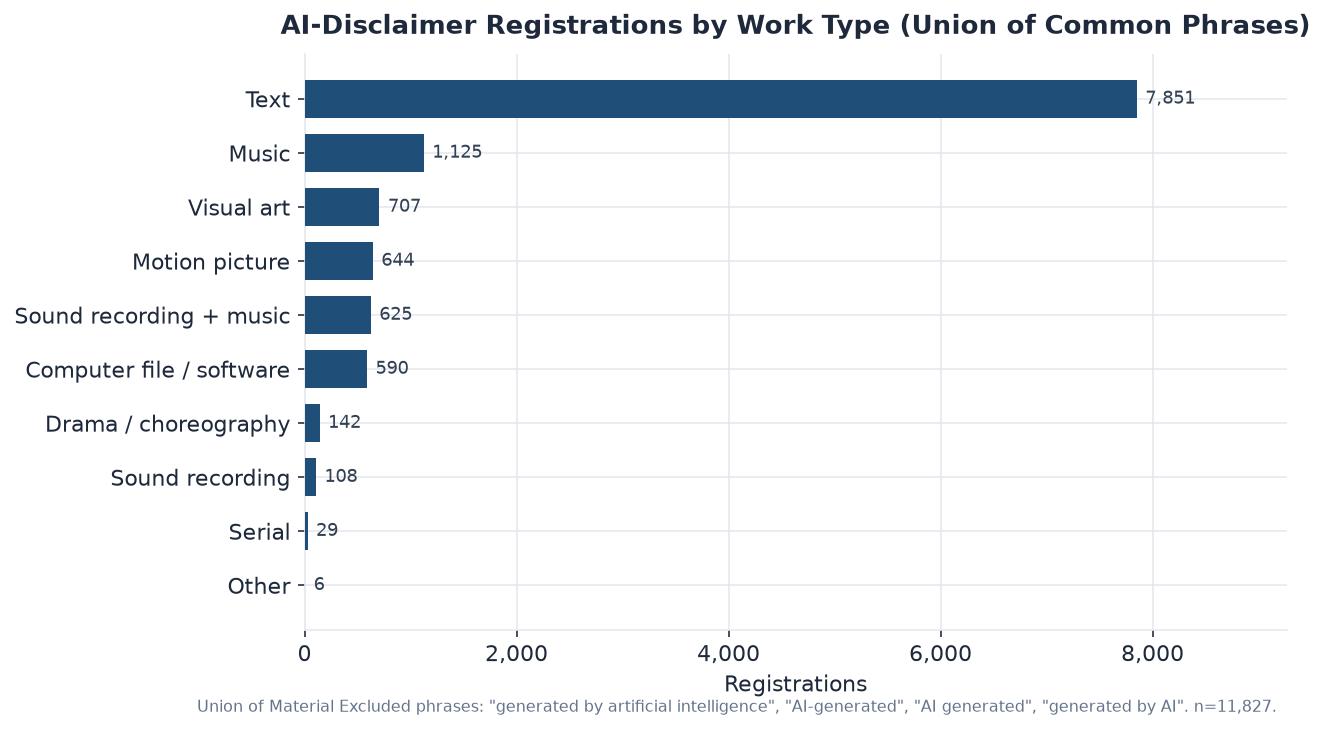
Work type comes from the Public Catalog's type-of-work field. The table uses the union of common disclaimer phrases (11,827 unique registrations), because the guidance phrase alone is dominated by text claims and understates visual art, music and audiovisual filings.
AI-Disclaimer Registrations by Work Type (Union of Common Phrases)
| Work Type | Registrations | Share |
|---|---|---|
| Text | 7,851 | 66.4% |
| Music | 1,125 | 9.5% |
| Visual art | 707 | 6.0% |
| Motion picture | 644 | 5.4% |
| Sound recording + music | 625 | 5.3% |
| Computer file / software | 590 | 5.0% |
| Drama / choreography | 142 | 1.2% |
| Sound recording | 108 | 0.9% |
| Serial | 29 | 0.2% |
| Other / cancelled | 6 | 0.1% |
| Total | 11,827 | 100.0% |
- Text still leads at 66.4%, which includes books, articles and other literary claims that exclude AI-written passages or AI-generated illustrations attached to text.
- Music, visual art, motion pictures and sound recordings together make up about 27% of the union set. Software and computer-file claims are 5.0% (590 registrations).
- Under the guidance phrase alone, text rises to 92.9% (6,472 of 6,968). Visual and music creators more often use the shorter "AI-generated" wording.
- AI disclaimers now reach well beyond books, with music, video and software claims in the same public trail.
Who Registers: Individuals vs Companies
We classified each guidance-phrase registration by claimant name text in the Public Catalog. A claimant counts as a company when the name includes a corporate marker such as Inc, LLC, Ltd, Corp, Publishing or Entertainment. All other named claimants count as individuals. A small mixed group lists both on the same record.
Guidance-Phrase AI-Disclaimer Registrations by Claimant Type
| Claimant Type | Registrations | Share |
|---|---|---|
| Individual | 5,920 | 85.0% |
| Company | 1,020 | 14.6% |
| Mixed (individual and company) | 24 | 0.3% |
| Unknown (no claimant name) | 2 | 0.0% |
| Total | 6,966 | 100.0% |
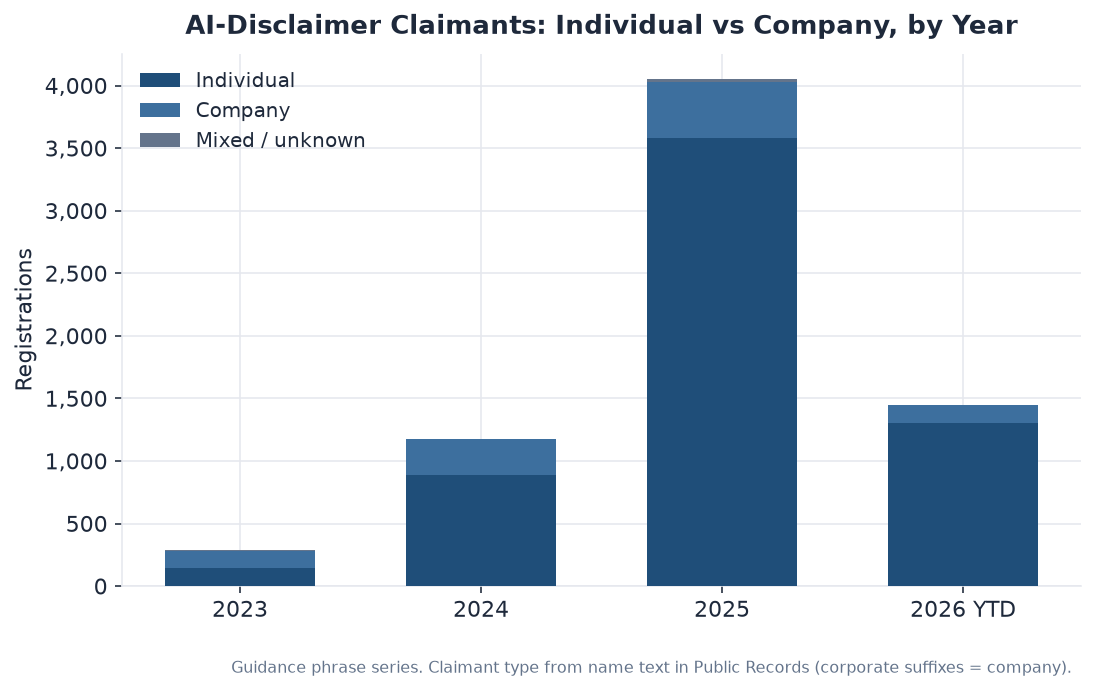
Claimant Type by Year (Guidance Phrase)
| Year | Individual | Company | Mixed / unknown | Company share |
|---|---|---|---|---|
| 2023 | 148 | 136 | 1 | 47.7% |
| 2024 | 886 | 292 | 0 | 24.8% |
| 2025 | 3,579 | 450 | 20 | 11.1% |
| 2026 (through Oct 19) | 1,304 | 141 | 5 | 9.7% |
- Individuals account for 85.0% of guidance-phrase registrations. Companies are 14.6%.
- Company share fell from 47.7% in 2023 to 11.1% in 2025 as individual text claims surged. Early adopters of the disclosure practice included a higher share of corporate claimants.
- Examples of company claimants in the dataset include Adobe Inc., Deloitte Development LLC, Kaplan North America, LLC, Sony Music Entertainment and Invoke AI, Inc. (the registrant of A Single Piece of American Cheese).
Review Board and Court Outcomes on AI Authorship
Refused applications do not appear as registrations in the Public Catalog. The public trail for refusals is the Copyright Office Review Board's published opinions, plus federal court review. From 2022 through 2026, four Review Board decisions in the Human authorship category were issued; three of them are the leading generative-AI cases.
Leading US Copyright Office and Court Decisions on AI Authorship
| Matter | Date | Forum | Outcome |
|---|---|---|---|
| A Recent Entrance to Paradise (Thaler) | Feb 14, 2022 | Review Board | Refusal affirmed (Creativity Machine listed as sole author) |
| Zarya of the Dawn (Kashtanova) | Feb 21, 2023 | Registration Program | Prior registration cancelled; new certificate limited to human-authored text and selection/arrangement; Midjourney images excluded |
| Théâtre D'opéra Spatial (Allen) | Sep 5, 2023 | Review Board | Refusal affirmed; applicant would not disclaim Midjourney-generated material |
| SURYAST (Sahni) | Dec 11, 2023 | Review Board | Refusal affirmed; RAGHAV AI painting app output lacked separable human authorship |
| A Single Piece of American Cheese (Invoke AI) | Effective Aug 5, 2024 (decision Jan 30, 2025) | Registration | Registered for selection, coordination and arrangement; AI-generated image components excluded |
| Thaler v. Perlmutter | Mar 18, 2025 | D.C. Circuit | Affirmed; Copyright Act requires human authorship |
| Thaler v. Perlmutter | Mar 2, 2026 | US Supreme Court | Certiorari denied; D.C. Circuit ruling stands |
- Every published Review Board decision that reached generative AI authorship has affirmed refusal when the applicant sought protection for AI output itself, or refused to disclaim it.
- Zarya of the Dawn and A Single Piece of American Cheese show the path that succeeds: register the human selection, arrangement or text, and exclude the AI-generated images.
- Thaler's case closed the pure machine-author theory in the D.C. Circuit. The Supreme Court's March 2, 2026 denial of review left that holding in place.
- Midjourney Boat (2026 Review Board) is a Midjourney, Inc. logo refused for lack of creativity, not an AI-authorship holding. It is listed on the Review Board index under common shapes, not Human authorship.
What the Registration Trend Points To
AI-assisted creative work now shows up in the registration system as an ordinary business filing. Hybrid works are being filed in volume, with the machine-made parts carved out and the human-authored remainder left on the certificate.
With the courts closed to pure machine authorship for now, what keeps changing is how many claimants disclose AI material, how they word the exclusion, and which work types show up in the catalog. So if you create or buy AI-assisted content, read the Material Excluded field on any registration you rely on, and search more than one disclaimer phrase before you treat Public Catalog silence as proof that no AI was used.
Data Collection and Methodology
The AI Industry Reviews research team built the dataset from the US Copyright Office Public Records System (publicrecords.copyright.gov) advanced search API on October 19, 2026.
Primary series: registrations where type_of_record is registration and the Material Excluded field (API column pre_existing_material) matches the phrase "generated by artificial intelligence." That query returned 6,968 hits. We exported every hit at 500 records per page (14 pages). The export repeated two records across page boundaries and did not return two others, so it holds 6,966 unique registration numbers. Year and published/unpublished counts use the API's own filtered counts for all 6,968 hits; claimant-type counts use the 6,966 unique exported records. The phrase exports in the union series had the same paging gaps, so the union may be a few registrations short. Dates throughout are the Public Catalog's representative date for each record.
Union series: we also ran phrase searches for "AI-generated," "AI generated" and "generated by AI" in the same field, then deduplicated by registration number. The union contains 11,827 unique registrations. Phrase hit counts before dedupe were 6,968, 4,416, 4,416 and 494 respectively ("AI-generated" and "AI generated" each returned 4,416 hits).
Claimant type: we labeled a registration as company when any claimant name matched a corporate marker (Inc, LLC, Ltd, Corp, Corporation, Company, Publishing, Press, Entertainment, Solutions, Technologies, and similar). Otherwise named claimants were labeled individual. Mixed means both kinds appear on one record. This is a name-text classifier, not a corporate registry match.
Work type uses the Public Catalog type_of_work field. Published vs unpublished uses registration_status.
Limits: the Public Catalog shows registered claims, not refused applications. We cannot estimate the refusal rate for AI-containing works from this source. Recent months can lag before records appear. Applicants who omit a required disclaimer, or who use uncommon wording, are outside both series. Perlmutter's May 2026 figure of more than 7,000 claims is an Office-reported total; it is not identical to either of our phrase searches and may reflect internal tracking across disclaimer forms. We report it separately and do not adjust our catalog counts to match it.
Review Board rows come from copyright.gov/rulings-filings/review-board/ and the linked decision letters. Court outcomes for Thaler v. Perlmutter come from the D.C. Circuit opinion (Mar 18, 2025) and the Supreme Court docket denial (Mar 2, 2026).
Sources
- AI Industry Reviews, AI Copyright Registration Study: advanced search of the US Copyright Office Public Records System for Material Excluded phrases disclaiming AI-generated content, retrieved October 19, 2026 (6,968 guidance-phrase registrations; 11,827 unique across common disclaimer phrases).
- US Copyright Office, Copyright Public Records System
- US Copyright Office, Copyright Registration Guidance: Works Containing Material Generated by Artificial Intelligence (88 Fed. Reg. 16190, Mar 16, 2023)
- US Copyright Office, Copyright and Artificial Intelligence, Part 2: Copyrightability (January 2025)
- Shira Perlmutter, Testimony before the Senate Judiciary Subcommittee on Intellectual Property (May 12, 2026) (more than 7,000 registered claims including disclaimed AI-generated material)
- US Copyright Office, Review Board Opinions
- Review Board, A Recent Entrance to Paradise (Feb 14, 2022)
- US Copyright Office, Cancellation Decision re: Zarya of the Dawn (VAu001480196) (Feb 21, 2023)
- Review Board, Théâtre D'opéra Spatial (Sep 5, 2023)
- Review Board, SURYAST (Dec 11, 2023)
- Registration VAu 1-543-942, A Single Piece of American Cheese (Invoke AI, Inc.; effective Aug 5, 2024)
- Thaler v. Perlmutter, No. 23-5233 (D.C. Cir. Mar 18, 2025)
- Thaler v. Perlmutter, No. 25-449 (cert. denied Mar 2, 2026)
- US Copyright Office Annual Report FY 2024 (overall refusal and Review Board volume)