
Home / Research / AI Copyright Lawsuit Statistics
Market research · October 13, 2026
AI Copyright Lawsuit Statistics: 2026 Report
 By Darin ten Bruggencate, Founder, AI Industry Reviews
Authors, publishers, record labels, studios and other rights holders have been suing AI companies in U.S. federal court since late 2022. They claim the companies copied their work to train AI models or that the models reproduce it. New suits keep coming, and most cases are still open.
Our analysts studied 127 of those lawsuits, filed through October 8, 2026. We sorted each by filing year, type of plaintiff, defendant, court, status and outcome. Rights holders filed 55 of those suits from January 1 to October 8, 2026, more than the 39 filed in all of 2025. The $1.5 billion Bartz v. Anthropic settlement is the only settlement or judgment amount that appears in a court order or docket filing.
In the following sections, we track filings by year, show who is suing whom and where, and report how the cases have ended so far.
AI Copyright Lawsuits Filed per Year
Counting suits by the year they were filed shows how quickly rights holders have turned to the courts since generative AI tools reached the public.
AI Copyright Lawsuits Filed per Year, November 2022 to October 8, 2026
| Year Filed | Lawsuits | Share of All Suits | Filed in N.D. Cal. | Filed in S.D.N.Y. |
|---|---|---|---|---|
| 2022 | 1 | 0.8% | 1 | 0 |
| 2023 | 13 | 10.2% | 7 | 4 |
| 2024 | 19 | 15.0% | 8 | 7 |
| 2025 | 39 | 30.7% | 17 | 9 |
| 2026 (through Oct. 8) | 55 | 43.3% | 25 | 14 |
| Total | 127 | 100.0% | 58 | 34 |
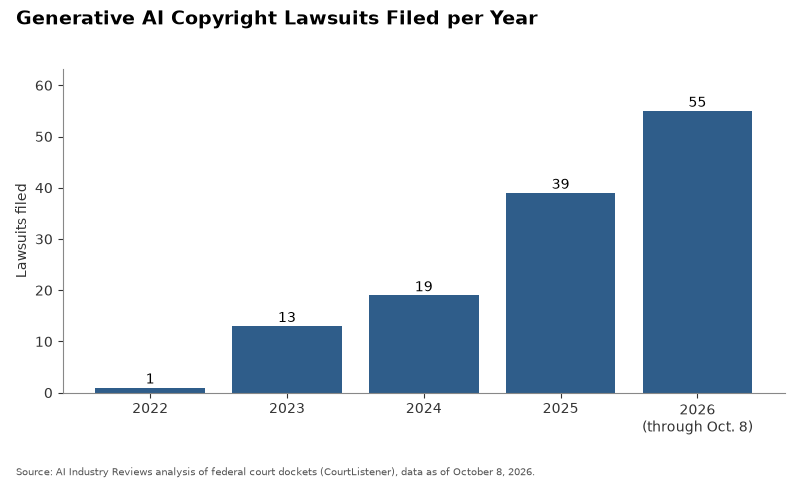
- Rights holders filed 55 AI copyright suits from January 1 to October 8, 2026, more than the 39 filed in all of 2025.
- 77 of the 127 suits (60.6%) were filed in the 12 months from October 8, 2025 to October 8, 2026.
- May 2026 had the most filings of any month, with 13 suits. They include a suit against Meta by publishers Elsevier, Cengage, Hachette, Macmillan and McGraw Hill, two suits by educational publisher Cognella against Anthropic and Meta, and CNN's suit against Perplexity.
- For AI companies, copyright litigation risk is rising, not fading. Rights holders filed 55 suits from January 1 to October 8, 2026, more than all of 2025, and 77 of 127 came in the past 12 months. If this pace holds, 2026 will end with the most filings yet.
Who Is Suing AI Companies Over Copyright
Authors, musicians, news publishers and studios each have their own stake in how AI models use their work, and sorting the suits by plaintiff shows which groups have filed the most.
AI Copyright Lawsuits by Type of Plaintiff
| Plaintiff Type | Lawsuits | Share | Filed in 2026 | Example Plaintiffs |
|---|---|---|---|---|
| Authors and writers | 37 | 29.1% | 9 | Authors Guild, Andrea Bartz, Richard Kadrey, Kai Bird |
| News and magazine publishers | 19 | 15.0% | 6 | The New York Times, Daily News, Dow Jones, Ziff Davis, CNN, USA Today |
| Record labels, music publishers and music licensors | 14 | 11.0% | 11 | UMG Recordings, Concord, BMG, Sony Music, Round Hill |
| Other or unspecified individuals | 12 | 9.4% | 9 | Austin Beaulier, David Vance Gardner, Rebecca Trinidad, Su-Mi Kim |
| Online video creators | 7 | 5.5% | 4 | Ted Entertainment |
| Independent musicians | 7 | 5.5% | 1 | Anthony Justice, David Woulard, Attack the Sound |
| Book and education publishers | 6 | 4.7% | 6 | Elsevier, Hachette, Cognella, Chicken Soup for the Soul |
| Film, TV and video producers | 6 | 4.7% | 1 | Disney, Warner Bros., Alcon Entertainment, Druyan-Sagan Associates |
| Photo and image licensors | 6 | 4.7% | 3 | Getty Images, EVOX Productions |
| Reference and data publishers | 4 | 3.1% | 3 | Encyclopaedia Britannica, Gracenote, wikiHow |
| Technology companies | 3 | 2.4% | 1 | Brave Software, Reddit |
| Visual artists | 2 | 1.6% | 0 | Sarah Andersen, Jingna Zhang |
| Other companies | 2 | 1.6% | 1 | Poseidon Wave Media, Main Sequence |
| Software developers | 1 | 0.8% | 0 | Anonymous GitHub programmers |
| Voice actors | 1 | 0.8% | 0 | Karissa Vacker |
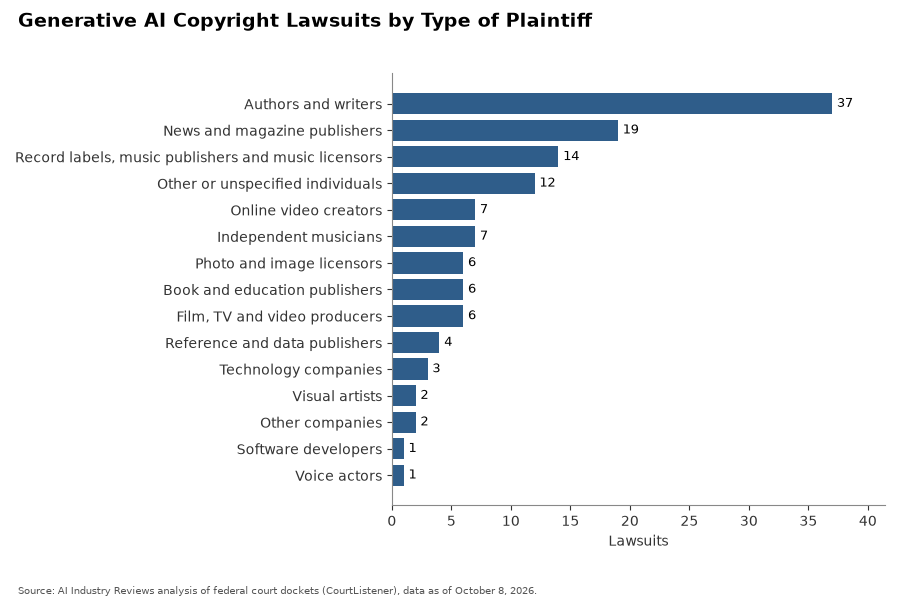
- Authors and writers brought 37 suits, more than any other group. 28 of them were filed before 2026.
- Music rights holders brought 21 suits: 14 from record labels, music publishers and music licensors and 7 from independent musicians. 12 of the 21 were filed in 2026.
- All six suits by book and education publishers were filed in 2026, starting with Chicken Soup for the Soul's suit against Meta on March 17.
- News and magazine publishers filed 19 suits, beginning with The New York Times' suit against Microsoft and OpenAI on December 27, 2023. USA Today sued OpenAI on October 8, 2026.
- Other or unspecified individuals filed 12 suits, 9 of them in 2026. Five of the seven suits that courts have dismissed came from this group.
- The range of plaintiffs is widening, which spreads risk across more types of AI products. Music rights holders filed 12 of their 21 suits in 2026, and all six publisher suits came this year. Music, video and education AI firms are likely to face more claims in 2027.
- Three suits come from technology companies. Brave Software, which runs an AI search engine, twice asked a court to declare that it does not infringe News Corp's copyrights, and Reddit sued SerpApi, Oxylabs, AWMProxy and Perplexity AI over scraping of Reddit content.
AI Companies as Defendants in Copyright Lawsuits
The AI Industry Reviews research team counted suits by the first company listed as defendant, which gives anyone following a particular AI company a quick sense of how many copyright claims it faces.
AI Copyright Lawsuits by Lead Defendant
| Lead Defendant | Lawsuits | Filed in 2026 | Closed | First Suit Filed |
|---|---|---|---|---|
| OpenAI | 22 | 9 | 4 | June 28, 2023 |
| Anthropic | 15 | 11 | 3 | Oct. 18, 2023 |
| Meta | 13 | 7 | 0 | July 7, 2023 |
| Microsoft | 8 | 3 | 0 | Dec. 27, 2023 |
| Suno | 8 | 5 | 1 | June 24, 2024 |
| 6 | 4 | 0 | July 11, 2023 | |
| NVIDIA | 5 | 2 | 0 | Mar. 8, 2024 |
| Perplexity | 5 | 1 | 0 | Oct. 21, 2024 |
| Stability AI | 5 | 1 | 2 | Jan. 13, 2023 |
| Apple | 4 | 1 | 0 | Sept. 5, 2025 |
| Uncharted Labs (Udio) | 4 | 1 | 0 | June 24, 2024 |
| Midjourney | 3 | 1 | 0 | June 11, 2025 |
| Adobe | 2 | 1 | 0 | Dec. 16, 2025 |
| Databricks | 2 | 0 | 0 | Mar. 8, 2024 |
| News Corp | 2 | 1 | 1 | Mar. 12, 2025 |
| Salesforce | 2 | 0 | 0 | Oct. 15, 2025 |
| 21 other companies and institutions, one suit each | 21 | 7 | 3 | Nov. 3, 2022 |
| Total | 127 | 55 | 14 |
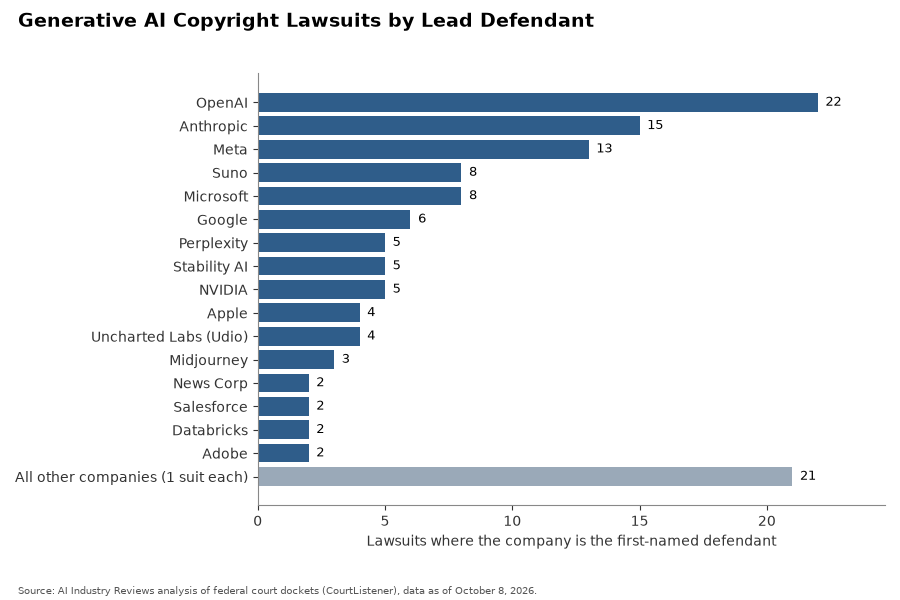
- OpenAI is the lead defendant in 22 suits, more than any other company. Courts dismissed all four of the OpenAI suits that have closed. Microsoft is the lead defendant in 8 more, and some of those also include OpenAI as a defendant. Times Publishing Co. v. Microsoft, filed September 16, 2026 by a group of local news publishers, lists ten OpenAI entities as defendants alongside Microsoft.
- Anthropic is the lead defendant in 15 suits, and 11 of them were filed in 2026. Four of the 2026 suits come from authors, four from music publishers, two from book and education publishers and one from an individual.
- Meta is the lead defendant in 13 suits. Seven were filed in 2026, three of them by book and education publishers.
- Suno, which makes an AI music generator, is the lead defendant in eight suits, five of them filed in 2026. Seven of the eight were brought by record labels, music publishers, music licensors or independent musicians. Suno is also one of several defendants in Will-Burn Recordings & Publishing v. UMG Recordings, filed in Alabama on May 13, 2026.
- Midjourney is the lead defendant in three suits: Disney's, filed June 11, 2025; Warner Bros. Discovery's, filed September 4, 2025 and merged into Disney's case on November 4, 2025; and EVOX Productions', filed July 30, 2026.
- Perplexity is the lead defendant in five suits, four by news publishers (Dow Jones, the Chicago Tribune, The New York Times and CNN) and one by Encyclopaedia Britannica. It is also a defendant in Reddit v. SerpApi and was a defendant in Carreyrou v. Anthropic until June 8, 2026.
- Carreyrou v. Anthropic, filed December 22, 2025, sued eight AI companies: Anthropic, Google, OpenAI, Meta, xAI, Perplexity, Apple and NVIDIA. The court split the claims against OpenAI and Meta into separate cases, and the OpenAI claims were moved to New York. On June 8, 2026, it split off the claims against Google, which continue as Cambronne v. Google, and dismissed xAI, Perplexity, Apple and NVIDIA from the case.
- The biggest AI developers carry most of the legal exposure. OpenAI leads 22 suits, Anthropic 15 and Meta 13, and 11 of Anthropic's came in 2026. Investors are likely to weigh legal reserves more heavily for these companies.
Where AI Copyright Lawsuits Are Filed
The court where a suit is filed decides which judges hear it and which appeals court reviews their rulings, so the places these cases cluster will shape how the law on AI and copyright develops.
AI Copyright Lawsuits by Federal Court Where Filed
| Court | Lawsuits | Share | Filed in 2026 |
|---|---|---|---|
| N.D. California | 58 | 45.7% | 25 |
| S.D. New York | 34 | 26.8% | 14 |
| C.D. California | 10 | 7.9% | 5 |
| D. Massachusetts | 5 | 3.9% | 3 |
| N.D. Illinois | 4 | 3.1% | 1 |
| D. Delaware | 3 | 2.4% | 0 |
| N.D. Florida | 2 | 1.6% | 0 |
| W.D. Washington | 2 | 1.6% | 2 |
| M.D. Tennessee | 1 | 0.8% | 0 |
| E.D. Virginia | 1 | 0.8% | 0 |
| D. Montana | 1 | 0.8% | 0 |
| W.D. North Carolina | 1 | 0.8% | 0 |
| D. Nevada | 1 | 0.8% | 1 |
| D. Utah | 1 | 0.8% | 1 |
| S.D. Mississippi | 1 | 0.8% | 1 |
| S.D. Alabama | 1 | 0.8% | 1 |
| D. South Carolina | 1 | 0.8% | 1 |
- The Northern District of California, which covers San Francisco and Silicon Valley, received 58 suits, 45.7% of the total. Together with the Southern District of New York, it received 92 of the 127 suits (72.4%).
- Several suits against OpenAI that were filed in other states have been moved to New York. The Judicial Panel on Multidistrict Litigation sent three of them to In re OpenAI Copyright Infringement Litigation in Manhattan: Tremblay v. OpenAI from California on April 21, 2025, Ziff Davis v. OpenAI from Delaware on May 16, 2025, and the OpenAI claims in Carreyrou v. Anthropic from California in April 2026. Denial v. OpenAI was transferred from California to New York on July 24, 2025.
- Suits against other companies have also changed courts. Concord Music Group's first suit against Anthropic went from Tennessee to the Northern District of California on June 24, 2024, and the Elsevier publishers' suit against Meta went from New York to the same court on September 25, 2026. David Woulard's suit against Udio went from Illinois to New York on August 3, 2026.
- Most cases land in two courts, so their rulings will shape the law for everyone. The Northern District of California and the Southern District of New York received 92 of 127 suits. Early decisions there are likely to set the terms for later cases and licensing deals.
Status and Outcomes of AI Copyright Lawsuits
Knowing how these cases end tells rights holders and AI companies what to expect from the courts, and so far only a small share have reached any result.
AI Copyright Lawsuit Status as of October 8, 2026
| Status | Lawsuits | Share |
|---|---|---|
| Pending | 102 | 80.3% |
| Pending in a consolidated case | 11 | 8.7% |
| Closed | 14 | 11.0% |
| Total | 127 | 100.0% |
Closed AI Copyright Lawsuits and How They Ended
| Case | Court | Filed | Outcome | Date Closed | Amount on the Public Record |
|---|---|---|---|---|---|
| Main Sequence v. Dudesy | C.D. Cal. | Jan. 25, 2024 | Consent judgment and permanent injunction | June 18, 2024 | None |
| Brave Software v. News Corp | N.D. Cal. | Mar. 12, 2025 | Dismissed by agreement of the parties, without prejudice | June 10, 2025 | None |
| Raw Story Media v. OpenAI | S.D.N.Y. | Feb. 28, 2024 | Dismissed by the court for lack of standing; on appeal | June 18, 2025 | None |
| Trinidad v. Anthropic | N.D. Fla. | July 8, 2025 | Dismissed by the court after transfer to N.D. Cal. | Aug. 5, 2025 | None |
| Getty Images v. Stability AI | D. Del. | Feb. 3, 2023 | Voluntarily dismissed by the plaintiff and refiled in N.D. Cal. | Aug. 18, 2025 | None |
| Vacker v. ElevenLabs | D. Del. | Aug. 29, 2024 | Dismissed by agreement of the parties, with prejudice | Nov. 6, 2025 | None |
| Trinidad v. OpenAI | N.D. Fla. | July 3, 2025 | Dismissed by the court after transfer to N.D. Cal. | Jan. 5, 2026 | None |
| Anders v. Stability AI | W.D.N.C. | Dec. 29, 2025 | Dismissed by the court, with prejudice | Mar. 23, 2026 | None |
| Erickson v. OpenAI | D. Nev. | Jan. 15, 2026 | Dismissed by the court after transfer to N.D. Cal. | Apr. 17, 2026 | None |
| Barrus v. Chai Research | D. Utah | Mar. 17, 2026 | Voluntarily dismissed by the plaintiff, with prejudice | May 1, 2026 | None |
| Goddard v. Anthropic | N.D. Cal. | Feb. 2, 2026 | Dismissed by the court, with prejudice | June 1, 2026 | None |
| Bartz v. Anthropic | N.D. Cal. | Aug. 19, 2024 | Class settlement approved; on appeal | July 20, 2026 | $1.5 billion settlement fund |
| Kim v. OpenAI | E.D. Va. | July 30, 2025 | Dismissed by the court | July 23, 2026 | None |
| S.A. Jamendo v. Suno | D. Mass. | June 29, 2026 | Voluntarily dismissed by the plaintiff | Aug. 13, 2026 | None |
- 113 of the 127 suits (89.0%) were still pending on October 8, 2026, including 11 that had been merged into a lead case, such as Silverman v. OpenAI and Chabon v. OpenAI, which were folded into Tremblay v. OpenAI on February 16, 2024.
- Courts have dismissed seven suits. In Raw Story v. OpenAI, the Southern District of New York dismissed the complaint for lack of standing and denied reconsideration on June 18, 2025, and Raw Story appealed. In Anders v. Stability AI, the Western District of North Carolina dismissed musician Jerry Anders' amended complaint with prejudice on March 23, 2026. The other five were brought by individuals: Rebecca Trinidad (two suits), Su-Mi Kim, Michael Erickson and Thomas Goddard.
- Three suits ended when the plaintiff withdrew. Getty Images dropped its Delaware suit against Stability AI and refiled in the Northern District of California on August 14, 2025, where the new suit is pending. Ashley Barrus's suit against Chai Research was dismissed with prejudice by notice on May 1, 2026, and S.A. Jamendo dropped its suit against Suno on August 13, 2026.
- Main Sequence and Jerold Hamza, executor of George Carlin's estate, sued Dudesy and its hosts Will Sasso and Chad Kultgen in January 2024. The suit ended in a consent judgment and permanent injunction on June 18, 2024, and the docket shows no payment amount.
- Voice actor Karissa Vacker's suit against ElevenLabs ended with a stipulated dismissal with prejudice, entered November 6, 2025. The docket does not disclose any payment.
- Nearly all cases are unresolved, so the legal rules are still unsettled. 113 of 127 suits were pending on October 8, 2026, and only seven were dismissed. AI companies and rights holders are likely to face years of uncertainty unless more cases settle.
AI Copyright Settlement and Judgment Amounts
A settlement amount is the most direct evidence of what a copyright claim against an AI company is worth, and only one has appeared in a court record so far.
Bartz v. Anthropic Class Settlement, Final Approval Order of July 20, 2026
| Item | Amount |
|---|---|
| Settlement fund paid by Anthropic (non-reversionary) | $1,500,000,000 |
| Works on the settlement Works List | 482,460 |
| Works claimed as of April 16, 2026 | 440,490 (91.3%) |
| Estimated payment per work, before costs and fees | About $3,000 |
| Attorneys' fees requested by class counsel | $187,500,000 (12.5%) |
| Attorneys' fees awarded | $101,561,111 (nearly 6.8%) |
| Litigation expenses reimbursed | $2,635,197.46 |
| Reserve for future expenses | $18,220,000 |
| Service awards to class representatives | $15,000 each, $45,000 total |
- The $1.5 billion Bartz v. Anthropic settlement is the only settlement or judgment amount in any of the 127 suits that appears in a court order or docket filing as of October 8, 2026.
- Judge Araceli Martínez-Olguín granted final approval on July 20, 2026, 700 days after the authors filed suit on August 19, 2024. Her order describes the estimated payment of about $3,000 per work as four times the $750 statutory minimum for ordinary infringement.
- The court awarded class counsel $101,561,111 in fees, $85,938,889 less than the $187,500,000 they requested, and is holding back 10% of that award until the parties file an accounting of how the fund was distributed.
- Edelson PC and Oppenheim + Zebrak, the law firms serving as publishers' coordination counsel in the settlement, filed a notice of appeal from the approval order on August 18, 2026.
- The one public settlement gives rights holders a benchmark for future claims. Bartz v. Anthropic set $1.5 billion, about $3,000 per work, and no other closed suit shows a payment. That figure is likely to shape demands in pending cases and in licensing talks.
What AI Copyright Lawsuit Trends Mean for 2027 and Beyond
Lawsuits over AI training are now a regular part of doing business for the big AI developers. Authors, news publishers, music labels and other groups are all suing, and with so few cases settled, nobody yet knows what the use of their work is worth.
That will start to change as judges in California and New York rule on the leading cases. Their decisions will set how much AI companies owe and whether licensing deals become the normal way to use creative work. The Anthropic settlement already gives rights holders a number to point to in their own talks.
So if you create books, music or news that could be used to train AI, keep records of what you publish and follow the rulings in these two courts, because they will set what your work can earn.
Data Collection and Methodology
The figures cover federal copyright suits filed against AI developers over generative AI from November 2022 through October 8, 2026. Each case's court, filing date, parties, status and outcome come from its federal court docket on CourtListener as of October 8, 2026, and the settlement figures come from the final approval order in Bartz v. Anthropic. A suit is included when its docket lists a copyright cause of action under Title 17 of the U.S. Code or a copyright nature of suit, or when a court order confirms copyright or DMCA claims, and when an AI company or the developer of an AI training data set is a defendant. Each separately filed complaint is one lawsuit. A suit that was transferred or split into a new case number is listed once, under the court and date where it was first filed. Suits merged into a lead case are listed separately and shown as pending in the consolidated case. Plaintiff type comes from the named plaintiffs, and the lead defendant is the first defendant named in the case title.
Shareholder suits, appeals, the master docket of the New York multidistrict litigation against OpenAI, and suits whose dockets list only trademark, contract, fraud, labor or personal-injury claims are left out. So are suits against file-sharing sites or a music distributor with no AI company as a defendant, Thomson Reuters v. ROSS Intelligence (a case over an AI legal search tool that returns existing court opinions), two suits sent back to state court (Reddit v. Anthropic on March 30, 2026 and Greene v. Google on July 23, 2026), and two suits filed in September and October 2026 whose dockets did not yet show a cause of action.
The figures cover U.S. federal courts only, so suits in state courts or outside the United States are not included. Each suit appears once, under the court where it was first filed, so a piece split off from a suit does not appear again: Cambronne v. Google, split from Carreyrou v. Anthropic on June 8, 2026, is included in Carreyrou v. Anthropic. A suit stays pending until its docket shows it closed, even when some of its plaintiffs have settled. Poseidon Wave Media v. Suno is listed as pending because its docket shows no dismissal. The lead defendant is the first company named in the case title, so a suit against Microsoft and OpenAI that names Microsoft first appears under Microsoft.
Sources
- AI Industry Reviews, AI Copyright Lawsuit Study: analysis of 127 generative AI copyright lawsuits filed in U.S. federal courts from November 3, 2022 through October 8, 2026, verified against CourtListener dockets and court orders, conducted October 2026.
- ChatGPT Is Eating the World, Latest U.S. map of copyright suits v. AI cos. (October 7, 2026). https://chatgptiseatingtheworld.com/2026/10/07/latest-u-s-map-of-copyright-suits-v-ai-cos-total-147/
- CourtListener, RECAP Archive of federal court dockets. https://www.courtlistener.com/
- Bartz v. Anthropic PBC, No. 3:24-cv-05417 (N.D. Cal.), Order Granting Final Approval of Class Action Settlement, Dkt. 680 (July 20, 2026). https://storage.courtlistener.com/recap/gov.uscourts.cand.434709/gov.uscourts.cand.434709.680.0.pdf
- Bartz v. Anthropic PBC, Publishers' Coordination Counsel Notice of Appeal, Dkt. 682 (August 18, 2026). https://storage.courtlistener.com/recap/gov.uscourts.cand.434709/gov.uscourts.cand.434709.682.0.pdf
- Bartz v. Anthropic PBC, docket. https://www.courtlistener.com/docket/69058235/bartz-v-anthropic-pbc/
- U.S. Court of Appeals for the Ninth Circuit, Doe v. GitHub, Inc., No. 24-7700, opinion (September 16, 2026). https://cdn.ca9.uscourts.gov/datastore/opinions/2026/09/16/24-7700.pdf
- Raw Story Media, Inc. v. OpenAI Inc., No. 1:24-cv-01514 (S.D.N.Y.), docket. https://www.courtlistener.com/docket/68290709/
- Anders v. Stability AI US Services Corp., No. 1:25-cv-00451 (W.D.N.C.), docket. https://www.courtlistener.com/docket/72083948/
- Vacker v. ElevenLabs, Inc., No. 1:24-cv-00987 (D. Del.), docket. https://www.courtlistener.com/docket/69111793/
- Brave Software, Inc. v. News Corporation, No. 3:25-cv-02503 (N.D. Cal.), docket. https://www.courtlistener.com/docket/69732536/
- S.A. Jamendo v. Suno Inc., No. 1:26-cv-12966 (D. Mass.), docket. https://www.courtlistener.com/docket/73547746/
- Carreyrou v. Anthropic PBC, No. 5:25-cv-10897 (N.D. Cal.), docket. https://www.courtlistener.com/docket/72069211/
- Times Publishing Company v. Microsoft Corporation, No. 1:26-cv-08082 (S.D.N.Y.), docket. https://www.courtlistener.com/docket/74802532/
- Tremblay v. OpenAI, Inc., No. 4:23-cv-03223 (N.D. Cal.), docket. https://www.courtlistener.com/docket/67538258/
- Getty Images (US), Inc. v. Stability AI, Inc., No. 1:23-cv-00135 (D. Del.), docket. https://www.courtlistener.com/docket/66788385/
- Warner Bros. Entertainment Inc. v. Midjourney, Inc., No. 2:25-cv-08376 (C.D. Cal.), docket. https://www.courtlistener.com/docket/71271014/
- Cambronne, Inc. v. Google LLC, No. 5:26-cv-05582 (N.D. Cal.), docket. https://www.courtlistener.com/docket/73465441/
- Main Sequence, Ltd. v. Dudesy, LLC, No. 2:24-cv-00711 (C.D. Cal.), docket. https://www.courtlistener.com/docket/68195331/
- Kim v. OpenAI Inc., No. 1:25-cv-01258 (E.D. Va.), docket. https://www.courtlistener.com/docket/70977380/