
Home / Research / AI Coding Assistant Pricing Statistics
Market research · September 9, 2026
AI Coding Assistant Pricing Statistics: September 2026
Companies now purchase AI coding assistants per seat, which is how they already purchase IDEs and source control. GitHub, Amazon, Google, JetBrains, Cursor and Zed each list a business plan with a monthly price per seat, and most of the plans add usage allowances or overage charges. Budgeting the tools for 25 developers means taking the rates off six pricing pages, and the billing terms on those pages do not match.
On September 9, 2026 we collected the published USD seat rate for one business coding assistant plan from each provider, six plans in total, and we calculated the monthly subscription cost for 10, 25 and 100 paid seats. If a vendor also posts an annual commitment rate, we worked out the saving over 12 months. Plans, rates, formulas and results are all in the downloads below.
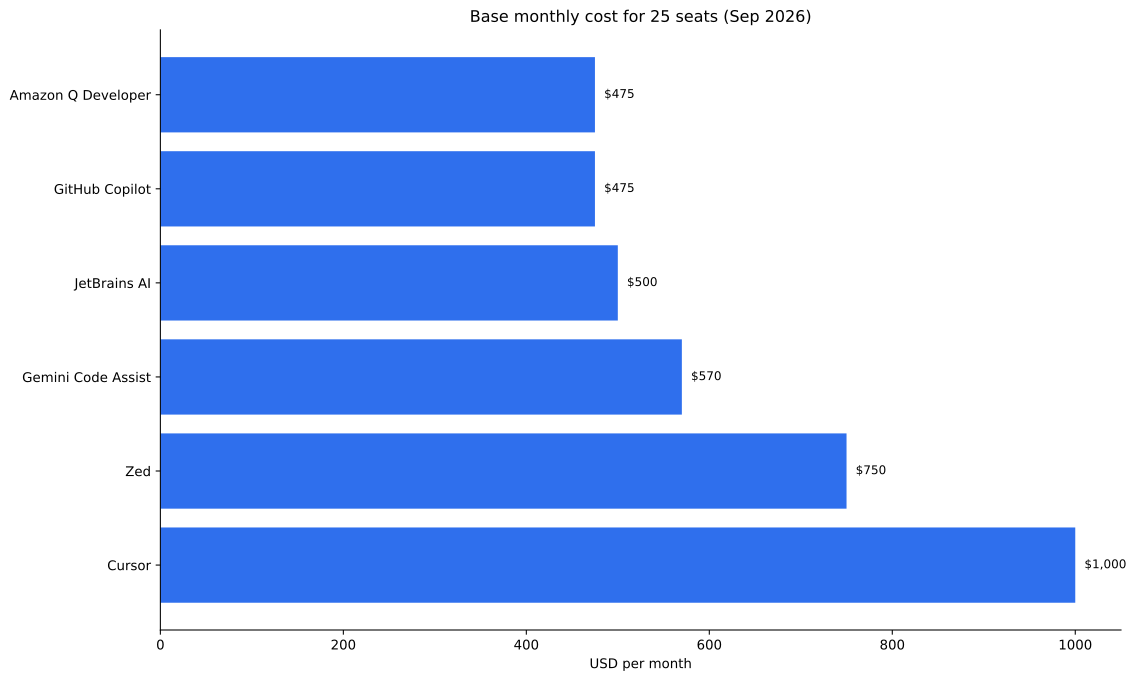
Base rates for 25 paid seats land between $475 and $1,000 a month. $535 a month is the median of the sample. Over 12 months at those monthly rates, the low base cost and the high base cost are $6,300 apart. Model usage can push the bill higher, and so can taxes and the cost of other software. Features and allowances differ by plan, and the comparison here is of the recurring subscription fee.
Monthly Cost of a Subscription by Team Size
Each of these columns supposes that every developer named holds a paid seat for the entire month. We used monthly commitment rates for every column. We calculated the team budgets from the vendor prices in Sources.
What Each Team Size Would Pay for a Coding Assistant, September 2026
Scroll sideways to see every column.
| Product and plan | USD per seat/month | 10 paid seats | 25 paid seats | 100 paid seats |
|---|---|---|---|---|
| Amazon Q Developer Pro | $19.00 | $190 | $475 | $1,900 |
| GitHub Copilot Business | $19.00 | $190 | $475 | $1,900 |
| JetBrains AI Pro for organizations | $20.00 | $200 | $500 | $2,000 |
| Gemini Code Assist Standard | $22.80 | $228 | $570 | $2,280 |
| Zed Business | $30.00 | $300 | $750 | $3,000 |
| Cursor Teams Standard | $40.00 | $400 | $1,000 | $4,000 |
All amounts are USD and were checked on September 9, 2026. What you see are scenarios priced from the published rates. Buying terms and eligibility rules continue to apply.
Insights
- The sample median is the midpoint of the JetBrains rate, $20, and the Gemini rate, $22.80, which puts it at $21.40 a seat each month.
- Four plans out of the six are at or under $22.80 a seat.
- The monthly rate at the top of the sample is 2.11 times the bottom rate: $40 a seat, against $19.
- At a headcount of 100 seats, $2,100 a month stands between the cheapest plan and the most expensive, and that gap is before usage charges.
Whether a buyer can get the plan is a check of its own. GitHub says new Copilot Business sign-ups are being switched on gradually. Google's current setup instructions send anyone buying Code Assist for the first time to the sales team. JetBrains is still promoting AI Pro licenses at the same time as it steers organizations onto shared AI credits. Seeing a price in public does not mean a new customer can purchase the plan at once.
What a Year-Long Commitment Saves
On two of the plans we checked, both a monthly commitment rate and an annual commitment rate were available. Commit for 12 months and Gemini Code Assist Standard comes to $19 a seat each month, while a monthly commitment comes to $22.80. Billed by the year, Cursor Teams Standard comes to $32 a seat each month, and billed by the month, it comes to $40.
Annual Commitment: The Saving on 25 Seats, September 2026
Scroll sideways to see every column.
| Plan, 25 paid seats | 12 months at monthly rate | 12-month commitment | Annual saving | Saving (%) |
|---|---|---|---|---|
| Gemini Code Assist Standard | $6,840 | $5,700 | $1,140 | 16.7% |
| Cursor Teams Standard | $12,000 | $9,600 | $2,400 | 20.0% |
Our own arithmetic produced the figures, using Google's pricing alongside Cursor's published Standard rates. The percentage saved is the size of that gap divided by the bill for 12 months on the monthly rate.
Insights
- A commitment lasting 12 months brings the 25-seat bill on Gemini Code Assist Standard down by $1,140 across that year, or 16.7%.
- On a yearly bill, Cursor Teams Standard for 25 seats comes out $2,400 lower across the year, or 20.0%.
The annual commitment from Google is invoiced each month. Google's documentation says that cutting the license quantity becomes effective only when the term of the commitment ends. Cursor offers billing for the year, and returning to a monthly bill is possible only after that year is over. The saving figures assume those 25 seats stay filled for the whole year. See Google subscription terms and Cursor billing documentation.
Costs Outside the Seat Fee
Zed Business comes with edit predictions, and hosted language models do not come with a fixed allowance in that plan. Once the allowances that are included run out, Cursor bills any further usage. Past the pooled allocation, Amazon Q Developer puts Java transformation on a separate charge. JetBrains AI Pro is bundled with some IDEs already, and that alters the added cost for someone who is already a customer. We treated the AI license in our table as one bought on its own.
Seat rules vary. Cursor will not sell the plan without at least a single paid member, though administrators may sit on the account without paying. Zed states no minimum number of seats, and the cutoff at 25 seats refers to order forms. Billing at Amazon is for each individual subscription that has been activated. Nothing on the pages we read for GitHub, or for Google Standard, or for JetBrains gave a current minimum as a number. Whether those scenarios hold depends on which purchase terms the team is offered.
Methodology
Six organizational products are in the study, some of them AI editors and some of them coding assistants, each posting a public recurring rate per seat in USD, with a single plan kept for every provider. We set aside plans for individual buyers, chatbots for general use, enterprise prices that had to be negotiated, and subscriptions sold either as one shared pack of credits or as one fixed bundle of collaborators. The set is a sample we chose. Its median is unweighted and it includes these six plans alone; spending across every coding-assistant customer was not estimated.
The monthly budget is the seat's published monthly rate times the count of paid seats. Saving from an annual commitment is the gap between the bill for 12 months on the rate charged each month and the published cost of a commitment that lasts 12 months. Decimals are kept intact during the arithmetic, after which currency totals are rounded to the nearest cent and a percentage saving is rounded to a single decimal. An annual rate that we could not find, or a minimum seat count we could not find, leaves the CSV cell empty and the JSON value null.
Other cloud charges sit outside the arithmetic, as do base IDE licenses, seat changes, prorating, introductory offers, volume discounts, usage overages and taxes. Productivity and model quality were left unmeasured, and customer invoices were not collected. A reader who has the downloadable dataset can rebuild the figures from it, since the file holds each plan's terms, sources, and formulas.
Cite the study as AI Industry Reviews, "AI Coding Assistant Pricing Statistics: September 2026," with the price observations dated September 9, 2026. The $535 median should be quoted with the six-plan sample and with the scope limited to the base fee.
Sources
- Amazon Web Services, Amazon Q Developer pricing.
- GitHub, Copilot plans.
- JetBrains, AI Assistant licensing and subscriptions.
- Google Cloud, Gemini pricing, subscription terms and Code Assist setup.
- Zed, Pricing.
- Cursor, Teams pricing, Standard rates announcement and billing documentation.