
Home / Research / AI Chip Export Statistics
Market research · October 13, 2026
AI Chip Export Statistics: 2026 Report
 By Darin ten Bruggencate, Founder, AI Industry Reviews
Since August 2022 the US government has repeatedly changed the rules on which advanced AI chips can be exported, and to whom. Those rules decide where AI hardware goes, how much US chipmakers can sell abroad and which countries can build AI data centers.
Our analysts studied US exports in four trade codes, or HS codes, that cover servers, computer units, computer parts and processor chips. The trade data came from UN Comtrade, collected on October 8, 2026. We measured exports by destination from 2022 to July 2026. We also reviewed Nvidia's and AMD's revenue by region and the charges both took after new license rules. The key finding is that exports in the four codes reached $108.53 billion in 2025, up 42.2% from 2024.
In the following sections, we break down US exports by trade code and by destination, with a closer look at China and Hong Kong. We then compare Nvidia's and AMD's sales by region, total the costs the rules imposed on both companies and lay out a timeline of the export controls.
US AI Chip Export Statistics by HS Code
Total US exports in the four trade codes show how much computing hardware leaves the country each year and how that trade has changed since the first chip export rules in 2022.
US Exports by HS Code, All Destinations ($ millions)
| HS Code | 2022 | 2023 | 2024 | 2025 | Change, 2024 to 2025 | Jan. to July 2025 | Jan. to July 2026 | Change |
|---|---|---|---|---|---|---|---|---|
| 8471.50 | $7,751 | $8,686 | $16,307 | $30,894 | +89.5% | $14,208 | $28,107 | +97.8% |
| 8471.80 | $2,522 | $2,222 | $4,219 | $8,001 | +89.6% | $5,079 | $5,086 | +0.2% |
| 8473.30 | $16,701 | $13,589 | $23,418 | $35,058 | +49.7% | $18,465 | $32,135 | +74.0% |
| 8542.31 | $29,658 | $25,078 | $32,381 | $34,581 | +6.8% | $20,501 | $21,950 | +7.1% |
| Four codes combined | $56,632 | $49,575 | $76,324 | $108,535 | +42.2% | $58,252 | $87,279 | +49.8% |
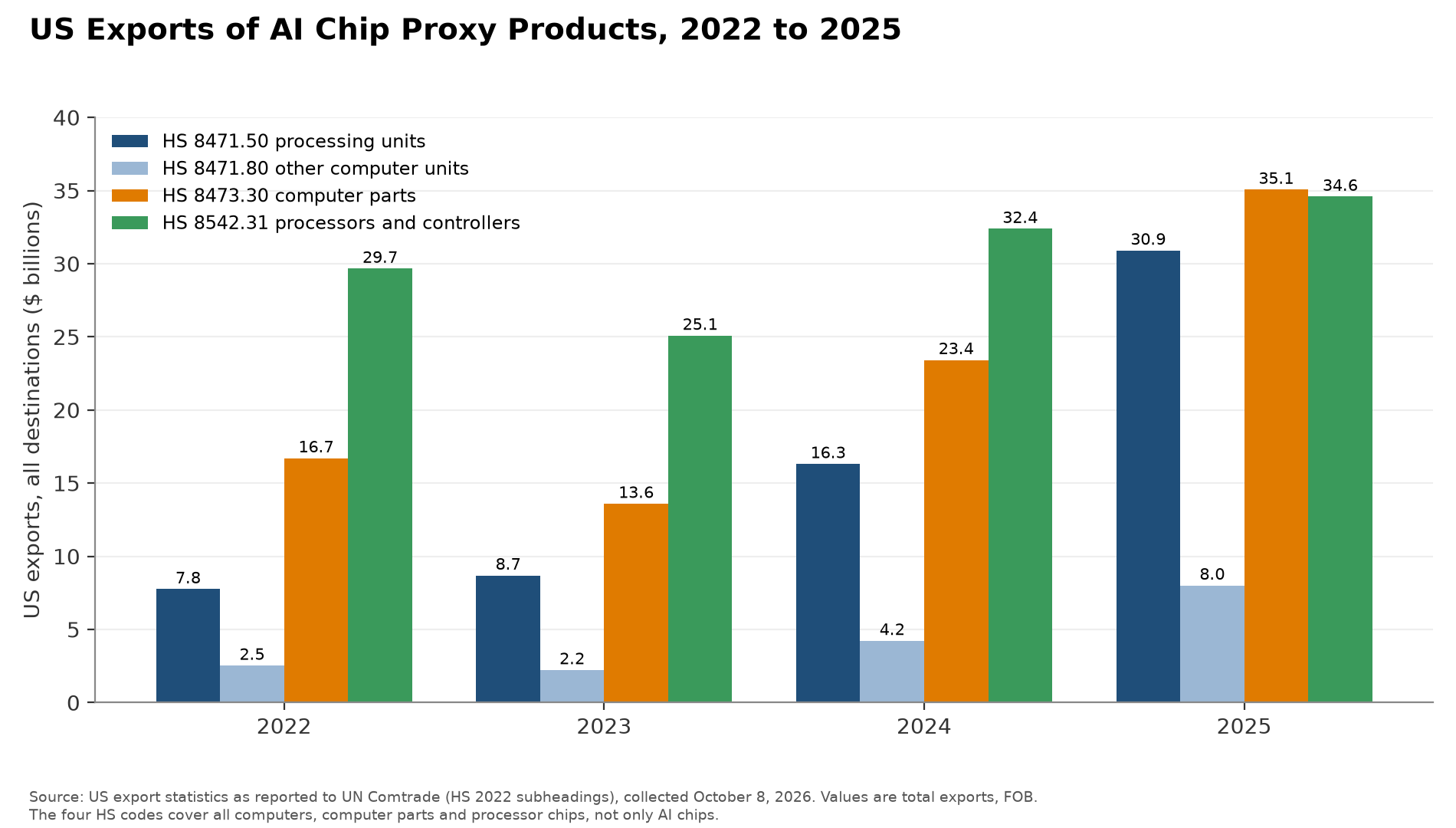
- US exports in the four codes reached $108.53 billion in 2025, up 42.2% from $76.32 billion in 2024 and up from $56.63 billion in 2022. In the first seven months of 2026 they were $87.28 billion, 49.8% more than in the same months of 2025.
- Exports of processing units (8471.50), the code that covers servers, nearly quadrupled from $7.75 billion in 2022 to $30.89 billion in 2025. They rose another 97.8% year over year in January to July 2026, to $28.11 billion.
- Computer parts and accessories (8473.30) were the largest of the four codes in 2025 at $35.06 billion, up 49.7% from 2024.
- Processors and controllers (8542.31) grew the least, by 6.8% in 2025 to $34.58 billion and by 7.1% in the first seven months of 2026.
- The growth is in finished servers and parts, not loose chips, which suggests US firms are shipping AI capacity as assembled systems. Processing units rose 97.8% and parts 74.0% in January to July 2026, against 7.1% for processors. If this pace holds, 2026 exports in the four codes will pass 2025's $108.53 billion before year end, with server makers and their suppliers gaining most.
Where US AI Hardware Exports Go
Destinations show which countries buy the most US servers and processors, which helps explain who is affected when the export rules change.
Top Five Destinations by HS Code, 2025 ($ millions and share of US exports in the code)
| HS Code | First | Second | Third | Fourth | Fifth |
|---|---|---|---|---|---|
| 8471.50 | Mexico, $6,175 (20.0%) | Netherlands, $3,730 (12.1%) | Canada, $2,694 (8.7%) | Taiwan, $2,323 (7.5%) | Japan, $2,010 (6.5%) |
| 8471.80 | Mexico, $2,970 (37.1%) | Taiwan, $1,794 (22.4%) | Netherlands, $658 (8.2%) | Germany, $639 (8.0%) | Malaysia, $425 (5.3%) |
| 8473.30 | Mexico, $20,425 (58.3%) | Taiwan, $5,207 (14.9%) | Ireland, $1,066 (3.0%) | Netherlands, $964 (2.7%) | Singapore, $948 (2.7%) |
| 8542.31 | Mexico, $10,289 (29.8%) | China, $7,311 (21.1%) | Malaysia, $5,712 (16.5%) | Taiwan, $2,687 (7.8%) | Vietnam, $1,436 (4.2%) |
US Exports of Processing Units (HS 8471.50) to Selected Destinations ($ millions)
| Destination | 2022 | 2023 | 2024 | 2025 | Jan. to July 2025 | Jan. to July 2026 |
|---|---|---|---|---|---|---|
| Mexico | $715 | $721 | $1,018 | $6,175 | $1,809 | $9,402 |
| Netherlands | $678 | $898 | $2,345 | $3,730 | $1,946 | $1,822 |
| Taiwan | $258 | $295 | $479 | $2,323 | $482 | $1,571 |
| Singapore | $395 | $467 | $781 | $1,850 | $1,232 | $1,030 |
| Malaysia | $49 | $60 | $392 | $264 | $176 | $2,098 |
| UAE | $75 | $88 | $183 | $745 | $178 | $120 |
| Saudi Arabia | $35 | $103 | $82 | $172 | $86 | $116 |
| Vietnam | $19 | $12 | $11 | $28 | $17 | $28 |
| China | $327 | $341 | $331 | $301 | $163 | $119 |
| Hong Kong | $66 | $102 | $110 | $227 | $107 | $118 |
- Mexico was the largest destination in all four codes in 2025. It took 58.3% of US exports of computer parts (8473.30), the same share as in 2022 (58.4%), and 62.6% in January to July 2026.
- US exports of processing units to Mexico grew from $715 million in 2022 to $6.17 billion in 2025, and reached $9.40 billion in the first seven months of 2026, 33.4% of the code's total. In the same months of 2025 Mexico's share was 12.7%.
- Processing-unit exports to Taiwan rose from $258 million in 2022 to $2.32 billion in 2025. Exports to Malaysia were $2.10 billion in January to July 2026, up from $176 million a year earlier.
- Exports of processing units to the UAE were $745 million in 2025, up from $75 million in 2022, and $120 million in January to July 2026. BIS moved the UAE into a more favorable country group in a rule published July 14, 2026, so the January to July 2026 figures almost entirely predate that change.
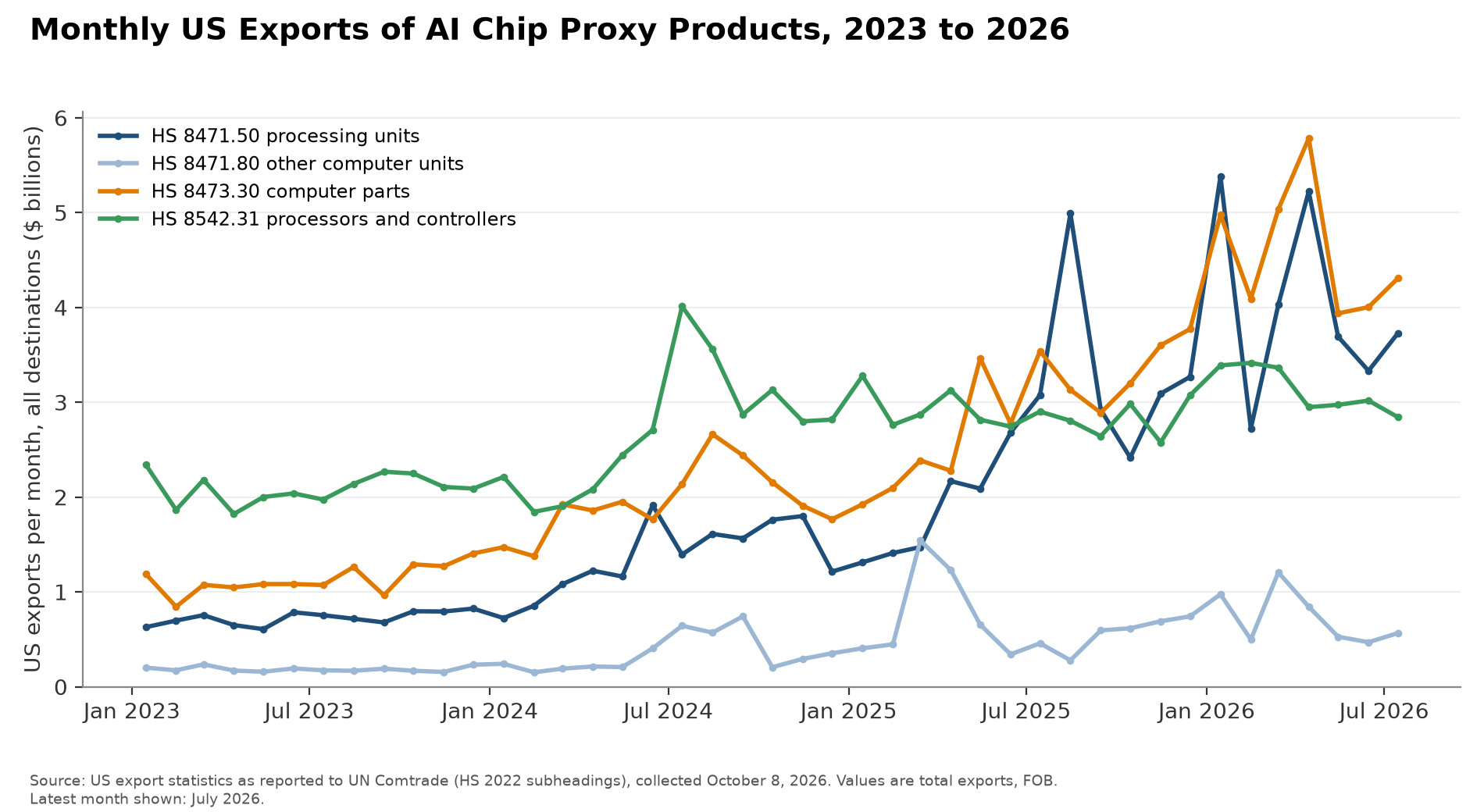
- Much of this trade appears to go to assembly and distribution hubs rather than to the places where AI is used. Mexico takes about 60% of US computer parts exports, and the statistics record only the first foreign destination. Buyers and investors should read jumps such as Malaysia's, from $176 million to $2.10 billion, as signs of where servers are built, not necessarily where they run.
US Exports to China and Hong Kong
China has been the main focus of US export rules on AI chips, and exports to China and Hong Kong show how that trade has moved as the rules changed.
US Exports to China and Hong Kong Combined, by HS Code ($ millions and share of US exports in the code)
| HS Code | 2022 | 2023 | 2024 | 2025 | Jan. to July 2025 | Jan. to July 2026 |
|---|---|---|---|---|---|---|
| 8471.50 | $394 (5.1%) | $443 (5.1%) | $442 (2.7%) | $528 (1.7%) | $270 (1.9%) | $237 (0.8%) |
| 8471.80 | $495 (19.6%) | $232 (10.4%) | $190 (4.5%) | $92 (1.2%) | $55 (1.1%) | $95 (1.9%) |
| 8473.30 | $1,236 (7.4%) | $836 (6.2%) | $1,245 (5.3%) | $1,185 (3.4%) | $667 (3.6%) | $1,168 (3.6%) |
| 8542.31 | $7,294 (24.6%) | $3,046 (12.1%) | $6,370 (19.7%) | $7,696 (22.3%) | $4,772 (23.3%) | $5,469 (24.9%) |
- China and Hong Kong together took 5.1% of US processing-unit exports in 2022 and 1.7% in 2025. In January to July 2026 they took 0.8%, or $237 million.
- The controls appear to have cut China off mainly from finished US systems, not from chips as a whole. China and Hong Kong's share of processing units fell from 5.1% to 0.8%, and of other computer units from 19.6% to 1.2%. Their processor share is back to 24.9%, so any further loosening would likely show up first in processor exports.
- In processors and controllers (8542.31), the China and Hong Kong share fell from 24.6% in 2022 to 12.1% in 2023, then rose to 22.3% in 2025 and 24.9% in January to July 2026. This code also includes CPUs and microcontrollers that the advanced computing rules do not cover.
Nvidia Revenue by Region
Trade codes mix AI hardware with ordinary computers, so company figures add a second view. The AI Industry Reviews research team followed Nvidia's revenue by where its customers are based.
Nvidia Revenue by Customer Headquarters Location, Fiscal Years ($ millions and share of total)
| Customer Headquarters | Fiscal 2024 | Fiscal 2025 | Fiscal 2026 | Change, Fiscal 2025 to 2026 |
|---|---|---|---|---|
| United States | $31,533 (51.8%) | $77,482 (59.4%) | $149,617 (69.3%) | +93.1% |
| Taiwan | $14,912 (24.5%) | $23,600 (18.1%) | $42,345 (19.6%) | +79.4% |
| China (including Hong Kong) | $12,330 (20.2%) | $25,048 (19.2%) | $19,677 (9.1%) | -21.4% |
| Other | $2,147 (3.5%) | $4,367 (3.3%) | $4,299 (2.0%) | -1.6% |
| Total revenue | $60,922 | $130,497 | $215,938 | +65.5% |
Nvidia Revenue by Customer Headquarters Location, by Quarter ($ millions)
| Fiscal Quarter | Quarter Ended | United States | Taiwan | China (incl. Hong Kong) | Other | Total | China Share |
|---|---|---|---|---|---|---|---|
| Q3 FY2025 | Oct. 27, 2024 | $19,620 | $6,188 | $8,142 | $1,132 | $35,082 | 23.2% |
| Q4 FY2025 | Jan. 26, 2025 | $23,609 | $6,236 | $7,818 | $1,668 | $39,331 | 19.9% |
| Q1 FY2026 | April 27, 2025 | $25,685 | $7,648 | $9,659 | $1,070 | $44,062 | 21.9% |
| Q2 FY2026 | July 27, 2025 | $32,897 | $8,902 | $3,985 | $959 | $46,743 | 8.5% |
| Q3 FY2026 | Oct. 26, 2025 | $39,177 | $13,751 | $2,973 | $1,105 | $57,006 | 5.2% |
| Q4 FY2026 | Jan. 25, 2026 | $51,858 | $12,044 | $3,060 | $1,165 | $68,127 | 4.5% |
| Q1 FY2027 | April 26, 2026 | $63,769 | $12,006 | $4,550 | $1,290 | $81,615 | 5.6% |
| Q2 FY2027 | July 26, 2026 | $60,074 | $26,985 | $7,880 | $1,282 | $96,221 | 8.2% |
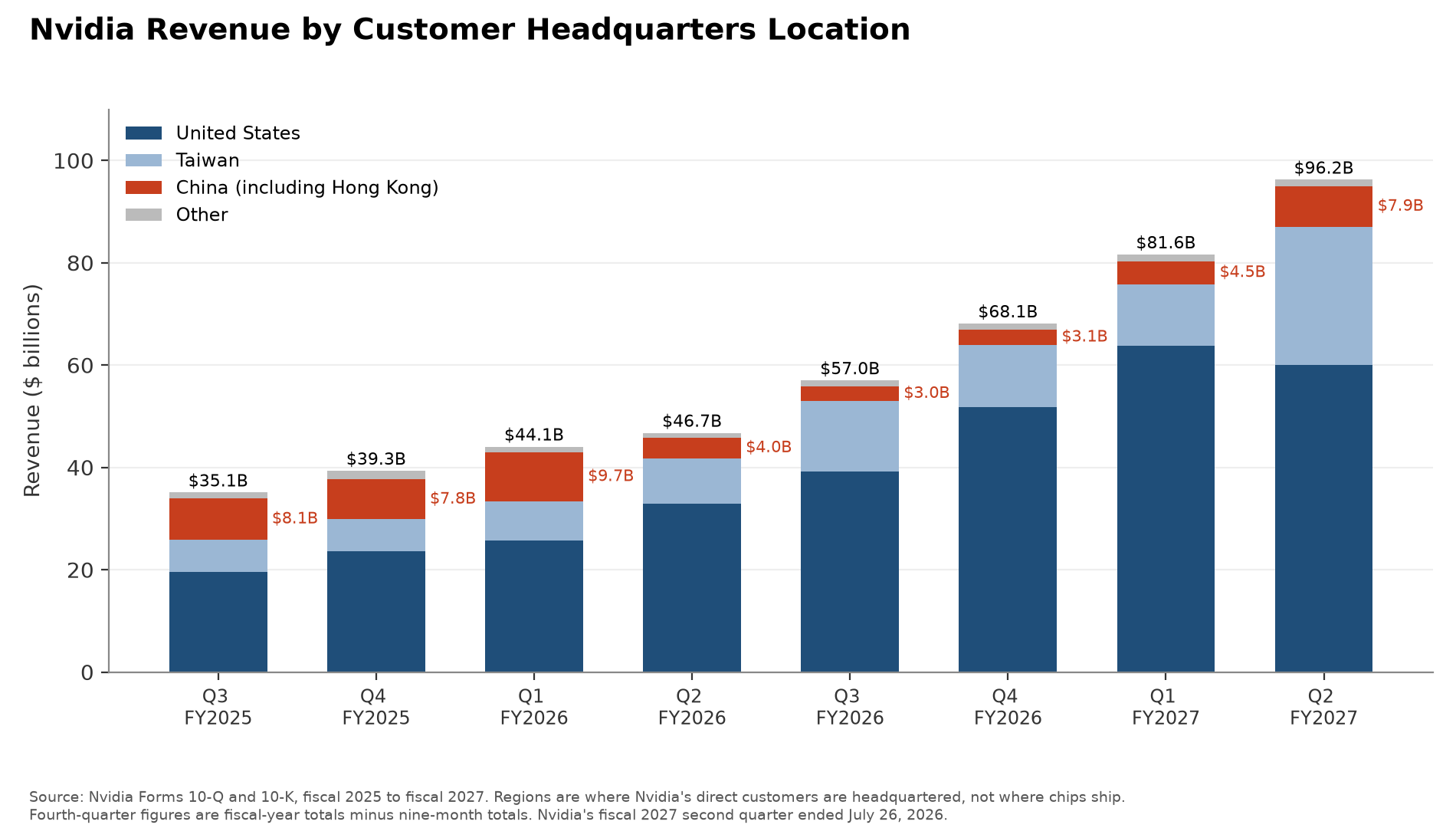
- Revenue from China-headquartered customers, including Hong Kong, fell 21.4% in fiscal 2026 to $19.68 billion, while Nvidia's total revenue rose 65.5% to $215.94 billion. China's share of revenue fell from 19.2% to 9.1%.
- China revenue dropped from $9.66 billion in the quarter ended April 27, 2025, to $3.99 billion in the next quarter, after the H20 license requirement took effect, and to $2.97 billion in the quarter after that. In the quarter ended July 26, 2026, it was $7.88 billion, 8.2% of revenue.
- Nvidia's growth now depends mostly on US buyers, which ties its results closely to US data center spending. US-headquartered customers made up 69.3% of fiscal 2026 revenue, up from 51.8% two years earlier. China's rebound to $7.88 billion in the latest quarter shows licensed sales can add revenue back, but at 8.2% it remains well below China's earlier 20% share.
- Revenue from Taiwan-headquartered customers was $26.99 billion in the quarter ended July 26, 2026, up from $12.01 billion in the previous quarter. Nvidia estimated that in fiscal 2026, 76% of its Data Center revenue from Taiwan-headquartered customers was attributed to end customers based in the US and Europe.
Until the third quarter of fiscal 2026, Nvidia reported revenue by customer billing location, and Singapore appeared as a large market.
Nvidia Revenue by Customer Billing Location, Earlier Basis ($ millions)
| Fiscal Year or Quarter | United States | Singapore | Taiwan | China (incl. Hong Kong) | Other | Total |
|---|---|---|---|---|---|---|
| Fiscal 2022 | $4,349 | Not shown separately | $8,544 | $7,111 | $6,910 | $26,914 |
| Fiscal 2023 | $8,292 | $2,288 | $6,986 | $5,785 | $3,623 | $26,974 |
| Fiscal 2024 | $26,966 | $6,831 | $13,405 | $10,306 | $3,414 | $60,922 |
| Fiscal 2025 | $61,257 | $23,684 | $20,573 | $17,108 | $7,875 | $130,497 |
| Q1 Fiscal 2026 | $20,739 | $9,017 | $7,158 | $5,522 | $1,626 | $44,062 |
| Q2 Fiscal 2026 | $23,470 | $10,156 | $8,529 | $2,769 | $1,819 | $46,743 |
- Singapore accounted for $23.68 billion, or 18.1% of Nvidia's fiscal 2025 revenue, by billing location. Nvidia said customers use Singapore to centralize invoicing, that its products are almost always shipped elsewhere, and that shipments to Singapore were less than 2% of fiscal 2025 revenue.
- In the quarter ended July 27, 2025, Singapore billing was $10.16 billion, 21.7% of revenue. Nvidia said over 99% of controlled Data Center compute revenue billed to Singapore in that quarter was for orders from US-based customers.
- Chipmakers' regional figures say more about where buyers are billed than where chips end up. Singapore was billed 18.1% of Nvidia's fiscal 2025 revenue but received less than 2% of shipments, and China's total for that year was $17.11 billion on one basis and $25.05 billion on the other. Anyone comparing regions over time should stick to one basis and treat hub countries as pass-through points.
AMD Revenue by Region
AMD reports its sales by billing location once a year, which shows where its customers are billed and how much of its business comes from China.
AMD Sales by Customer Billing Location ($ millions and share of total)
| Billing Location | 2022 | 2023 | 2024 | 2025 | Change, 2024 to 2025 |
|---|---|---|---|---|---|
| United States | $8,049 (34.1%) | $7,837 (34.6%) | $8,693 (33.7%) | $11,363 (32.8%) | +30.7% |
| China (including Hong Kong) | $5,207 (22.1%) | $3,417 (15.1%) | $6,231 (24.2%) | $7,751 (22.4%) | +24.4% |
| Taiwan | $2,369 (10.0%) | $1,841 (8.1%) | $3,301 (12.8%) | $5,186 (15.0%) | +57.1% |
| Singapore | $1,380 (5.8%) | $2,231 (9.8%) | $3,614 (14.0%) | $4,284 (12.4%) | +18.5% |
| All other regions | $6,596 (27.9%) | $7,354 (32.4%) | $3,946 (15.3%) | $6,055 (17.5%) | +53.4% |
| Total | $23,601 | $22,680 | $25,785 | $34,639 | +34.3% |
- AMD's sales billed to China and Hong Kong rose 24.4% in 2025 to $7.75 billion, 22.4% of its revenue. The share was 22.1% in 2022, dropped to 15.1% in 2023 and rose to 24.2% in 2024.
- Sales billed to Taiwan grew 57.1% in 2025 to $5.19 billion. Singapore accounted for $4.28 billion, or 12.4%.
- AMD is more exposed to China than Nvidia, which makes it more sensitive to any change in the rules. China and Hong Kong were 22.4% of AMD's 2025 sales by billing location, against 9.1% of Nvidia's fiscal 2026 revenue by headquarters, though the two bases differ. If licensed MI308 and MI325 sales grow, AMD stands to gain more from looser rules and lose more from tighter ones.
Export-Rule Charges at Nvidia and AMD
Nvidia and AMD each told investors what the new license requirements cost them, and those amounts put a dollar figure on what the rules meant for each company.
Charges and Revenue Effects Tied to US Export Licensing Disclosed in SEC Filings
| Company | Period | Item | Amount |
|---|---|---|---|
| Nvidia | Q1 fiscal 2026 (ended April 27, 2025) | Charge for H20 excess inventory and purchase obligations | $4.5 billion ($1.9 billion inventory provision and $2.6 billion excess purchase obligations) |
| Nvidia | Q1 fiscal 2026 | H20 sales before the license requirement took effect | $4.6 billion |
| Nvidia | Q2 fiscal 2026 (ended July 27, 2025) | Sequential drop in H20 sales | $4.0 billion |
| Nvidia | Q2 fiscal 2026 | H20 sold to an unrestricted customer outside China, and reserve released | About $650 million of revenue; $180 million released |
| Nvidia | Fiscal 2026 | H20 revenue under licenses granted in August 2025 | About $60 million |
| Nvidia | First half of fiscal 2027 (ended July 26, 2026) | Charge for H200 excess inventory and purchase obligations | $0.4 billion |
| AMD | Q2 2025 (ended June 28, 2025) | Inventory and related charges on MI308 GPUs | About $800 million |
| AMD | Q4 2025 | Charges reversed after MI308 shipments to China began | About $360 million |
| AMD | Fiscal 2025 | Net MI308 inventory and related charges | About $440 million |
- Nvidia said that on April 9, 2025, the US government told it that exports of its H20 chip to China, including Hong Kong and Macau, and to Country Group D:5 countries would need a license. The resulting $4.5 billion charge was less than Nvidia had first expected because it was able to reuse some materials.
- Export rules now carry direct costs that can cut a chipmaker's margins in a single quarter. Nvidia's gross margin fell to 60.5% from 78.4% in the quarter of its $4.5 billion H20 charge, and AMD took about $800 million on MI308. With an expected 15% government share and a 25% tariff that Nvidia says it absorbs, a licensed China sale is likely to earn less than the same sale did before the rules.
- Both companies said US officials expected the government to receive 15% of revenue from licensed sales of these chips to China. Nvidia's later filings say "15% or more." Both said the government had not published a regulation requiring the payment.
- Nvidia's licensed H200 shipments to China were less than 1% of its Data Center revenue in the quarter ended July 26, 2026. Chips shipped under the H200 licenses must be inspected in the US first and face a 25% tariff on import for that inspection, which Nvidia said it has not passed on to customers. AMD's MI325 licenses carry the same inspection and tariff terms.
Timeline of US AI Chip Export Controls
The export rules have changed many times since 2022, and a dated list helps readers match each shift in the trade figures to the rule in force at the time.
US Export-Control Actions on AI Chips, August 2022 to July 2026
| Date | Action | Source |
|---|---|---|
| August 2022 | US government announces license requirements on exports to China and Russia of chips including the Nvidia A100 and H100, according to Nvidia's filings | Nvidia 10-K |
| Oct. 7, 2022 (published Oct. 13, 2022) | BIS interim final rule adds license requirements for advanced computing chips, computers containing them and some chipmaking equipment bound for China, and restricts supercomputer and semiconductor manufacturing end uses | 87 FR 62186 |
| July 2023 | US government informs Nvidia of a license requirement for some A100 and H100 products bound for certain customers and regions, including some Middle East countries | Nvidia 10-K |
| Oct. 17, 2023 (published Oct. 25, 2023) | BIS updates the advanced computing rule, extending license requirements to more chips and to Country Groups D:1, D:4 and D:5 (effective November 17, 2023) | 88 FR 73458 |
| April 4, 2024 | BIS publishes corrections and clarifications to the October 2023 advanced computing and chipmaking equipment rules | 89 FR 23876 |
| Oct. 2, 2024 | BIS creates a Data Center Validated End User authorization for exporting advanced computing items to pre-approved data centers | 89 FR 80080 |
| Dec. 2, 2024 (published Dec. 5, 2024) | BIS adds controls on high bandwidth memory and more chipmaking equipment, with new foreign direct product rules | 89 FR 96790 |
| Jan. 13, 2025 (published Jan. 15, 2025) | BIS issues the Framework for Artificial Intelligence Diffusion, a worldwide license requirement for advanced computing chips plus a control on certain AI model weights | 90 FR 4544 |
| Jan. 16, 2025 | BIS adds due diligence requirements for foundries and packaging firms that make advanced computing chips | 90 FR 5298 |
| April 9, 2025 | US government informs Nvidia that H20 exports to China (including Hong Kong and Macau) and D:5 countries need a license; AMD reports the same requirement for its MI308 | Nvidia and AMD 10-Q filings |
| May 13, 2025 | BIS announces it will rescind the AI Diffusion rule and issues guidance on Huawei Ascend chips and on diversion | BIS press release |
| August 2025 | US government grants licenses for some H20 sales to China-based customers; officials say they expect 15% of licensed revenue, per Nvidia and AMD filings | Nvidia and AMD filings |
| Sept. 29, 2025 (published Sept. 30, 2025) | BIS extends Entity List restrictions to companies at least 50% owned by listed entities | 90 FR 47201 |
| Nov. 10, 2025 (published Nov. 12, 2025) | BIS suspends the 50% affiliates rule for one year, to November 9, 2026 | 90 FR 50857 |
| Jan. 15, 2026 | BIS moves license review for chips such as the Nvidia H200 and AMD MI325X bound for China and Macau from a presumption of denial to case-by-case, with conditions including a cap of 50% of US shipments and third-party testing in the US | 91 FR 1684 |
| February 2026 | US government grants Nvidia a license for small amounts of H200 and AMD licenses for MI325 to specific China-based customers; chips must be inspected in the US and face a 25% tariff on import | Nvidia 10-K, AMD 10-Q |
| July 10, 2026 (published July 14, 2026) | BIS moves the UAE to Country Group A:5, giving the UAE government and approved companies license-free access to advanced computing items | 91 FR 43034 |
- Nvidia says the government announced license requirements for its A100 and H100 chips bound for China in August 2022. The BIS rule dated October 7, 2022, set license requirements for advanced computing chips, computers containing them and some chipmaking equipment. Rules dated October 17, 2023, and December 2, 2024, widened the controls to more chips, more destinations and high bandwidth memory.
- The AI Diffusion rule published January 15, 2025, would have required licenses for advanced computing chips worldwide. BIS announced on May 13, 2025, that it would rescind it before its compliance date of May 15, 2025.
- The January 15, 2026 rule changed license review for chips such as the Nvidia H200 and AMD MI325X bound for China and Macau from a presumption of denial to case-by-case review. Exporters must certify that shipments to China and Macau will not exceed 50% of the product's shipments to US customers and that each shipment is checked by a third-party lab in the US.
- Because the rules have changed direction several times since 2022, exporters and buyers should plan for further change rather than a settled regime. The suspension of the 50% affiliates rule, published September 30, 2025, is set to end November 9, 2026, unless BIS extends it. US officials said in September 2026 that the related US-China trade truce now runs to January 10, 2027, but BIS had not published a formal extension as of mid-October.
What AI Chip Export Trends Mean for 2027 and Beyond
American AI hardware is being shipped abroad faster than ever, but mostly as finished servers routed through assembly hubs, not as chips sold into China. That shift means US chipmakers now earn most of their money from American data center builders, so their fortunes rise and fall with US spending on AI rather than with access to China.
The rules have changed many times since 2022 and will keep changing. Licensed sales to China can bring some revenue back, but the payments the government expects on those sales and new tariffs make each one less profitable. The next date to watch is the end of the suspension of the rule covering affiliates of restricted companies, because it decides which foreign buyers can get US chips.
So if you own chip stocks or buy AI hardware outside the US, keep track of each change to the export rules, because a single decision can move sales and delivery times within weeks.
Data Collection and Methodology
Trade statistics and company filings each have blind spots, and the choices below shape every figure in this report.
US export values come from the US government's merchandise export statistics as reported to the UN Comtrade database, collected on October 8, 2026, for calendar years 2022 to 2025 and for each month from January 2023 to July 2026, the latest month available. Values are total US exports, including re-exports of foreign-made goods, measured free on board in US dollars. The figures use four six-digit Harmonized System (HS) codes, the product categories customs agencies use to classify traded goods. No HS code is limited to AI chips, so these four codes serve as proxies: each one also covers ordinary servers, PCs, computer parts or processors with no AI use. Taiwan appears in UN Comtrade as "Other Asia, not elsewhere specified," and it is labeled Taiwan here. Hong Kong is reported separately from mainland China.
HS Codes Used as AI Chip Proxies
| HS Code | Official Description (HS 2022) | Also Includes |
|---|---|---|
| 8471.50 | Processing units of automatic data processing machines, other than those of 8471.41 or 8471.49, whether or not containing storage, input or output units | Servers and other computer processing units of every kind, with or without AI accelerators |
| 8471.80 | Other units of automatic data processing machines, not elsewhere covered in 8471.50, 8471.60 or 8471.70 | Computer units other than processing, input, output and storage units |
| 8473.30 | Parts and accessories of the machines of heading 84.71 | Parts and accessories for computers of every kind |
| 8542.31 | Electronic integrated circuits: processors and controllers, whether or not combined with memories, converters, logic circuits, amplifiers, clock and timing circuits or other circuits | CPUs, microcontrollers and other processors of every performance level |
Company figures come from Nvidia's and AMD's Forms 10-K and 10-Q filed with the SEC. Nvidia's fiscal year ends in late January, so its fiscal 2026 ran from January 27, 2025, to January 25, 2026, and its fiscal 2027 second quarter ended July 26, 2026. In the third quarter of fiscal 2026 Nvidia stopped reporting revenue by customer billing location and began reporting it by the location of each direct customer's headquarters, recasting earlier periods. Both series are shown, and they are not mixed. Nvidia's fourth-quarter regional figures are fiscal-year totals minus nine-month totals. AMD reports revenue by billing location once a year in its 10-K. The rule timeline uses Federal Register documents and Bureau of Industry and Security (BIS) releases, with dates of license requirements that were not published as rules taken from the companies' filings.
The four HS codes cover all servers, computer units, computer parts and processor chips, so the export figures are an upper bound on AI hardware trade and include products with no AI use. Export statistics record the first foreign destination, which can be an assembly or distribution location instead of the final user, and they do not track later re-exports. Nvidia's regional figures follow where direct customers are headquartered or billed, which can differ from where the chips are used, and the two bases give different China totals for the same year. AMD reports regional revenue only once a year.
Sources
- AI Industry Reviews, AI Chip Export Study: analysis of US export statistics for HS 8471.50, 8471.80, 8473.30 and 8542.31 by destination for 2022 to July 2026, Nvidia and AMD SEC filings, and BIS and Federal Register export-control actions, conducted October 2026.
- UN Comtrade database, United States exports (reporter code 842) for HS 847150, 847180, 847330 and 854231, annual 2022 to 2025 and monthly January 2023 to July 2026. https://comtradeplus.un.org/
- UN Comtrade, HS code and partner area reference lists. https://comtradeapi.un.org/files/v1/app/reference/HS.json
- Nvidia, Form 10-Q for quarter ended July 26, 2026. https://www.sec.gov/Archives/edgar/data/1045810/000104581026000075/nvda-20260726.htm
- Nvidia, Form 10-Q for quarter ended April 26, 2026. https://www.sec.gov/Archives/edgar/data/1045810/000104581026000052/nvda-20260426.htm
- Nvidia, Form 10-K for fiscal year ended January 25, 2026. https://www.sec.gov/Archives/edgar/data/1045810/000104581026000021/nvda-20260125.htm
- Nvidia, Form 10-Q for quarter ended October 26, 2025. https://www.sec.gov/Archives/edgar/data/1045810/000104581025000230/nvda-20251026.htm
- Nvidia, Form 10-Q for quarter ended July 27, 2025. https://www.sec.gov/Archives/edgar/data/1045810/000104581025000209/nvda-20250727.htm
- Nvidia, Form 10-Q for quarter ended April 27, 2025. https://www.sec.gov/Archives/edgar/data/1045810/000104581025000116/nvda-20250427.htm
- Nvidia, Form 10-K for fiscal year ended January 26, 2025. https://www.sec.gov/Archives/edgar/data/1045810/000104581025000023/nvda-20250126.htm
- Nvidia, Form 10-K for fiscal year ended January 28, 2024. https://www.sec.gov/Archives/edgar/data/1045810/000104581024000029/nvda-20240128.htm
- AMD, Form 10-K for fiscal year ended December 27, 2025. https://www.sec.gov/Archives/edgar/data/2488/000000248826000018/amd-20251227.htm
- AMD, Form 10-K for fiscal year ended December 28, 2024. https://www.sec.gov/Archives/edgar/data/2488/000000248825000012/amd-20241228.htm
- AMD, Form 10-Q for quarter ended June 28, 2025. https://www.sec.gov/Archives/edgar/data/2488/000000248825000108/amd-20250628.htm
- AMD, Form 10-Q for quarter ended June 27, 2026. https://www.sec.gov/Archives/edgar/data/2488/000000248826000123/amd-20260627.htm
- Federal Register, 87 FR 62186, October 13, 2022: Implementation of Additional Export Controls: Certain Advanced Computing and Semiconductor Manufacturing Items. https://www.federalregister.gov/documents/2022/10/13/2022-21658/implementation-of-additional-export-controls-certain-advanced-computing-and-semiconductor
- Federal Register, 88 FR 73458, October 25, 2023: Implementation of Additional Export Controls: Certain Advanced Computing Items; Updates and Corrections. https://www.federalregister.gov/documents/2023/10/25/2023-23055/implementation-of-additional-export-controls-certain-advanced-computing-items-supercomputer-and
- Federal Register, 89 FR 23876, April 4, 2024: corrections and clarifications to the advanced computing and semiconductor manufacturing rules. https://www.federalregister.gov/documents/2024/04/04/2024-07004/implementation-of-additional-export-controls-certain-advanced-computing-items-supercomputer-and
- Federal Register, 89 FR 80080, October 2, 2024: Data Center Validated End User Authorization. https://www.federalregister.gov/documents/2024/10/02/2024-22587/expansion-of-validated-end-user-authorization-data-center-validated-end-user-authorization
- Federal Register, 89 FR 96790, December 5, 2024: Foreign-Produced Direct Product Rule Additions, and Refinements to Controls for Advanced Computing and Semiconductor Manufacturing Items. https://www.federalregister.gov/documents/2024/12/05/2024-28270/foreign-produced-direct-product-rule-additions-and-refinements-to-controls-for-advanced-computing
- Federal Register, 90 FR 4544, January 15, 2025: Framework for Artificial Intelligence Diffusion. https://www.federalregister.gov/documents/2025/01/15/2025-00636/framework-for-artificial-intelligence-diffusion
- Federal Register, 90 FR 5298, January 16, 2025: Implementation of Additional Due Diligence Measures for Advanced Computing Integrated Circuits. https://www.federalregister.gov/documents/2025/01/16/2025-00711/implementation-of-additional-due-diligence-measures-for-advanced-computing-integrated-circuits
- Bureau of Industry and Security, Department of Commerce Announces Rescission of Biden-Era Artificial Intelligence Diffusion Rule, May 13, 2025. https://www.bis.gov/press-release/department-commerce-announces-rescission-biden-era-artificial-intelligence-diffusion-rule-strengthens
- Federal Register, 90 FR 47201, September 30, 2025: Expansion of End-User Controls To Cover Affiliates of Certain Listed Entities. https://www.federalregister.gov/documents/2025/09/30/2025-19001/expansion-of-end-user-controls-to-cover-affiliates-of-certain-listed-entities
- Federal Register, 90 FR 50857, November 12, 2025: One Year Suspension of Expansion of End-User Controls for Affiliates of Certain Listed Entities. https://www.federalregister.gov/documents/2025/11/12/2025-19846/one-year-suspension-of-expansion-of-end-user-controls-for-affiliates-of-certain-listed-entities
- Federal Register, 91 FR 1684, January 15, 2026: Revision to License Review Policy for Advanced Computing Commodities. https://www.federalregister.gov/documents/2026/01/15/2026-00789/revision-to-license-review-policy-for-advanced-computing-commodities
- Federal Register, 91 FR 43034, July 14, 2026: Enhanced Favorable Treatment for the United Arab Emirates Under the Export Administration Regulations. https://www.federalregister.gov/documents/2026/07/14/2026-14132/enhanced-favorable-treatment-for-the-united-arab-emirates-under-the-export-administration